
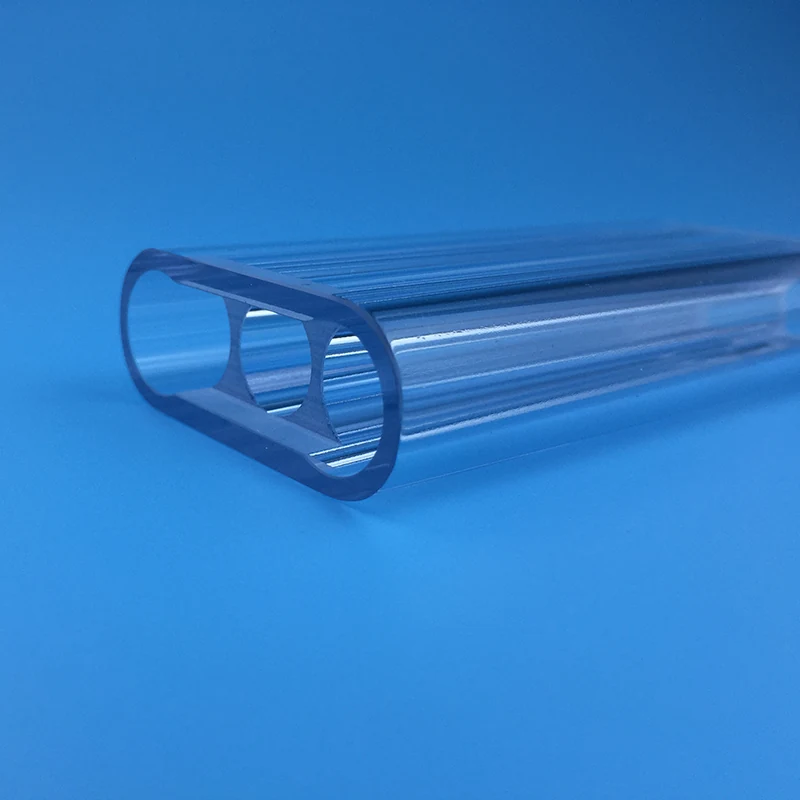
 Custom Double-Bore & Multi-Bore Quartz Tubes
Custom Spiral, Helical & U-Shaped Quartz Tubes
| Parameter | Typical Range | Notes |
|---|---|---|
| Tube OD / ID | 4–30 mm | Smaller tube forms tighter bends |
| Minimum bend radius | ~3–5× tube OD | Tighter radius increases wall deformation |
| Coil OD | 20–300 mm | Confirm per configuration |
| Pitch | 1.2–3× tube OD | — |
| Turns | 2–20 | Confirm per configuration |
| Leg length tolerance | ±0.5 mm | Precision cut-to-length |
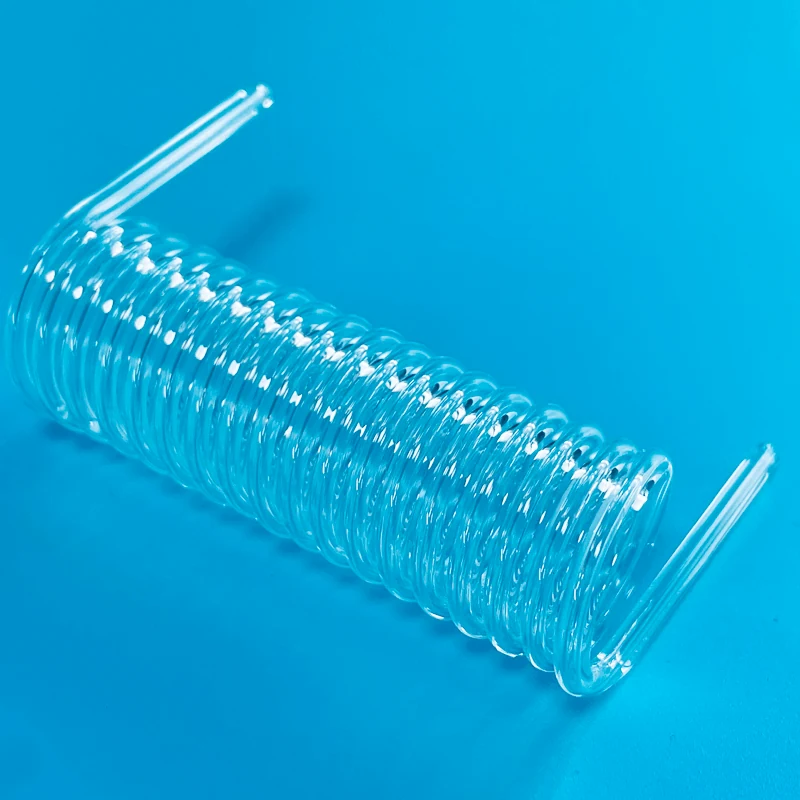
Quartz Glass flame-forms straight quartz tubing into U-bends, spirals, and helical coils for heating elements, fluid paths, and lab setups that need a formed shape rather than a straight run.
Tube OD, bend radius, coil OD, pitch, and turn count all move together — a smaller bend radius increases cross-section deformation and forming difficulty, which limits how tight a coil can be made at a given tube OD. Quartz Glass has confirmed U-bend, spiral/coil, and flame-forming capability; exact size limits for your configuration are confirmed against the drawing.
Bend Radius, Coil Diameter, Pitch and Leg Length
Bend radius is the number that drives everything else on a formed tube. Too tight a radius for the tube OD thins the outer wall of the bend and can collapse the bore slightly — both are checked during inspection. Coil OD, pitch, and turn count are then set relative to that minimum radius, not chosen independently.
How to Dimension a Quartz Coil or U-Bend
Send these together rather than one at a time: tube OD/ID, bend radius (or coil OD if that's the driving dimension), pitch, number of turns, and leg length at the straight ends. For a U-bend specifically, leg length and the angle between legs both need to be on the drawing — a bend radius alone doesn't fix the finished shape.
Flame Forming, Coil Forming and Joined Assemblies
Forming is done by localized flame heating and controlled bending or winding — the tube is heated only where it bends, not along its full length, to keep the straight sections true. After forming, the part gets a local anneal at the bend to relieve stress from the heating and shaping. If your design needs the formed section joined to a straight run or a flange, that weld is added after forming and annealing, not before.
Inspection covers bend radius, pitch, overall height, leg length, symmetry between turns, cross-section deformation at the bend, and cracks.
≥2×Reference Bend Radius / OD
30–150 mmReference Coil OD
0.5–15 mmGeneral Wall Envelope
1–20+Turns to Drawing
≥99.99%Natural SiO₂ · synthetic ≥99.999%
≤1100 °CContinuous Service Guideline
Specifications
Spiral, Helical & U-Shaped Tube Specifications
| Parameter | Reference Capability / Requirement |
|---|---|
| Tube OD / ID | Selected with flow, heating duty and bend geometry |
| Minimum Bend Radius | Reference centerline radius ≥2 × tube OD; final limit is geometry-dependent |
| Coil Outside Diameter | Reference 30–150 mm |
| Pitch | Axial distance per turn, specified on the finished coil |
| Number of Turns | Drawing-specific |
| Leg Length | Straight inlet and outlet sections dimensioned from tangent points |
| Overall Height / Width | Controlled by coil OD, pitch, turns and end orientation |
| Wall Control | Reviewed at the outside and inside of the bend |
| Annealing | Stress relief after flame forming and welded joints |
Standard Series
Reference U-Bend & Coil Geometry Series
| Form | Reference Geometry | Controlled Dimensions | Typical Function |
|---|---|---|---|
| 180° U-bend | R ≥2 × OD | Leg spacing / leg length | Fluid routing and compact heaters |
| 90° bend | R ≥2 × OD | Tangent lengths / orientation | Equipment connections |
| Single-turn loop | Coil OD 30–150 mm | Loop plane / end angle | Radiant heating and optical paths |
| Helical coil | OD 30–150 mm | Pitch / turns / overall height | Heat exchange and fluid preheating |
| Flat spiral | By drawing | Inner / outer diameter | Planar heating and reaction paths |
| Multi-section assembly | Formed + welded | Port and flange datums | Custom reactors and process skids |
Dimensional Tolerances
Formed-Geometry Inspection Requirements
| Feature | Size / Condition | Reference Tolerance |
|---|---|---|
| Bend Radius | Centerline | Checked with finished-part gauge |
| Coil OD | 30–150 mm reference | Drawing-specific after forming |
| Pitch | Per turn | Drawing-specific |
| Leg Length | From tangent point | ±0.5 mm standard where geometry permits |
| End Orientation | Inlet / outlet | Angular datum specified on drawing |
| Wall Section | Inside / outside bend | Verified after forming |
| Overall Envelope | Width / height | Finished-part gauge or CMM inspection |
Configurations
Bent, Coiled & Formed Tube Configurations
U-Shaped Tube180° bend with parallel or offset legs
Serpentine PathRepeated U-bends for compact flow or heating length
Helical CoilConstant coil OD and pitch around a center axis
Flat SpiralPlanar winding with controlled inner and outer diameters
Single LoopOne-turn circular path with oriented inlet and outlet
Conical HelixChanging coil diameter along the axis
Milky Quartz Heater CoilDiffusing specialty quartz for infrared heating
Welded Formed AssemblyCoils combined with ports, straight sections or flanges
Material Selection
Quartz Grades for Heating & Fluid Paths
Electric-Fused QuartzGrade-specific UV cut-offOH 5–150 ppm; heat treatment can adjust OH. General-purpose continuously drawn stock. Confirm UV boundary by grade datasheet.
Flame-Fused Quartz · JGS2220–2500 nmOH 120–260 ppm; UV-visible optical components.
Synthetic Fused Silica · JGS1185–2500 nmSiO₂ ≥99.999%; OH ≈1000 ppm. Selected for deep-UV transmission; strong OH absorption near 2730 nm.
Vacuum-Fused / Low-OH · JGS3Grade-specific UV–IR / 260–3500 nmVacuum-fused OH <3 ppm; JGS3-class OH ≤10 ppm. Use the lot certificate and transmission curve at the working thickness.
OH content varies by grade and batch; the lot certificate is authoritative. Compare material routes and typical transmission data.
Fabrication
Flame Bending, Coil Forming & Annealing
- Mandrel / Gauge SetupFinished centerline geometry converted into forming controls
- Flame BendingLocal heating controls radius while limiting wall collapse
- Coil FormingCoil OD, pitch and turn count developed around the tool
- End OrientationStraight legs and connection angles set after forming
- Quartz WeldingPorts, flanges and straight extensions joined to the formed tube
- Stress-Relief AnnealingApplied after forming and welding before final inspection
Applications
Formed Quartz Tube Applications
Infrared HeatingMilky or transparent coils around radiant heating elements
Fluid PreheatingHelical paths increase residence time in a compact envelope
Condensation SystemsQuartz coils for corrosive or high-purity vapor handling
Laboratory ReactorsU-bends and coils integrated with vessels and ports
Gas DistributionFormed paths route gases around thermal or optical assemblies
Optical & UV SystemsQuartz loops and shaped paths around lamps and samples
FAQ
Frequently Asked Questions
What is the minimum bend radius?
A reference starting point is a centerline radius of at least 2 × tube OD. The final limit depends on OD, wall, bend angle and material grade.
What dimensions define a quartz helix?
Specify tube OD/ID, coil OD, pitch, number of turns, overall height, leg lengths and inlet/outlet orientation.
Can milky quartz be formed into heater coils?
Yes. Opaque or milky quartz can be reviewed for infrared heater coils, subject to raw-tube size and forming geometry.
Can formed tubes include ports or flanges?
Yes. Formed sections can be welded to straight tubes, branches and quartz flanges, followed by stress-relief annealing.
Need a spiral, helix or U-shaped quartz tube?Send the centerline geometry, tube size, bend radius, coil OD, pitch, turns and end orientation.
Open the Tube ConfiguratorEngineering Data
Grade-Qualified Material Purity
Electric-fused / flame-fused quartz: SiO₂ ≥99.99%; synthetic JGS1-grade fused silica: ≥99.999%. Grade and lot certificate govern supplied material.
Engineering Data
Service Temperature
Transparent quartz: continuous use ≤1100 °C; short-term excursions ≤1200 °C. Opaque / milky quartz: continuous use ≤1000 °C. Load, atmosphere, support span and thermal cycling determine the application limit.
Customize This Product
Enter your dimensions of Custom Spiral, Helical & U-Shaped Quartz Tubes — the technical drawing updates instantly, then request a quotation.
Technical Drawing
Drawing redraws live · blue hatched area = cut section · all dimensions in mm
Parameters
Every field is editable — drawing, weight estimate and part code update instantly.
Common Options
pcs
Configuration Summary
Attached to your inquiry automatically when you press “Use This Configuration”.
—
Related Products
Custom Double-Bore & Multi-Bore Quartz Tubes Custom Large-Diameter & Thick-Wall Quartz Tubes
 Custom Opaque, Milky, Colored & Translucent Quartz Tubes
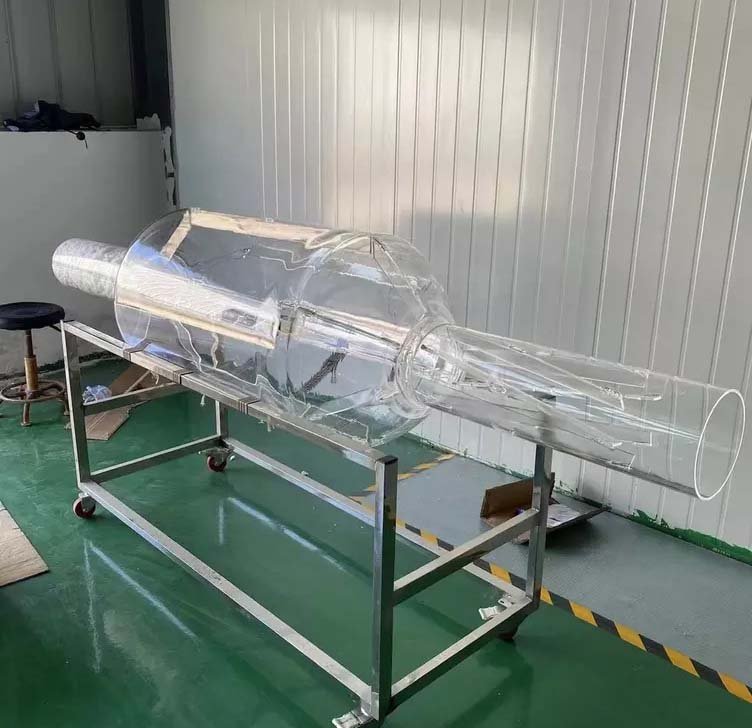 Custom Quartz Furnace & Diffusion Tubes
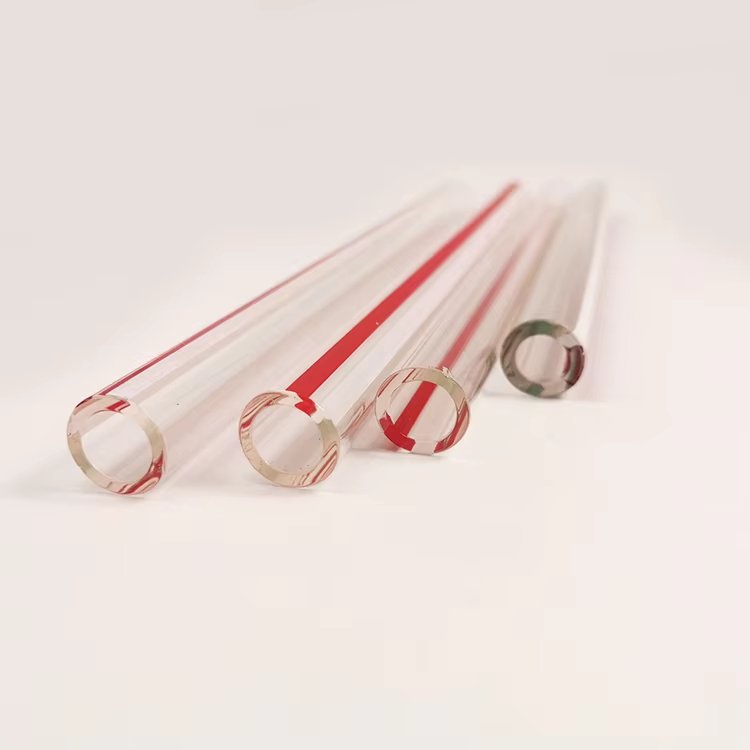 Custom Quartz Gauge, Sight & Vacuum Tubes
 Custom Square, Rectangular & Shaped Quartz Tubes
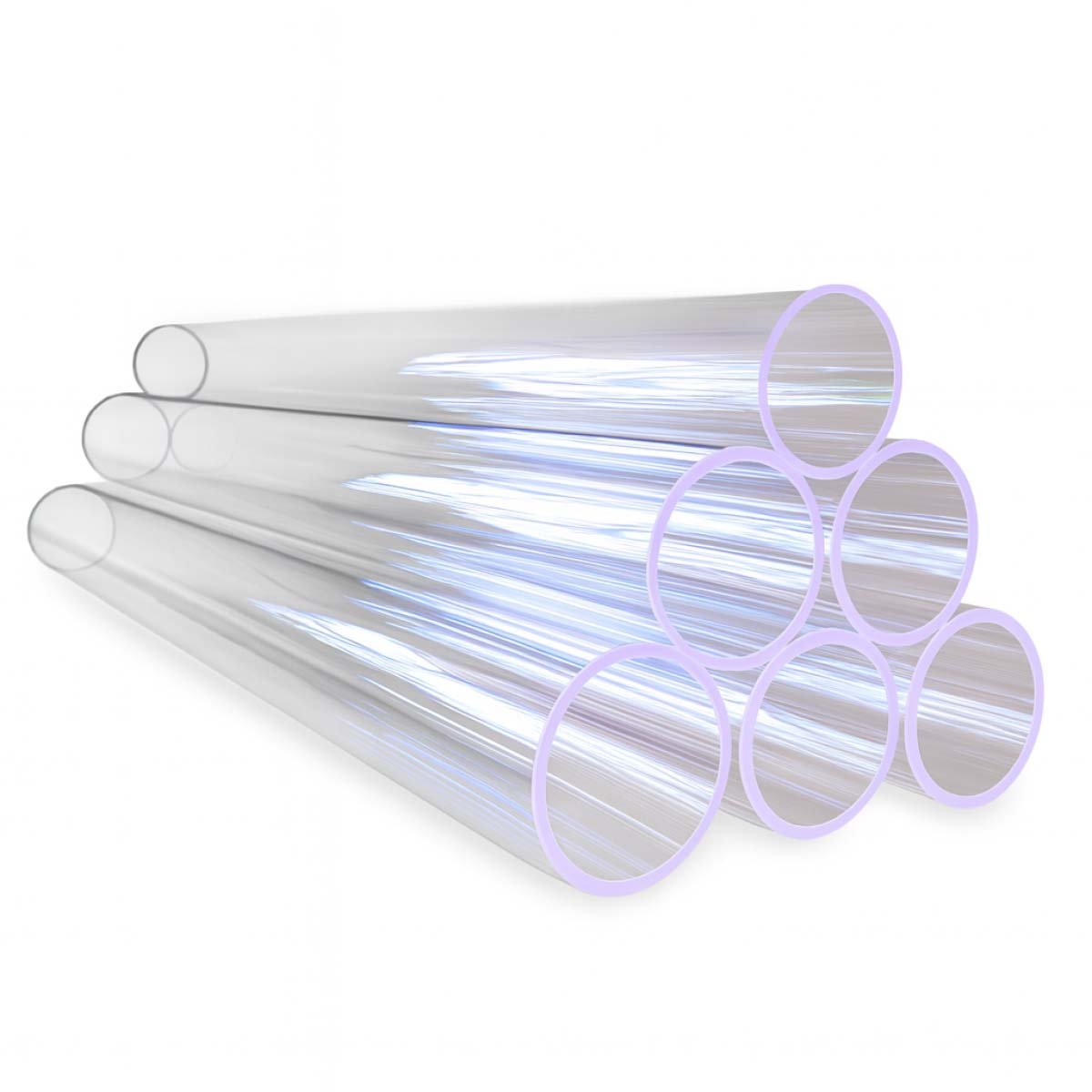 Custom UV & Ozone-Free Quartz Tubes
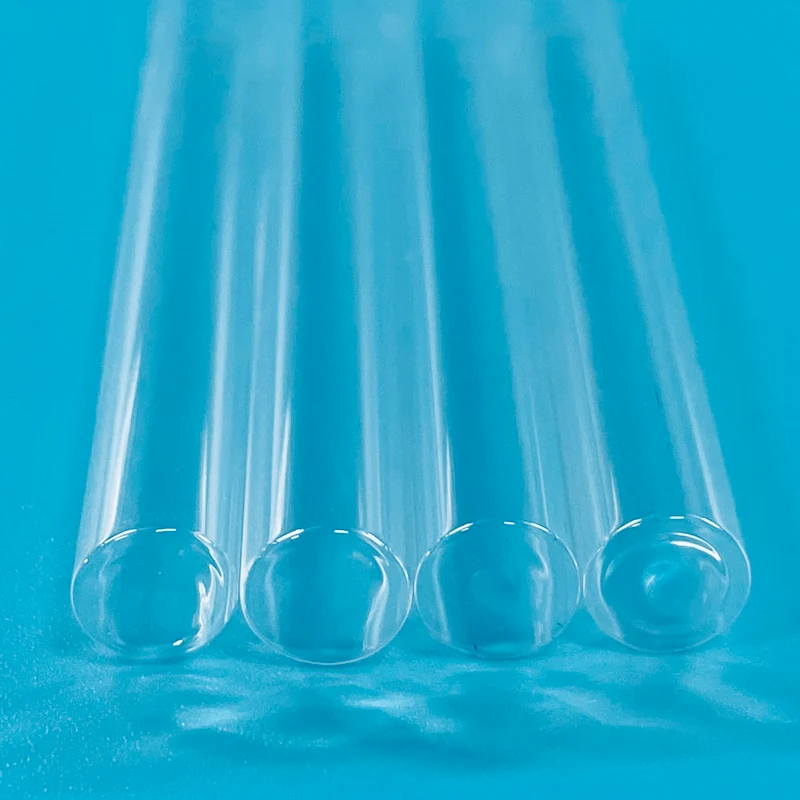 Quartz Glass Tubes


