Choose a material by wavelength, purity, hydroxyl content, thermal function and certification requirement. Grade names alone are not a complete specification, so each material page explains what should be placed on the drawing or RFQ.
Wavelength, transmission at thickness, homogeneity and surface specification
IR transmission with low hydroxyl content
HPFS® 7979 IR or a qualified low-OH fused silica grade
OH limit, absorption bands, path length and certificate
General UV-visible optical parts
JGS1 or JGS2, selected by cutoff and budget
Actual spectral curve, bubble/inclusion grade and optical finish
Radiant heat reflection or shielding
Milky / opaque quartz glass
Reflectivity or opacity target, service temperature and thermal geometry
Low-contamination process hardware
High-purity synthetic fused silica
Trace metals, OH, cleaning, packaging and lot documentation
Final material selection is made against the complete application and drawing. Published values are reference data, not a substitute for a lot certificate or an agreed purchase specification.
Engineering Data
Material Route, OH Content and Working Band
Material route
Grade
Applicable band
OH content
Typical use
Synthetic hydrolysis-fused silica
JGS1
185–2500 nm
≈1000 ppm
Deep-UV optics and lithography
Flame-fused natural quartz
JGS2
220–2500 nm
120–260 ppm
UV-visible windows and instruments
Vacuum-fused quartz
Grade-specific
UV–near IR; confirm grade
<3 ppm
Semiconductor and lamp components
Vacuum-fused low-OH quartz
JGS3
260–3500 nm grade classification
≤10 ppm
IR observation and low-OH components
Electric-fused continuously drawn quartz
Grade-specific
UV cut-off depends on grade
5–150 ppm; heat-treatment dependent
Lamps, heaters and optical-fiber support parts
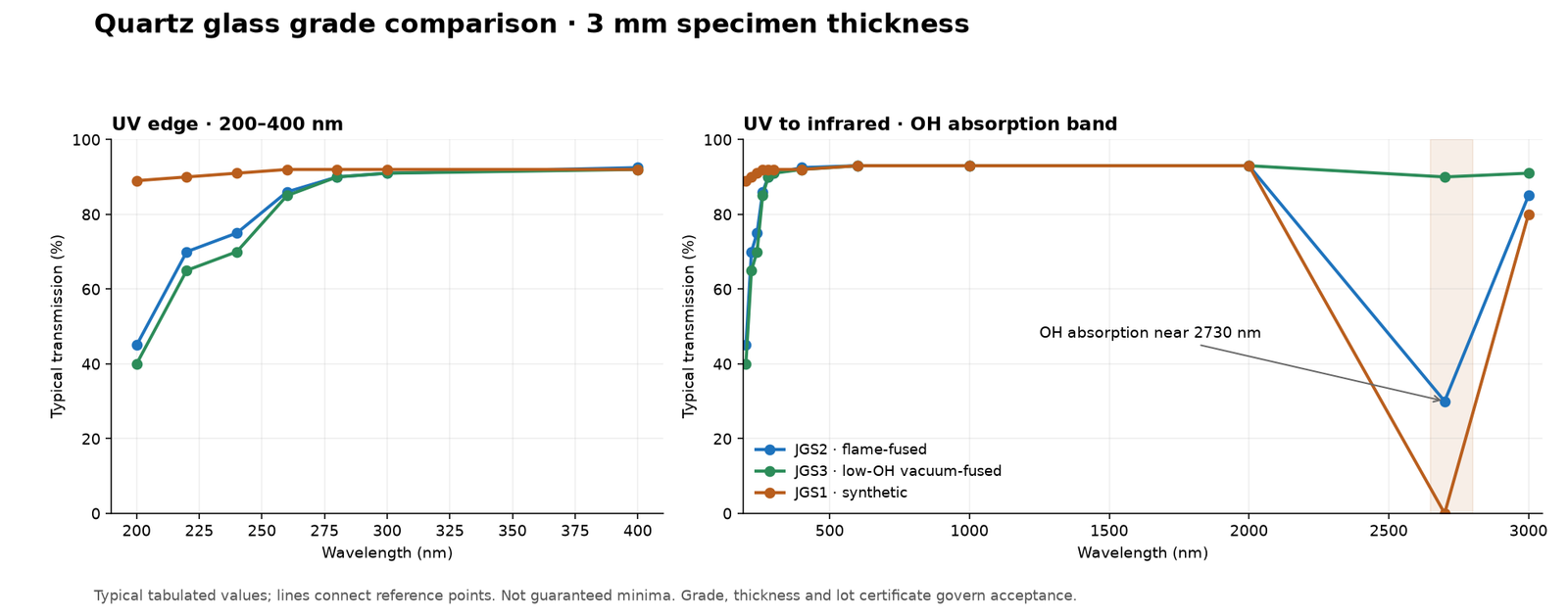
OH content is grade- and batch-dependent; the lot certificate governs acceptance. UV-end transmission is influenced by metallic impurities. The absorption peak near 2730 nm is governed by OH, which is why JGS1 deep-UV material and JGS3 low-OH IR material behave differently.
Engineering Data
Typical Physical Properties
Property
Transparent quartz glass
Opaque quartz glass
Density
2.2 × 10³ kg/m³
1.92–1.95 × 10³ kg/m³
Hardness
570–585 KHN100
—
Tensile strength
4.8–5.0 × 10⁷ Pa
—
Compressive strength
>1.1 × 10⁹ Pa
>1.0 × 10⁹ Pa
Linear expansion coefficient
5.5 × 10⁻⁷ /°C
5.4 × 10⁻⁷ /°C
Thermal conductivity
1.4 W/(m·°C)
—
Specific heat
660–680 J/(kg·°C)
640–650 J/(kg·°C)
Softening point
1630–1700 °C
1580–1600 °C
Annealing point
1180–1220 °C
1050–1100 °C
General continuous service guideline
≤1100 °C
≤1000 °C
Typical properties are reference data, not allowable assembly stresses. Transparent material short-term excursions may reach 1200 °C; sustained use follows the lower continuous-service guideline. Annealing and softening temperatures are material properties, not service ratings.
Engineering Data
Typical Transmission · 3 mm Thickness
Typical reference-point comparison at 3 mm thickness; OH absorption near 2730 nm is grade dependent.
Grade
200 nm
220 nm
240 nm
260 nm
280 nm
300 nm
400 nm
600 nm
1000 nm
2000 nm
2700 nm
3000 nm
JGS2 · flame-fused
45
70
75
86
90
91
92.5
93
93
93
30
85
JGS3 · low-OH vacuum-fused
40
65
70
85
90
91
92
93
93
93
90
91
JGS1 · synthetic
89
90
91
92
92
92
92
93
93
93
0
80
All entries are transmission %. These are typical 3 mm specimen data, not guaranteed minima or values for all thicknesses. The 2700 nm tabulated point is near the 2730 nm OH band: JGS1 is approximately 0%, while low-OH JGS3 is approximately 90%. Specify wavelength, path length, surface finish and minimum transmission for the delivered part.