 Custom Fiber Optic Quartz Capillaries
Custom Thick-Wall Quartz Capillaries
| Parameter | Factory Standard | Manufacturing Limit |
|---|---|---|
| OD | 1–15 mm | — |
| ID (bore) | 0.1–3 mm | — |
| Wall thickness | 0.5–6 mm | — |
| OD/ID ratio | 3:1–20:1 | Higher ratios on request |
| Bore tolerance | ±0.01–0.03 mm | Tighter, confirmed per order |
| Concentricity | ≤8% of wall | Tighter, confirmed per order |
| Length | 10–500 mm | — |
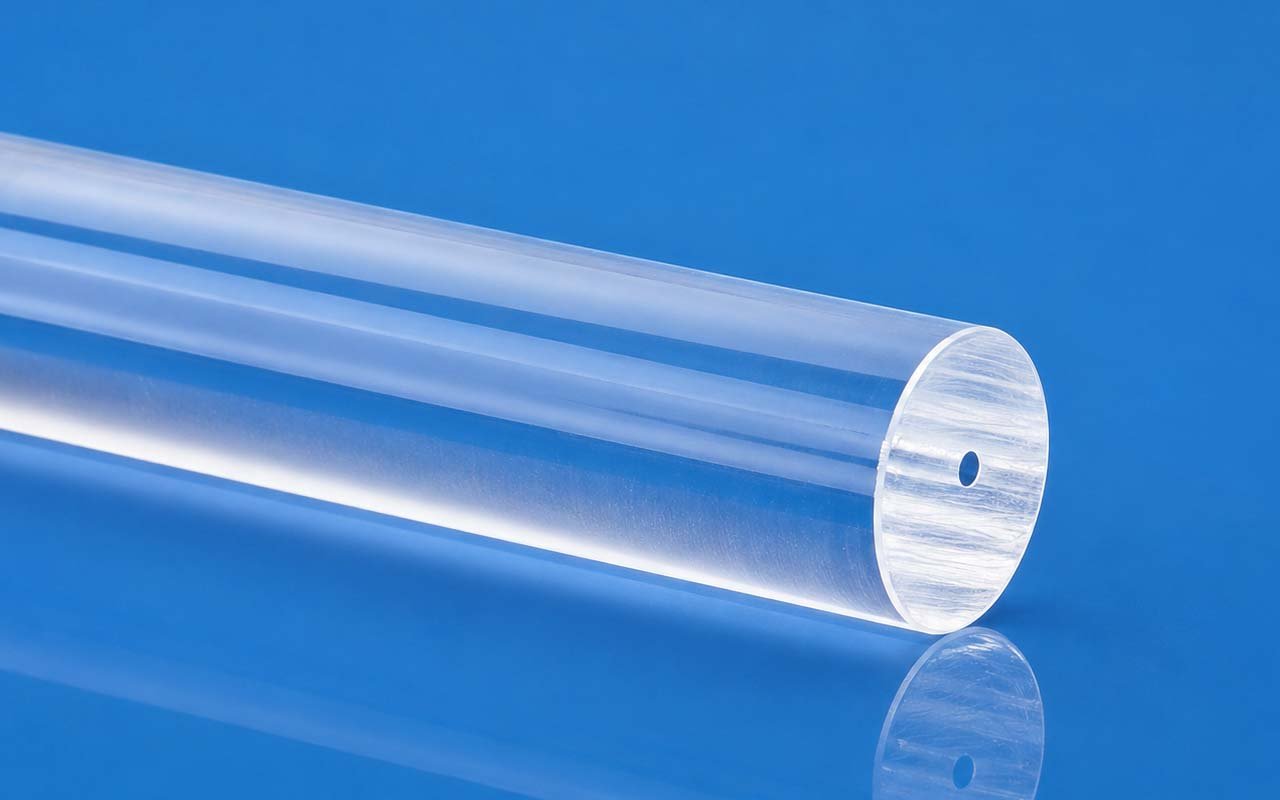
Thick-wall quartz capillaries provide additional quartz around a controlled bore for handling stiffness, protected alignment and secondary machining. This series covers 0.5–6 mm walls, with the thick-wall classification starting at a wall thickness of 1 mm.
OD/ID Ratio as the Main Design Variable
For a concentric round section, nominal wall thickness is (OD − ID) / 2. Select the ID from the flow or inserted component, then choose the OD for mounting and the required section. Include any material that will be removed by grinding, flats or shoulders: the finished minimum wall, rather than the starting wall alone, determines the available quartz section.
Minimum Wall and Bore Centering
Nominal ID and OD do not identify the thinnest wall if the bore is offset. Specify bore position and the minimum permitted wall around the circumference, particularly where secondary machining approaches the channel. A thick nominal wall does not remove the need to control centering or to inspect the finished section.
Pressure Duty Requires Full Geometry Review
Wall thickness by itself is not a pressure rating. A pressure-duty assembly needs review of ID, OD, finished length, temperature, surface condition, supports and end connections, followed by appropriate assembly validation. Include the pressure and thermal cycle on the drawing or RFQ. The product family provides geometry for evaluation; no universal working-pressure limit is assigned to all thick-wall capillaries.
Thick-Wall Geometry
OD, ID and Minimum Wall Must Agree
| Controlled Feature | Reference Capability / Requirement |
|---|---|
| Bore ID | Specified from flow, insert or alignment function |
| Outer Diameter | Selected from the required wall section and holder fit |
| Wall Thickness | Overall series 0.5–6 mm; thick-wall classification starts at ≥1 mm |
| Wall Tolerance | Agreed by OD, ID, wall and length; ±0.10–0.15 mm is a 1–3 mm reference-wall band, not a universal series tolerance |
| Concentricity | Bore position controlled to preserve minimum wall around the circumference |
| Wall Uniformity | Minimum and maximum wall limits used where strength or machining stock matters |
| Length | Cut to drawing with straightness added only where assembly requires it |
| Pressure / Mechanical Duty | Reviewed from complete geometry, temperature, surface condition and end connectionNo universal pressure rating is assigned to the product family |
Wall Selection
Choose Wall for Stiffness, Protection or Machining Stock
| Reference Wall | Design Benefit | Check Before Quote |
|---|---|---|
| 1.0–1.5 mm | More handling stiffness around a small bore | ID, OD and cut length |
| 1.5–2.0 mm | Protected alignment channel and improved section for holding | Concentricity and minimum wall |
| 2.0–3.0 mm | Additional stock for ground OD, flats or secondary features | Finished envelope and machining drawing |
Delivery Forms
Thick-Wall Capillaries as Structural Quartz Blanks
Small Bore / Large ODHigh wall-to-bore ratio for stiffness and protected alignment
Centered Thick-Wall TubeControlled bore position maintains usable wall around the full section
Ground OD or EndsFinished fit surfaces and axial length for holders and flow cells
Machining BlankExtra quartz section for flats, shoulders, tips and custom interfaces
Applications
Where Extra Quartz Section Adds Function
High-Pressure Flow CellsThick-wall starting geometry for assemblies whose final pressure duty is separately validated
Nozzle & Restrictor BodiesSmall controlled bore with quartz stock for external fit and handling
Structural Liners & SupportsProtected channels and stiff alignment components in analytical or thermal equipment
Need a thick-wall capillary reviewed as a complete geometry?Send ID, OD, minimum wall, concentricity, length, temperature and end-connection drawing.
Open the Capillary ConfiguratorEngineering Data
Grade-Qualified Material Purity
Electric-fused / flame-fused quartz: SiO₂ ≥99.99%; synthetic JGS1-grade fused silica: ≥99.999%. Grade and lot certificate govern supplied material.
Thick-wall means wall thickness ≥1 mm. This product series also includes 0.5–<1 mm transitional-wall configurations, covering an overall wall range of 0.5–6 mm.
Customize This Product
Enter your dimensions of Custom Thick-Wall Quartz Capillaries — the technical drawing updates instantly, then request a quotation.
Technical Drawing
Drawing redraws live · blue hatched area = cut section · all dimensions in mm
Parameters
Every field is editable — drawing, weight estimate and part code update instantly.
Common Options
pcs
Configuration Summary
Attached to your inquiry automatically when you press “Use This Configuration”.
—