
The quartz cuvette vs glass cuvette decision is primarily about spectral range, not prestige. Optical glass works well for many visible measurements. Quartz or fused silica is required when the method extends into ultraviolet wavelengths that ordinary optical glass absorbs.
Material is only the first choice. Path length, window count, sample volume, cell orientation, closure, solvent, cleaning method and dimensional fit can each change measurement quality or whether the cell works in the instrument at all.
Quick answer: Use optical glass for routine visible-range work when its certified transmission covers the method. Use quartz/fused silica for UV measurements and broad UV-Vis work, selecting the exact quartz grade by wavelength. Match the nominal path length and external geometry to the instrument, and keep every optical window clean and consistently oriented.
Key Takeaways
- Glass is economical for visible wavelengths; quartz extends measurement into the UV.
- Not every quartz grade has the same UV or IR transmission, fluorescence or OH content.
- A 10 mm path is common, but short and long paths are used to keep absorbance in a measurable range.
- Two-window absorption cells and four-window fluorescence cells are not interchangeable.
- Handling, matched orientation and cleaning often cause more variability than nominal material choice.
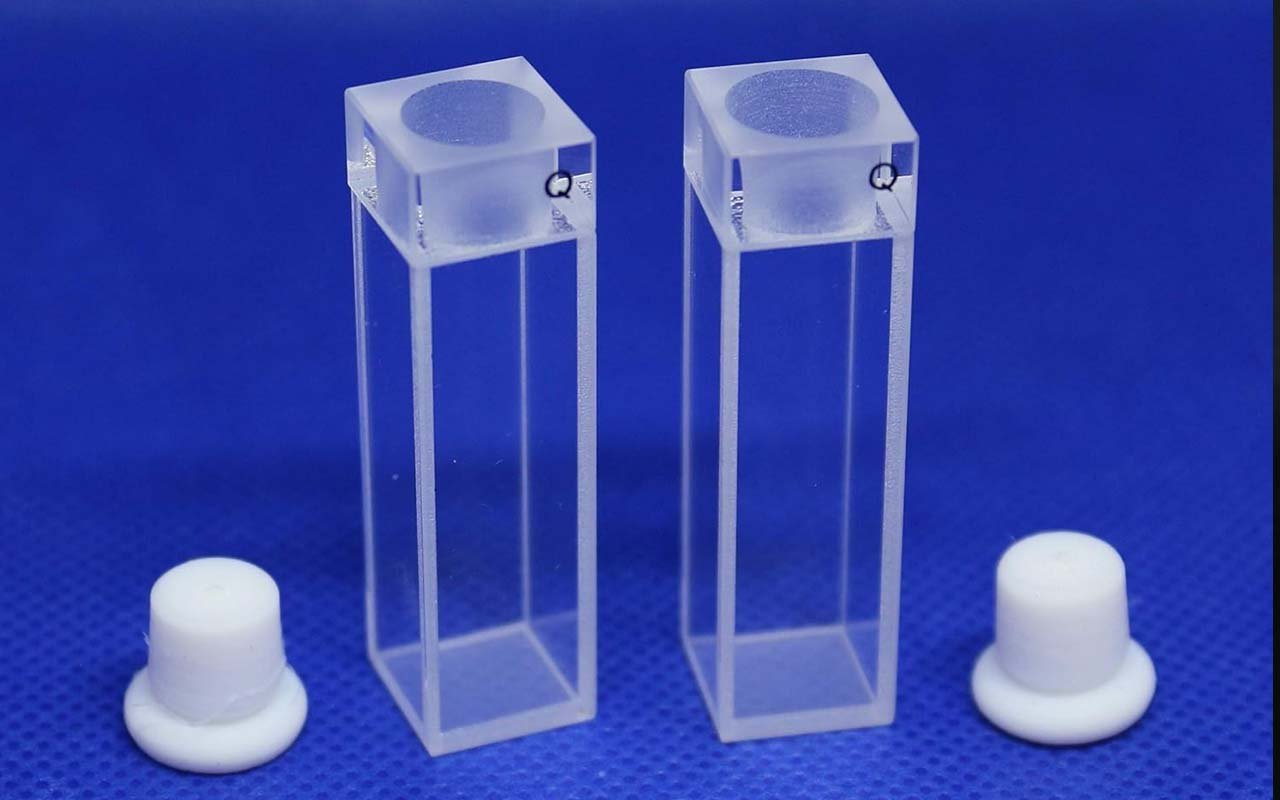
The Main Difference Is Spectral Transmission
Visible-grade optical glass blocks much of the UV, so it can add absorbance or remove usable signal below its specified cutoff. Quartz glass has a wider spectral window, but the usable limit depends on composition and grade. High-purity synthetic fused silica is preferred for demanding deep-UV work, while other quartz grades may be optimized toward the infrared.
Do not select from a generic range copied from a catalog. Use the cell manufacturer's certified material data at the measurement wavelength and consider the full optical path through two windows, the sample and any solvent background.
| Cell material | Best-fit use | Limitation to check |
|---|---|---|
| Optical glass | Routine visible absorption | UV cutoff and solvent/cleaning compatibility |
| UV quartz/fused silica | UV-Vis absorption and fluorescence | Grade-specific transmission and fluorescence |
| Low-OH/IR-oriented quartz | Selected near-IR work | OH absorption bands and instrument range |
| Disposable polymer | High-throughput compatible assays | Spectral range, solvent and dimensional consistency |
Path Length and the Beer-Lambert Relationship
For absorbance measurements, Beer-Lambert behaviour relates absorbance to concentration and optical path length under suitable conditions. A longer path increases sensitivity for dilute samples; a shorter path prevents highly absorbing samples from saturating the measurement.
Ten millimetres is common but not mandatory. Hellma lists quartz path lengths across a much broader range and specifies tighter path-length tolerances for many standard lengths. Use the actual certificate/tolerance when quantitative uncertainty depends on path length.
| Sample condition | Path-length direction | Reason |
|---|---|---|
| High absorbance / concentrated | Shorter | Reduce total absorbance and avoid saturation |
| Routine concentration | Often 10 mm | Common instrument and method convention |
| Very dilute analyte | Longer | Increase absorbance signal |
| Very small volume | Micro-volume geometry | Maintain path while reducing chamber volume |
Two Windows, Four Windows and Cell Orientation
A standard absorption cell normally has two optical windows opposite each other, with the other walls frosted or non-optical for handling and orientation. A fluorescence cell commonly has four clear sides so excitation and emission can be measured at right angles. Flow-through, stoppered and anaerobic cells add ports or closures.
Mark the beam direction and keep cell orientation consistent, particularly when using a matched set. Fingerprints, small scratches or placing a frosted wall in the beam can create an error that looks like chemistry.
| Cell style | Optical faces | Typical use |
|---|---|---|
| Absorption | Two opposite clear windows | UV-Vis absorbance |
| Fluorescence | Four clear windows | 90° excitation/emission |
| Flow-through | Defined inlet/outlet plus windows | Continuous or automated analysis |
| Micro-volume | Reduced internal chamber | Limited sample quantity |
| Stoppered/sealed | Two or four windows with closure | Volatile, air-sensitive or contamination-controlled samples |
Surface Quality, Parallelism and Matching
Window flatness and parallelism influence beam deviation, repeatability and scatter. For routine spectrophotometry, a well-made standard cell is usually more valuable than an unnecessarily tight custom optical specification. For laser interrogation, interferometry or high-precision matched measurements, surface and path controls may need to be stronger.
A matched set is selected so empty-cell or solvent baselines track closely. Keep each cell indexed to the same orientation and do not mix caps or bodies when traceability matters.
Cleaning Without Creating a New Optical Problem
Rinse promptly with a solvent compatible with the sample and cell construction, using a validated laboratory method. Avoid abrasive brushes on optical windows and do not wipe dry residue across the clear surfaces. Handle frosted sides or upper non-optical areas whenever possible.
Strong alkalis and hydrofluoric acid attack silica and are not appropriate just because quartz resists many other chemicals. Bonded or cemented cells can have different solvent and temperature limits from all-fused construction. Confirm the construction before choosing aggressive cleaning, ultrasonics or heat.
When a Custom Quartz Cuvette Is Justified
Custom quartz cuvettes are useful for unusual path lengths, low sample volume, special ports, flow-through operation, electrodes, temperature control or nonstandard instrument envelopes. The value is in solving a measurement problem, not changing dimensions without a method requirement.
Supply the instrument model, beam height and width, wavelength range, sample chemistry, temperature, pressure or vacuum if any, closure and cleaning method. Identify whether quoted path length is nominal, calibrated or supplied with a certificate.
- Material grade and certified spectral range
- Path length, tolerance and certificate requirement
- External dimensions, beam height and clear aperture
- Sample volume, ports, stopper, lid or flow connections
- Two-window or four-window optical arrangement
- Solvent, temperature, cleaning, matching and packaging
Frequently Asked Questions
Can I use a glass cuvette for UV measurements?
Only if the exact glass cell is certified to transmit at the method wavelength. Ordinary optical glass is usually unsuitable for deep-UV work, so quartz/fused silica is the normal choice.
Is every quartz cuvette usable down to 190 nm?
No. The usable short-wavelength limit depends on fused-silica grade, cell construction, cleanliness and the manufacturer's specification. Verify the actual certified range.
Why is 10 mm path length so common?
It is a convenient spectroscopy convention supported by many instruments and methods. Other lengths are useful for concentrated, dilute or low-volume samples.
Can I clean a quartz cuvette with strong alkali?
Use the cell manufacturer's validated method. Strong alkali can attack silica, and bonds, coatings or closures may have additional limits.
Do I need four polished sides?
Use four clear optical windows for typical fluorescence geometry. Standard absorbance usually needs two opposing clear windows, making orientation easier and often reducing cost.
Related Quartz Glass Resources
- Custom Quartz Cuvettes
- Quartz Glass in Analytical and Scientific Instrumentation
- Fused Quartz Labware Guide
- Natural vs Synthetic Quartz Glass
Technical References
- Hellma Analytics — Material and Technical Information for Cuvettes
- Hellma Analytics — Cuvette Finder and Wavelength Ranges
Choose the Cell From the Measurement Method
Send the wavelength range, instrument and beam geometry, required path length, sample volume and chemistry. We can review standard or custom quartz cell geometry and the required optical windows.


