
Most labs start with borosilicate glassware, and for good reason — it's affordable, easy to source, and handles a wide range of everyday lab work. But some processes push past what borosilicate can reliably do, and when that happens, fused quartz labware is usually the answer.
Related resources: custom quartz beakers and custom quartz flasks.
This guide covers the signs your lab has outgrown borosilicate, the quartz labware types available, and how to think about the cost of upgrading.
Quick answer: Upgrade from borosilicate to fused quartz labware when your work involves temperatures above roughly 500°C, deep-UV transmission, trace-level metal contamination sensitivity, or exposure to chemicals borosilicate can't reliably handle. Common quartz labware includes beakers, flasks, crucibles, combustion boats, and cuvettes, typically made from JGS1 or JGS2 fused quartz.
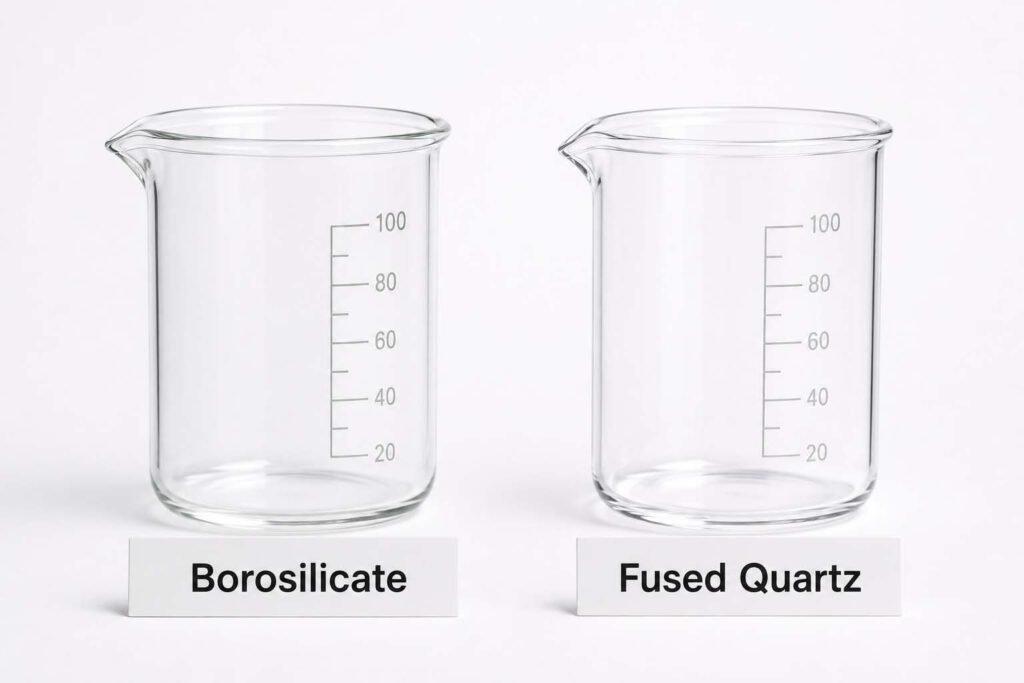
Borosilicate vs. Quartz Labware at a Glance
| Borosilicate Labware | Fused Quartz Labware | |
|---|---|---|
| Max continuous temperature | ~450–500°C | ~1100–1200°C |
| Deep-UV transmission | Poor (blocks below ~300 nm) | Excellent (down to ~185 nm) |
| Trace metal purity | Good for general use | Better, especially in synthetic grades |
| Chemical resistance | Good for most everyday use | Excellent, except HF |
| Relative cost | Lower | Higher |
Values above are general industry reference figures. For the full technical comparison, see our guide on quartz glass vs borosilicate glass.
Signs You've Outgrown Borosilicate
Your process runs above 500°C. Borosilicate softens and loses reliability well before quartz's operating range even starts to become a concern. If a step in your protocol approaches or exceeds this range, borosilicate glassware is a real failure risk, not just a performance compromise.
You're doing trace-level analysis. If your results are sensitive to parts-per-billion contamination, the small amount of boron and other elements that can leach from borosilicate under aggressive conditions may be enough to affect your data. Quartz, especially synthetic grades, essentially eliminates this variable.
You need deep-UV transmission. Borosilicate blocks most light below about 300 nm. If your protocol involves UV spectroscopy, photochemistry, or any process where UV light needs to pass through the vessel wall, quartz is the only practical option.
You're working with hot concentrated acids or aggressive solvents. Quartz's chemical resistance profile handles a wider range of aggressive reagents at high temperature than borosilicate reliably does — with hydrofluoric acid as the one exception both materials share.
You're seeing repeated thermal shock failures. If your glassware keeps cracking from rapid heating and cooling cycles, quartz's much lower thermal expansion coefficient largely eliminates this failure mode.
If none of these apply to your work, borosilicate is very likely still the more practical and economical choice — quartz labware isn't a universal upgrade, it's a solution to specific limitations.
Common Quartz Labware Types
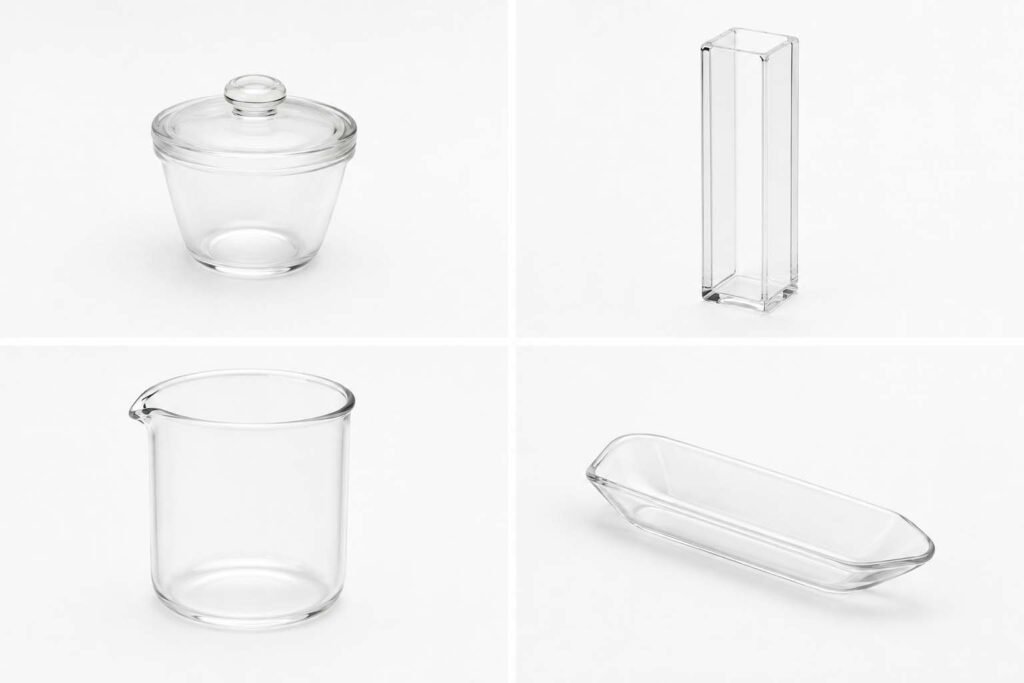
Beakers and flasks — for general high-temperature or high-purity reactions and sample preparation, available in a range of volumes similar to standard borosilicate glassware.
Crucibles — for high-temperature material processing, ashing, and gravimetric analysis, where quartz's thermal shock resistance and chemical inertness matter most.
Combustion boats — for sample holding during high-temperature combustion or thermal analysis, often single- or double-handled for furnace handling.
Cuvettes — for UV-Vis and fluorescence spectroscopy, where quartz's UV transmission is the entire reason to use it over standard optical glass or plastic.
Test tubes and evaporating dishes — general-purpose vessels for high-temperature or chemically demanding sample handling.
Choosing the Right Grade for Lab Use
Most general lab glassware doesn't need the highest available purity grade. JGS2 fused quartz — natural material with good general performance — covers the majority of high-temperature and chemical-resistance use cases at a lower cost than synthetic JGS1 material.
JGS1 or synthetic fused silica becomes worth the added cost specifically for trace-analysis work, deep-UV applications like cuvettes for spectroscopy below 250 nm, or any protocol where the purity of the vessel itself could bias results. See our guide on JGS1 vs JGS2 vs JGS3 for how to match grade to your specific requirement.
Cost Considerations
Quartz labware costs meaningfully more than equivalent borosilicate items, and that gap is easy to justify when it solves a real limitation — a failed high-temperature run or a contaminated dataset costs far more than the price difference between materials. It's harder to justify as a blanket replacement for glassware that's working fine within borosilicate's normal operating range.
A practical approach: upgrade the specific items in your workflow that hit one of the limitations above, rather than replacing an entire lab's glassware inventory at once.
Frequently Asked Questions
Can I mix quartz and borosilicate glassware in the same lab?
Yes, this is standard practice. Most labs use borosilicate for general work and quartz specifically for the steps that need its higher temperature range, purity, or UV transmission.
Is quartz labware more fragile than borosilicate?
Quartz has excellent thermal shock resistance but is mechanically brittle, similar to borosilicate in that respect. Careful handling matters for both, though quartz tolerates rapid temperature changes far better.
What grade of quartz should I use for UV-Vis cuvettes?
This depends on your exact wavelength range. General UV-Vis work is typically fine with JGS2; deep-UV work below roughly 250 nm usually needs JGS1 or synthetic fused silica. See our JGS1 vs JGS2 vs JGS3 guide for details.
Does quartz labware need special cleaning or handling?
Standard lab glassware cleaning practices generally apply, though avoiding hydrofluoric acid and preventing surface contamination before high-temperature use both matter more for quartz than for borosilicate, given quartz's devitrification sensitivity at very high temperatures.
Is quartz labware available in the same sizes as standard borosilicate glassware?
Common items like beakers, flasks, and crucibles are typically available in comparable standard volumes, with custom sizing available for specific needs.
Making the Switch
The decision to upgrade usually comes down to one clear limitation — a temperature ceiling, a purity requirement, or a UV wavelength — rather than a general sense that quartz is "better." If you're not sure whether your protocol needs quartz labware, send us your temperature range, purity requirements, and item types, and we can recommend the right grade and pieces for your lab.


