
If you've seen "JGS1," "JGS2," or "JGS3" on a drawing or a quote and weren't sure what actually changes between them, you're not alone. These are the three most common optical grades of quartz glass, and picking the wrong one usually means paying for purity you don't need — or specifying material that can't handle your wavelength range.
Related resources: quartz glass for optics and fiber applications and custom quartz windows.
This guide breaks down what each grade actually is, how they differ, and how to choose without guessing.
Quick answer: JGS1, JGS2, and JGS3 are optical grades of quartz glass, sorted mainly by raw material origin and OH (hydroxyl) content. JGS1 is synthetic fused silica with the best deep-UV transmission. JGS2 is natural fused quartz with good general UV-Vis performance at lower cost. JGS3 is a low-OH grade optimized for infrared transmission. The right choice depends on your working wavelength, not on which grade sounds the most premium.
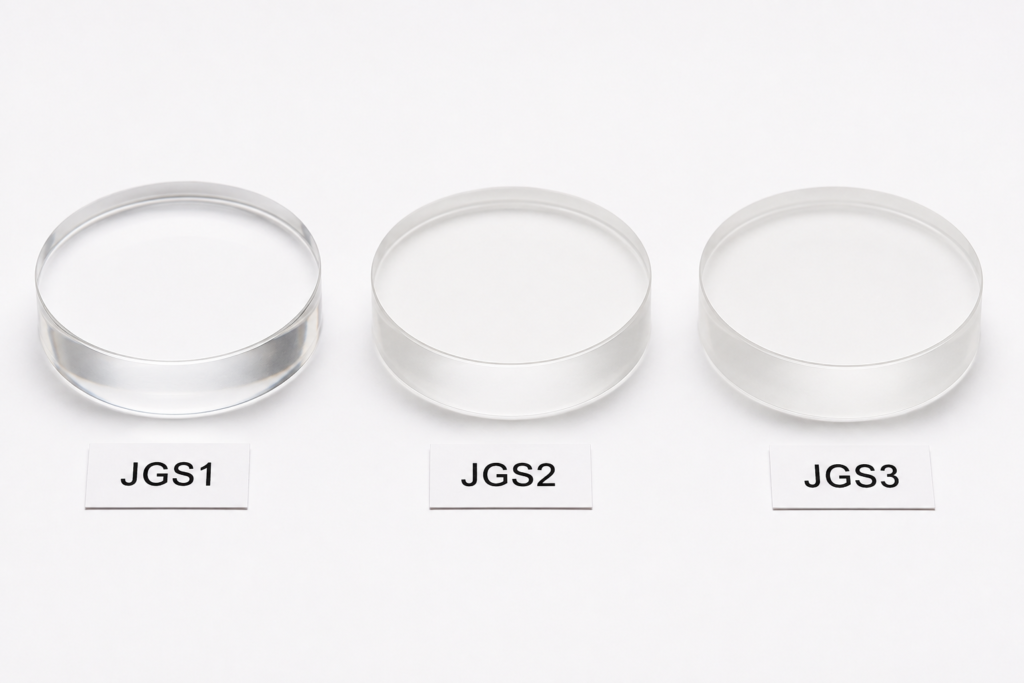
JGS1, JGS2, JGS3 at a Glance
| JGS1 | JGS2 | JGS3 | |
|---|---|---|---|
| Raw material | Synthetic silica (e.g. SiCl₄) | Natural quartz crystal | Natural quartz crystal, low-OH processed |
| OH content | High | Low to moderate | Very low |
| Best transmission range | Deep UV (~185 nm) to visible | UV-Vis (~220 nm) to near-IR | Visible to infrared (up to ~3500 nm) |
| Bubble/inclusion level | Lowest | Low, small bubbles possible | Varies by supplier |
| Common equivalents | Suprasil, Corning 7980 | Homosil | — |
| Typical use | DUV lithography, precision UV optics | General optics, UV sterilization, sight glass | IR optics, high-power lasers |
| Relative cost | Highest | Medium | Medium–high |
Values above are general industry reference figures. Confirm exact specs with your supplier's data sheet.
For background on quartz glass composition and properties in general, see our guide on what quartz glass is and how it's made.
What Do JGS1, JGS2, and JGS3 Actually Mean?
JGS is a widely used classification system for optical-grade quartz glass, originating from Chinese industry standards. The number after "JGS" isn't a quality ranking — JGS3 isn't worse than JGS1. Each grade is optimized for a different part of the spectrum.
The real dividing line is raw material and production route:
- JGS1 is made from synthetic silicon compounds, not natural quartz. It's grown through a flame hydrolysis or vapor deposition process, which produces very high purity and very few bubbles.
- JGS2 is made by melting natural quartz crystal. It's less pure than JGS1 but far more affordable, and still performs well for general UV and visible-light use.
- JGS3 starts from natural quartz as well, but goes through additional processing to strip out hydroxyl (OH) groups, which is what makes it better suited to infrared applications.
The Real Driver: OH (Hydroxyl) Content
Almost every practical difference between these three grades comes back to one variable: how much OH is locked into the glass structure.
OH content helps UV performance and hurts IR performance. High-OH material (JGS1) transmits deep UV very well but has absorption bands in the infrared. Low-OH material (JGS3) does the opposite — weak in deep UV, but clean and efficient in the infrared, without the water-absorption band that shows up around 2720 nm in high-OH glass.
This is why you can't just pick "the best" grade. A grade that's excellent for a UV application will underperform in an IR application, and vice versa.
JGS1: Synthetic Fused Silica
JGS1 is produced from synthetic raw material, typically silicon tetrachloride, melted in a high-purity oxyhydrogen flame. Because it doesn't start from a natural mineral, it avoids the trace metal impurities that come with natural quartz.
Where it's used: deep-UV lithography, UV spectroscopy, laser optics, and any application where transmission below 250 nm matters.
Trade-off: it's the most expensive of the three grades, and its high OH content limits its infrared performance.
JGS2: Natural Fused Quartz
JGS2 is melted from natural quartz crystal. It carries some trace metallic impurities, and small bubbles are more common than in JGS1, but for most general-purpose optical and industrial applications, this doesn't matter.
Where it's used: general optics, UV sterilization sleeves, sight glass, and telescope mirror blanks, where JGS2 is often a direct cost-effective substitute for older reference materials like Homosil.
Trade-off: UV transmission drops off below roughly 220 nm, so it's not suitable for deep-UV work.
JGS3: Low-OH, Infrared-Optimized
JGS3 goes through extra processing to reduce OH content well below JGS1 and JGS2. That removes the absorption bands that would otherwise interfere with infrared transmission.
Where it's used: infrared sensing, thermal imaging components, and high-power laser systems, where low OH content also means lower absorption-related heating at the laser wavelength.
Trade-off: weaker UV performance than JGS1 or JGS2, and it's typically a specialty order rather than a stock item.
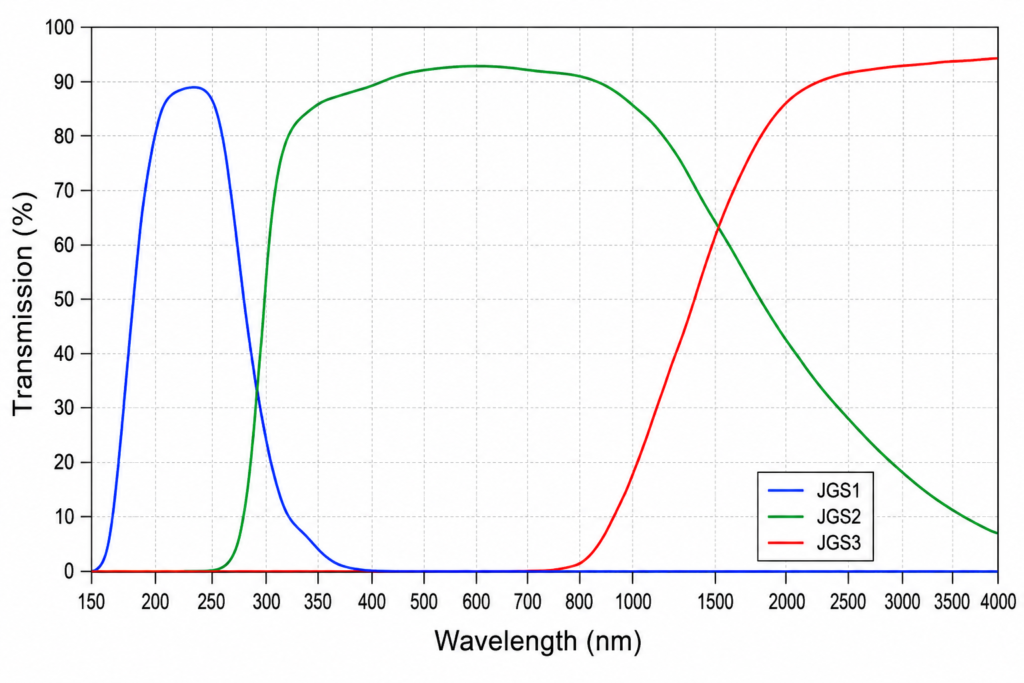
How to Choose the Right Grade
Work through these questions in order:
- What wavelength does your application actually use? If you don't know the number, find it before you specify a grade — this one fact drives the whole decision.
- Is UV transmission below 250 nm required? If yes, JGS1 is likely the only grade that will work.
- Is the application general UV-Vis, with no deep-UV requirement? JGS2 usually covers this at lower cost.
- Is the application infrared or high-power laser related? JGS3 is built for this.
- Does the part see structural or thermal load rather than optical transmission? If optical performance isn't the point, a non-optical industrial grade may be more cost-effective than any JGS grade.
Common Mistakes When Specifying Grade
Assuming higher number means higher spec. JGS3 isn't an upgrade over JGS1 — it's a different tool for a different wavelength range.
Defaulting to JGS1 "to be safe." This is the most common way projects overspend. If your application runs entirely in the visible range, JGS2 will perform identically for a lower price.
Copying a grade from an old drawing without checking the wavelength. Legacy specs sometimes reference discontinued reference materials. Confirm the actual transmission requirement before matching an old part number.
Frequently Asked Questions
What does JGS stand for? It's a classification label for optical-grade quartz glass, with the number indicating spectral optimization rather than purity ranking.
Is JGS1 always better than JGS2? No. JGS1 has higher purity and better deep-UV performance, but JGS2 performs just as well for general UV-Vis use and costs less. "Better" depends on the application.
Which grade should I use for UV sterilization equipment? JGS2 is the standard choice for most UV sterilization sleeves and lamp jackets, since deep-UV performance below 220 nm usually isn't required.
Which grade is best for infrared applications? JGS3, because its low OH content avoids the absorption bands that interfere with infrared transmission.
Can JGS2 be used for laser optics? It depends on the wavelength and power level. Many general laser applications use JGS2, but high-power or deep-UV laser systems typically require JGS1 or JGS3 depending on the wavelength.
Do all suppliers use the same JGS definitions? The general performance pattern is consistent, but exact transmission curves and OH content can vary between suppliers. Always check the specific data sheet for the material you're sourcing.
Getting the Grade Right the First Time
The fastest way to specify quartz glass correctly is to start from the application, not the material. Nail down your working wavelength, temperature range, and any power or purity constraints first — the correct grade usually becomes obvious once those numbers are on paper.
If you're not sure which grade fits your project, send us your wavelength range and application details and we can recommend a grade and material form — tube, rod, plate, or custom-machined part — based on your actual requirements.


