
Quartz glass and borosilicate glass both show up in labs, industrial equipment, and lighting systems, and it's common to see them treated as interchangeable. They aren't. Each one is built from a different chemistry, and that difference shows up clearly once you push temperature, chemical exposure, or optical performance to their limits.
Related resources: fused quartz labware guide and custom quartz beakers.
This guide compares the two directly, so you can specify the right one instead of defaulting to whichever is more familiar.
Quick answer: Borosilicate glass handles moderate heat (up to ~500°C), resists most everyday chemicals, and is far cheaper to mold into complex shapes. Quartz glass costs more but handles much higher temperatures (up to ~1200°C), transmits UV light, and resists a wider range of aggressive chemicals. Choose quartz glass when temperature, UV performance, or extreme purity are non-negotiable. Choose borosilicate for general lab and industrial use where cost and formability matter more.
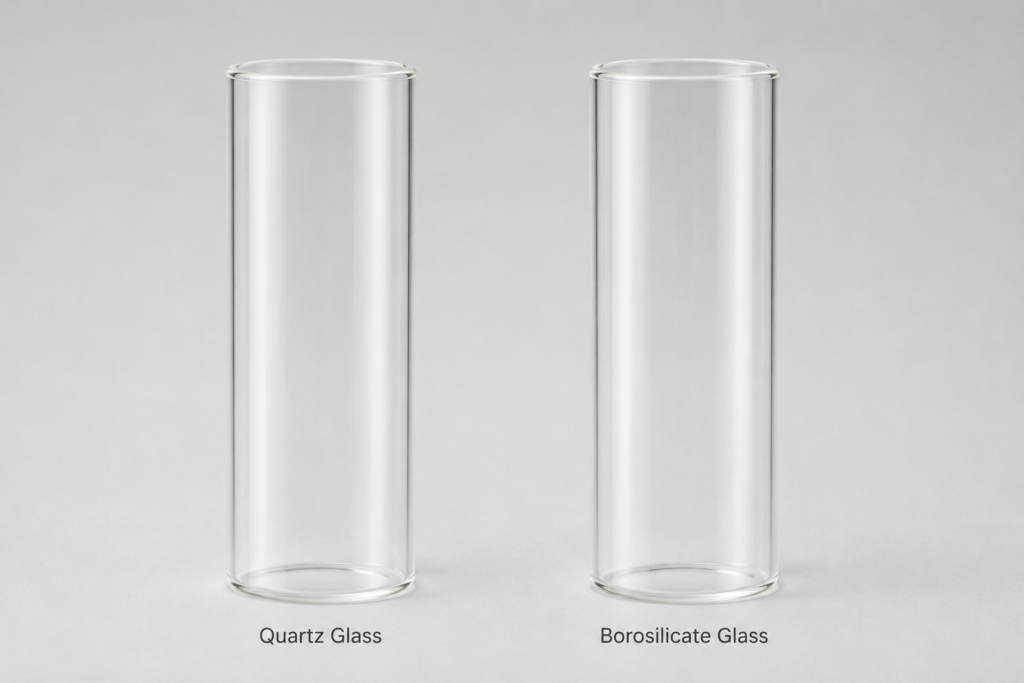
Quartz Glass vs. Borosilicate Glass at a Glance
| Property | Quartz Glass | Borosilicate Glass |
|---|---|---|
| Main composition | SiO₂ ≥ 99.9% | ~81% SiO₂, ~13% B₂O₃ |
| Max continuous use temp | ~1100–1200°C | ~450–500°C |
| Thermal shock resistance | Excellent | Good |
| Thermal expansion | ~0.50–0.55 × 10⁻⁶/°C | ~3.3 × 10⁻⁶/°C |
| UV transmission | Excellent (from ~185 nm) | Poor (below ~300 nm) |
| Chemical resistance | Excellent, except HF | Good, except strong alkalis and HF |
| Ease of molding/forming | Limited, mostly machined from stock | Easier to mold into complex shapes |
| Relative cost | Medium–high | Low–medium |
Values above are general industry reference figures. Confirm exact specs with your supplier's data sheet.
For a full breakdown of quartz glass properties and types, see our guide on what quartz glass is and how it's made.
Composition: Why They Behave So Differently
Quartz glass is almost pure silicon dioxide, with no fluxing additives. Borosilicate glass starts from a similar base but adds boron trioxide, along with small amounts of other oxides. That boron content is what gives borosilicate its name and its properties.
Adding boron lowers the melting point and makes the glass easier to form, but it also lowers the temperature ceiling and reduces UV transmission compared to pure silica. Every practical difference between these two materials traces back to this one compositional choice.
Temperature Performance
Quartz glass holds up under continuous use around 1100–1200°C, with short-term tolerance closer to 1300°C. Borosilicate glass tops out around 450–500°C for continuous use.
Both materials handle thermal shock reasonably well compared to standard soda-lime glass, but quartz glass is in a different league. Its lower thermal expansion coefficient lets it survive extreme, rapid temperature swings — including being heated red-hot and quenched in water — without cracking. Borosilicate can handle moderate shock (boiling water to room temperature, for example) but isn't built for that kind of extreme swing.
If your application runs above 500°C, borosilicate isn't an option. Below that, either material may work, and the decision shifts to the other factors below.
Chemical Resistance
Both materials resist a wide range of chemicals, and for most everyday lab and industrial use, either one holds up fine. The differences show up at the extremes.
Quartz glass resists nearly all acids, including concentrated nitric and sulfuric acid at high temperature. Its one significant weakness is hydrofluoric acid, which dissolves it.
Borosilicate glass is also chemically stable against most acids and everyday chemicals, but it's more vulnerable than quartz to strong alkaline solutions and to hydrofluoric acid. For applications involving ultrapure water systems or semiconductor-grade cleanliness, quartz is the standard — it doesn't leach ions the way borosilicate can under aggressive conditions.
UV and Optical Transmission
This is one of the clearest dividing lines between the two. Quartz glass transmits light from deep UV (around 185 nm) through the visible range and into the near-infrared. Borosilicate glass blocks most UV light below roughly 300 nm.
If your application involves UV curing, UV sterilization, UV spectroscopy, or any process where ultraviolet light needs to pass through the material, borosilicate simply won't work. This isn't a matter of choosing a "better" borosilicate grade — the boron content itself blocks the UV range.
Mechanical Strength: A Common Misconception
It's easy to assume quartz glass is mechanically tougher than borosilicate across the board, since it beats borosilicate on temperature, purity, and chemical resistance. In practice, it's more complicated.
Quartz glass is strong under compressive load but brittle, and its performance is very sensitive to surface flaws and edge finish. Tempered borosilicate glass, on the other hand, gains strength from the tempering process itself, which puts the surface under compression. For applications like pressure viewports and sight glasses, tempered borosilicate can actually outperform standard quartz glass in raw pressure resistance, even though quartz has better theoretical material properties.
The practical takeaway: for pressure-rated components, don't assume quartz automatically wins. Confirm actual tested pressure ratings for your specific thickness, diameter, and edge treatment rather than relying on general material properties alone.
Cost and Manufacturability
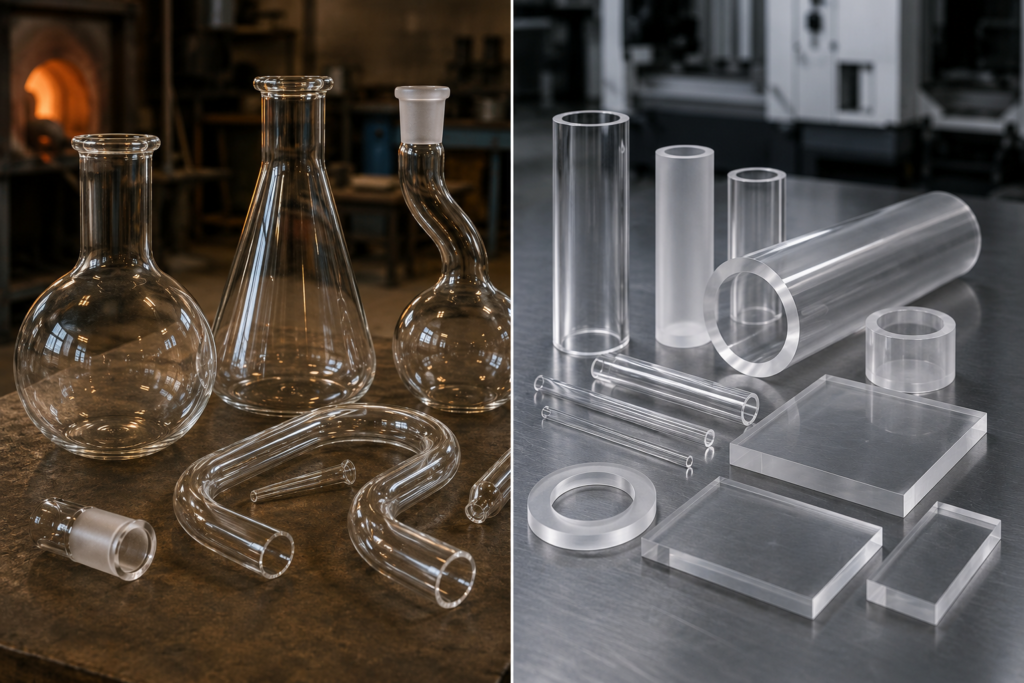
Borosilicate glass is significantly less expensive and much easier to shape into complex geometries — bends, flasks, molded vessels — because its lower melting point allows conventional glassblowing and molding techniques.
Quartz glass requires much higher processing temperatures and specialized tooling. Most quartz components start as tube, rod, or plate stock and are cut, ground, and machined into their final shape rather than molded. This adds cost but allows for tight tolerances on precision parts.
Typical Applications for Each
Borosilicate glass is the default choice for general laboratory glassware, cookware, moderate-temperature sight glasses, chemical processing vessels, and lighting components where cost matters and temperatures stay under 500°C.
Quartz glass is the standard for semiconductor processing equipment, UV lamp systems and sterilization sleeves, high-temperature furnace components, precision optics, and any application requiring both high purity and high heat tolerance at the same time.
Which Should You Choose?
Work through these questions in order:
- Does the application exceed 500°C, even briefly? If yes, quartz glass is required.
- Does UV light need to pass through the material? If yes, quartz glass is required.
- Is the part exposed to hydrofluoric acid or strong hot alkalis? Neither material is ideal, but this needs a closer material review either way.
- Does the part need a complex molded shape, at low cost, in volume? Borosilicate is usually the more practical and economical choice.
- Is the application general-purpose lab or industrial use with no extreme requirements? Borosilicate is typically sufficient and more cost-effective.
Frequently Asked Questions
Can borosilicate glass replace quartz glass?
Only for applications below roughly 500°C that don't require UV transmission or extreme chemical purity. Above that, quartz is necessary.
Is quartz glass always stronger than borosilicate glass?
Not necessarily. Quartz has better theoretical properties, but tempered borosilicate can outperform standard quartz under pressure or impact due to the tempering process.
Why is quartz glass more expensive than borosilicate?
Higher raw material purity, much higher melting temperatures, and machining-based fabrication (rather than molding) all add cost.
Does borosilicate glass block UV light?
Yes, most standard borosilicate glass blocks the majority of UV light below about 300 nm.
Which material is better for a high-temperature sight glass?
Quartz glass, if the operating temperature exceeds borosilicate's roughly 500°C ceiling. Below that, either can work depending on the pressure and chemical requirements.
Getting the Right Material for Your Project
The choice usually comes down to whether your application crosses one of two hard lines: the 500°C temperature ceiling, or the need for UV transmission. If neither applies, cost and manufacturability often make borosilicate the more practical choice.
If you're not sure which material fits your specification, send us your temperature range, chemical exposure, and optical requirements, and we can recommend the right material and form for your part.


