
Analytical instruments are only as accurate as the components inside them, and quartz glass shows up in a surprising number of measurement technologies — not because it's a generic lab material, but because specific properties (UV transmission, chemical inertness, piezoelectric behavior, low background signal) are exactly what certain measurement techniques require.
This guide covers the main ways quartz glass and quartz crystal are used in analytical and scientific instrumentation, and what to check when specifying components for instrument manufacturing.
Quick answer: Quartz glass and quartz crystal are used in analytical instrumentation for UV-Vis and fluorescence spectroscopy (cuvettes), mass-sensing (quartz crystal microbalance sensors), X-ray diffraction (sample holders), and general instrument components requiring optical clarity, chemical inertness, or low background interference. Component grade and surface finish should be matched to the specific measurement technique's sensitivity requirements.
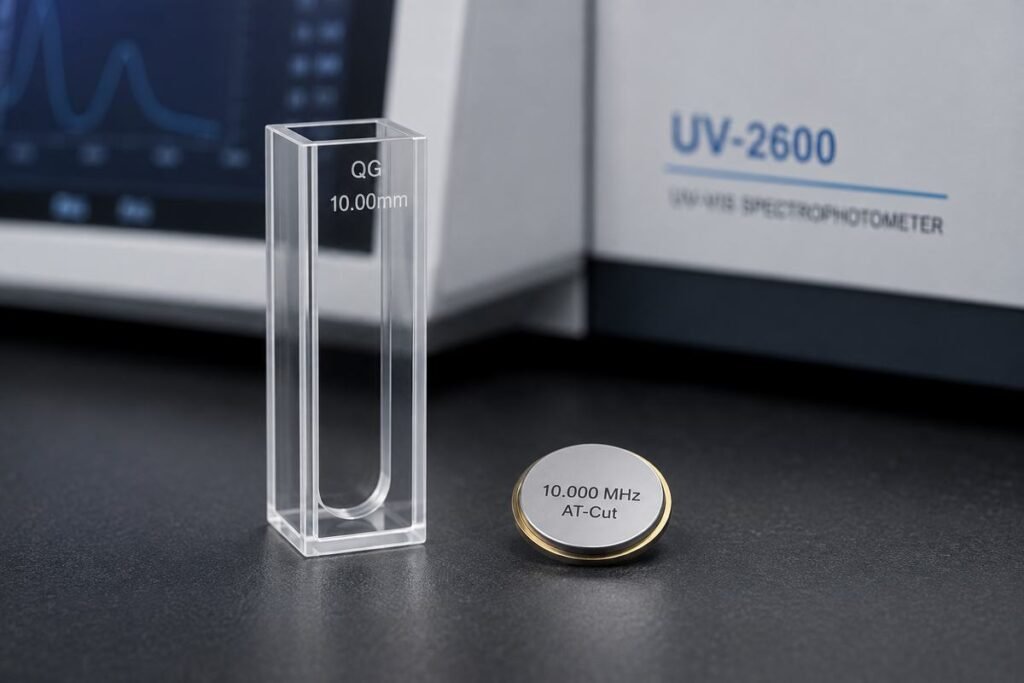
Quartz in Analytical Instrumentation at a Glance
| Application | Quartz Component | Key Property Used |
|---|---|---|
| UV-Vis / fluorescence spectroscopy | Cuvettes | Deep-UV transmission |
| Quartz crystal microbalance (QCM) | Precision-cut quartz crystal resonator | Piezoelectric response |
| X-ray diffraction (XRD) | Sample holders | Low-background, dimensionally stable substrate |
| General instrument optics | Windows, lenses, beam splitters | Optical clarity, UV/IR transmission |
| Balance and precision measurement | Structural and reference components | Low thermal expansion, dimensional stability |
For general optical component background, see our guide on quartz glass for optics and fiber applications.
Spectroscopy Cuvettes
UV-Vis and fluorescence spectroscopy both depend on light passing cleanly through a sample container without the container itself absorbing or distorting the relevant wavelengths. Standard optical glass and plastic cuvettes work fine for visible-range measurements, but they block a significant portion of the UV range that many analytical methods depend on.
Quartz cuvettes solve this by transmitting well into the deep UV — grade selection matters here the same way it does for any other UV-sensitive application. See our guide on JGS1 vs JGS2 vs JGS3 to match grade to your instrument's working wavelength range.
Quartz Crystal Microbalance (QCM) Sensors
QCM is a different category of application entirely — it uses the piezoelectric properties of precisely cut quartz crystal, not the optical or thermal properties that dominate most other applications on this site. A QCM sensor measures extremely small mass changes by tracking shifts in the crystal's resonant frequency as material adsorbs onto its surface.
This technique is used across pharmaceutical formulation research, biosensing, thin-film deposition monitoring, and materials science, wherever a highly sensitive, real-time mass measurement is needed. The manufacturing precision required for QCM crystal cuts is significant — resonant frequency depends on exact crystal orientation and thickness, making this one of the most tightly toleranced quartz applications outside of fiber-optic preforms.
X-Ray Diffraction (XRD) Sample Holders
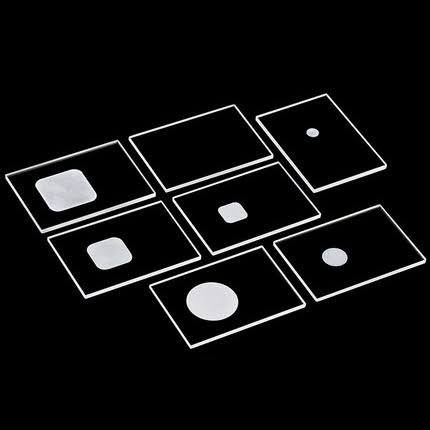
XRD analysis needs a sample substrate that won't interfere with the diffraction pattern being measured. Quartz glass sample holders are chosen for their low background signal and dimensional stability, keeping the substrate itself effectively invisible to the measurement. Flatness and surface consistency matter here in the same way they do for other precision flat quartz components — see our guide on custom precision quartz components for how these parts are typically specified and machined.
General Instrument Optics and Structural Components
Beyond the specialized applications above, quartz glass shows up in general instrument construction wherever optical clarity, UV/IR transmission, or dimensional stability under temperature change matters — windows over sensors, beam-path components in spectrometers, and structural elements where thermal expansion needs to stay minimal to preserve calibration accuracy over time and temperature swings.
What to Check When Specifying Instrument Components
Wavelength range. For any optical component, confirm the instrument's actual working wavelength before selecting a grade — see JGS1 vs JGS2 vs JGS3 for how this affects material choice.
Surface and dimensional tolerance. Precision instrumentation often has tighter tolerance requirements than general industrial use — confirm what level of tolerance your specific measurement technique actually needs rather than defaulting to the tightest available spec.
Background interference. For techniques like XRD where the substrate itself needs to stay "invisible" to the measurement, confirm purity and structural requirements specific to that technique rather than assuming general high-purity quartz is automatically sufficient.
Frequently Asked Questions
Why are quartz cuvettes required for some spectroscopy but not others?
Standard glass and plastic cuvettes block significant UV light, so any measurement technique working in the UV range — rather than purely visible light — typically requires quartz cuvettes for accurate results.
What makes quartz useful for QCM sensors specifically?
Quartz crystal's piezoelectric properties allow precise, repeatable resonant frequency behavior, which is the physical mechanism QCM sensors use to detect extremely small mass changes.
Why use quartz for XRD sample holders instead of another material?
Quartz provides a low-background, dimensionally stable substrate that doesn't interfere with the diffraction pattern being measured, which is critical for accurate XRD results.
Does every optical instrument component need synthetic (rather than natural) quartz?
Not necessarily — it depends on the wavelength range and purity sensitivity of the specific technique. See our natural vs synthetic quartz glass guide for how to make that call.
Can standard-grade quartz glass be used for precision instrumentation, or does it need to be optical-grade?
This depends entirely on the application. Structural or non-optical components may not need optical-grade material, while any component in the actual light or measurement path typically does.
Specifying Components for Instrument Manufacturing
Instrument-grade quartz specification comes down to matching material grade, surface finish, and tolerance to the specific measurement technique's sensitivity — not defaulting to the highest spec available. If you're developing or manufacturing analytical instrumentation, send us your technique, wavelength, and tolerance requirements for a component recommendation.


