
Aerospace and defense applications push quartz glass into some of its most demanding roles — surviving extreme temperature swings, transmitting specific wavelengths for sensors and optics, and in one specialized case, letting radio waves pass through structural material almost unimpeded. This guide separates the two main ways quartz shows up in this sector: as solid glass components, and as woven fiber reinforcement in composite structures.
Quick answer: In aerospace and defense, solid quartz glass is used for optical windows, sensor domes, and viewports where high temperature tolerance and specific wavelength transmission matter — building on the same properties covered in our general quartz glass guide. Separately, quartz fiber (woven and combined with resin) is used in radome composites, valued for its low dielectric loss, which lets radar and communication signals pass through structural material with minimal interference.
Quartz Applications in Aerospace & Defense at a Glance
| Application | Form | Key Property |
|---|---|---|
| Sensor and optical windows | Solid flat or curved quartz glass | UV/IR transmission, thermal shock resistance |
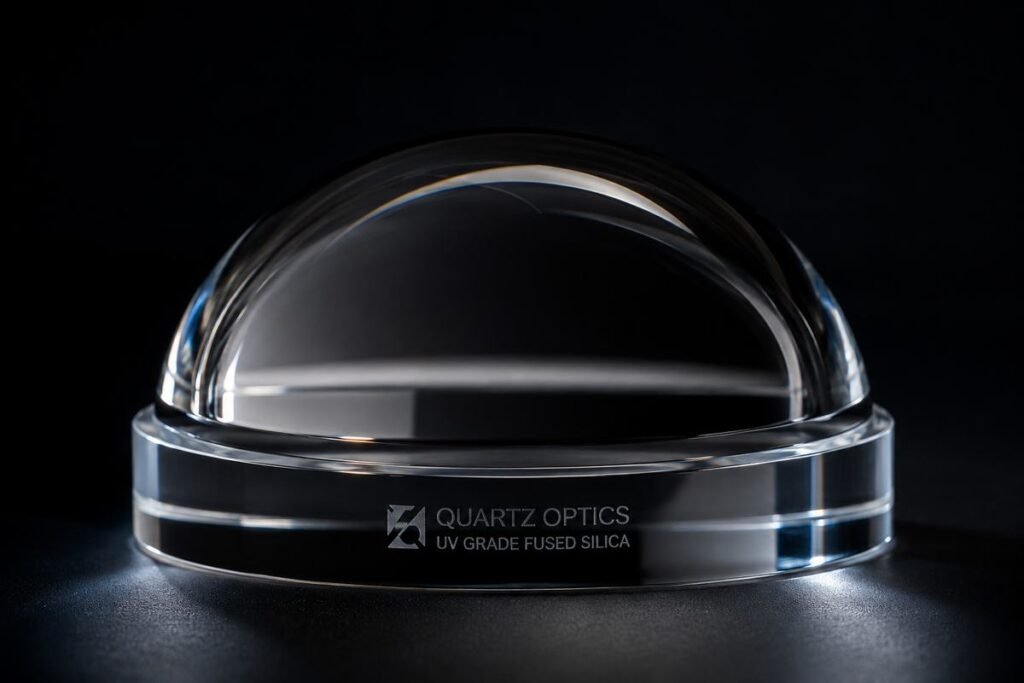
| Domes for seekers and sensors | Solid curved/molded quartz glass | Optical clarity plus high-temperature survival |
| High-temperature viewports | Solid flat quartz glass | Thermal stability, visual monitoring |
| Radomes (radar-transparent covers) | Woven quartz fiber composite | Low dielectric loss, RF transparency |
| Antenna substrates | Quartz fiber composite | Low dielectric constant, signal integrity |
Optical Windows and Sensor Domes
Aerospace and defense optical systems — imaging sensors, targeting systems, and instrumentation — often need a protective window or dome that survives extreme conditions without degrading the optical path behind it. Quartz glass fits this role for the same underlying reasons covered in our what is quartz glass guide: wide transmission range, high-temperature tolerance, and strong thermal shock resistance for components that may face rapid heating during flight.
For flat window components specifically, dimensional and surface quality requirements follow the same principles covered in our flat quartz glass guide — flatness, parallelism, and surface finish need to match the optical system's actual precision requirements, since aerospace-grade tolerance and cost both scale together.
Curved dome shapes add forming complexity beyond flat window fabrication, and typically require specialized shaping processes suited to the specific geometry and optical requirements of the sensor system involved.
High-Temperature Viewports
Some aerospace and defense equipment — ground support systems, engine test equipment, and high-temperature process monitoring — uses quartz viewports for the same reason they're used in industrial furnace applications: the ability to visually monitor a process at temperatures that would damage standard glass. This is a more general industrial use case that happens to apply in aerospace ground and manufacturing support contexts as much as in flight hardware itself.
Radomes: A Different Application Entirely
It's worth being clear that radome applications generally rely on a different form of the material than the tubes, rods, plates, and machined components covered elsewhere on this site. Radomes are structural composite parts, built from woven quartz fiber fabric combined with a resin system (commonly epoxy or cyanate ester), not solid cast or machined quartz glass.
What makes quartz fiber valuable here is its combination of low dielectric constant and very low dielectric loss — meaning radar and communication signals pass through a quartz fiber composite radome with minimal distortion or attenuation, while the composite structure still provides the mechanical strength and environmental protection the antenna underneath needs.
This property makes quartz fiber composites the material of choice for demanding radome applications — aircraft nose radomes, missile radomes, and satellite communication covers — where both RF transparency and structural performance matter simultaneously. Glass fiber composites are more common and less expensive for less demanding radome applications, with quartz fiber reserved for higher-frequency or higher-performance requirements.
Solid Quartz Glass vs. Quartz Fiber Composite: Which Applies to Your Project
If your project needs a component that transmits light (optical or IR wavelengths) or needs to visually or optically interact with the environment, you're looking at solid quartz glass — windows, domes, or viewports, sourced and machined the way any other precision quartz component is.
If your project needs a structure that's transparent to radio frequency signals rather than light, and needs to provide mechanical and environmental protection as a composite structure, you're looking at quartz fiber composite material — a fundamentally different manufacturing process and product category from solid quartz glass components.
Frequently Asked Questions
Is a radome made from the same material as a quartz optical window?
No — radomes are typically made from woven quartz fiber composite (fiber plus resin), while optical windows are solid quartz glass. They share the base material (silica) but are manufactured completely differently for different functions.
Why is quartz fiber used for radomes instead of standard glass fiber?
Quartz fiber has lower dielectric loss than standard glass fiber, meaning it interferes less with the radar or communication signal passing through it — important for high-performance or high-frequency radome applications.
Can quartz glass windows survive rapid temperature changes during flight?
Yes, this is one of quartz glass's core strengths — its low thermal expansion gives it strong thermal shock resistance compared to most other window materials, which is part of why it's used in aerospace optical applications.
What's the difference between a sensor dome and a flat optical window?
A dome is a curved, typically molded or specially shaped optical component, adding forming complexity beyond flat window fabrication, while a flat window is simpler to specify and machine using standard flat-stock processes.
Do quartz viewports in aerospace applications need optical-grade material?
It depends on the specific function — precision imaging or targeting systems typically need optical-grade material, while general high-temperature visual monitoring viewports may not require the same level of optical precision.
Specifying Aerospace and Defense Quartz Components
The most important first step is identifying which category your project actually needs — solid quartz glass for optical or thermal viewing applications, or quartz fiber composite for RF-transparent structural applications — since these follow completely different sourcing and fabrication paths. If you're specifying solid quartz glass windows, domes, or viewports for an aerospace or defense application, send us your optical, thermal, and dimensional requirements for a recommendation.


