
Water treatment and industrial filtration systems rely on quartz glass in two very different roles: as a UV-transparent sleeve enabling disinfection, and as a porous filtration medium removing particulates from process fluids. Both applications lean on the same core material properties covered elsewhere on this site, applied to a specific and high-volume industrial use case.
This guide covers how quartz glass fits into water treatment and filtration systems, and how to think about specifying components for this kind of equipment.
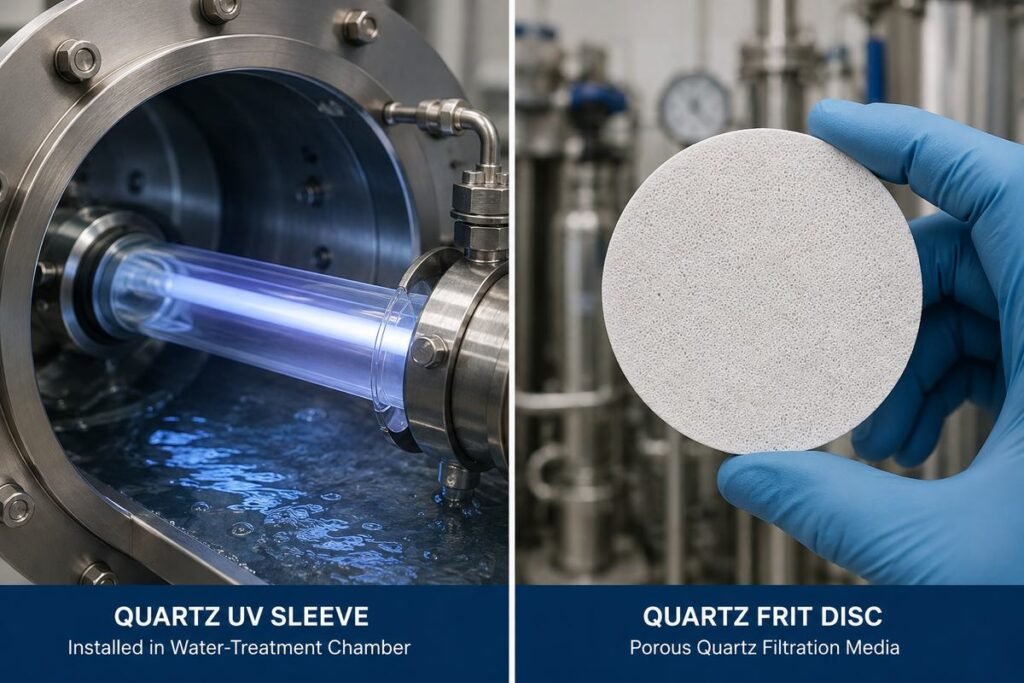
Quick answer: Quartz glass supports water treatment primarily through UV sterilization sleeves, which transmit UV light for disinfection while protecting the lamp from direct water contact, and through sintered quartz frits, used for particulate filtration, gas sparging, and flow distribution. Both applications rely on quartz's chemical resistance and, for UV sleeves, its UV transmission — properties that let quartz outperform standard glass and most plastics in these roles.

Quartz Components in Water Treatment at a Glance
| Component | Function | Key Property |
|---|---|---|
| UV sterilization sleeves | House the UV lamp, protect it from water contact while transmitting UV light | UV transmission, chemical resistance |
| Quartz frits | Filter particulates, distribute flow, support filter beds | Controlled porosity, chemical resistance |
| Sight glasses | Visual monitoring of process fluid or treatment stage | Chemical resistance, clarity |
| Sensor and probe protection | Sleeves shielding sensors from direct chemical exposure | Chemical resistance, thermal stability |
UV Disinfection: Why Quartz Sleeves Are Necessary
UV water disinfection works by exposing water to UV light at a wavelength that disrupts the DNA of bacteria and other microorganisms, deactivating them without chemical treatment. This only works if the UV light actually reaches the water — which is where quartz becomes essential.
The UV lamp itself typically can't be submerged directly in water, so it sits inside a sealed sleeve. That sleeve has to transmit UV light efficiently while protecting the lamp electrically and physically. Standard glass blocks most of the relevant UV wavelength range, and most plastics degrade under continuous UV exposure. Quartz glass solves both problems — see our what is quartz glass guide for the underlying transmission properties that make this possible.
Sleeve dimensions need to match the specific UV system design closely, since fit affects both UV dose delivery and lamp cooling. For general tube sizing and grading background, see our quartz glass tube buyer's guide.
Quartz Frits in Filtration and Process Water Systems
Quartz frits — sintered porous discs — serve a different function in water treatment: physically filtering particulates, distributing flow evenly across a bed or vessel cross-section, or supporting filter media in packed columns. Their chemical resistance makes them suitable for water treatment processes involving aggressive cleaning chemicals or extreme pH conditions that would degrade standard filter media over time.
Porosity grade selection is the key specification decision here — see our quartz frits & filtration guide for how porosity grading works and how to match grade to your particle size and flow requirements.
Sight Glasses and Process Monitoring
Water treatment and industrial process systems often need visual confirmation that a stage is functioning correctly — flow presence, clarity, or general process condition. Quartz sight glasses serve this role wherever the process involves chemicals or temperatures that would degrade standard glass over the system's service life, providing a durable, chemically stable viewing point without needing frequent replacement.
Choosing Grade and Purity for Water Treatment Applications
Most water treatment applications don't need the highest-purity synthetic quartz grades used in semiconductor or precision optical applications. Standard industrial-grade material, selected mainly for UV transmission (for sleeves) or appropriate porosity (for frits), typically covers the functional requirement without the added cost of ultra-high-purity synthetic material. See our JGS1 vs JGS2 vs JGS3 guide if your UV disinfection system's specific wavelength requires closer grade matching.
Frequently Asked Questions
Why can't UV lamps be submerged directly in water without a sleeve?
UV lamps generally aren't designed for direct water contact — a sealed sleeve protects the lamp electrically and physically while still allowing UV light to pass through to the water.
Can standard glass be used instead of quartz for UV disinfection sleeves?
No — standard glass blocks most of the UV wavelength range used for disinfection, making it ineffective for this application regardless of its other properties.
What porosity grade of quartz frit is used for water filtration?
This depends on the target particle size and flow rate requirement. See our quartz frits & filtration guide for how porosity grades correspond to different filtration needs.
Do water treatment applications need optical-grade or synthetic quartz?
Generally not — standard industrial-grade quartz is usually sufficient for UV sleeves and frits, since the requirement is UV transmission and chemical resistance rather than the extreme optical or purity performance needed in semiconductor or precision optics applications.
How often do quartz UV sleeves need to be replaced?
This depends on operating conditions, water chemistry, and any scaling or fouling that develops on the sleeve surface, which can reduce UV transmission over time even if the quartz itself remains structurally sound.
Specifying Quartz Components for Water Treatment Systems
Water treatment applications generally call for standard industrial-grade quartz matched to the specific functional requirement — UV transmission for sleeves, or the right porosity for frits — rather than premium optical or semiconductor-grade material. If you're specifying UV sleeves, frits, or sight glasses for a water treatment or filtration system, send us your dimensions and process requirements for a recommendation.


