
Quartz glass tubes are one of the most common forms this material comes in, and also one of the easiest to misspecify. Getting the wrong wall thickness, grade, or tolerance can mean a part that doesn't survive your process — or one that costs more than it needs to.
Related resources: quartz glass tubes and large-diameter and thick-wall quartz tubes.
This guide covers how quartz tubes are sized and graded, what "custom fabrication" actually includes, and how to specify a tube correctly the first time.
Quick answer: Quartz glass tubes are specified by outer diameter, wall thickness, and length, typically ranging from under 1 mm (capillary) up to several hundred millimeters OD. Grade selection depends on temperature, UV transmission, and purity requirements. Standard tubes can be cut, flared, tapered, drilled, and end-finished to a custom drawing.
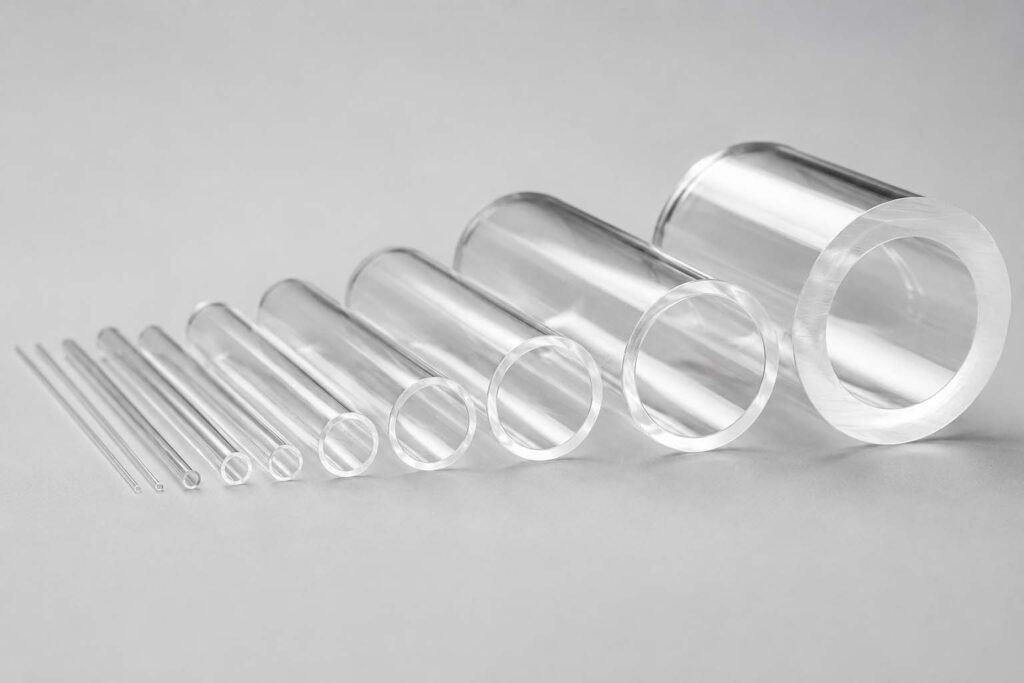
Quartz Tubes at a Glance
| Spec | Typical Range |
|---|---|
| Outer diameter (OD) | ~0.5 mm (capillary) to 400+ mm |
| Wall thickness | ~0.1 mm to 25 mm |
| Standard length | Up to 1,500–3,000 mm; longer on request |
| SiO₂ purity | 99.9% – 99.999%+ depending on grade |
| Continuous use temperature | Up to ~1100–1200°C |
| Common forms | Transparent, UV-grade, opaque, capillary |
Values above are general industry reference figures. Confirm exact specs with your supplier's data sheet.
For quartz glass properties and grading in general, see our guides on what quartz glass is and JGS1 vs JGS2 vs JGS3.
Types of Quartz Glass Tubes
Transparent (clear) tubes are the standard form, used wherever visual clarity or general optical transmission is needed — sight glasses, lighting, general lab tubing.
UV-grade tubes are selected specifically for their transmission below 300 nm, used in UV lamp jackets and sterilization sleeves. Grade selection here matters — see our guide on JGS1 vs JGS2 vs JGS3 for how UV performance varies by grade.
Opaque tubes are white and non-transparent, made with fine bubbles or crystalline inclusions. They diffuse heat more evenly and are common in semiconductor diffusion furnaces and thermal shielding.
Capillary tubes are a specialized, small-bore form — often under a few millimeters OD, with correspondingly thin walls and tight ID tolerances. They're used in analytical instruments, chromatography, and micro-scale fluid or gas handling.
How Tube Sizes Are Specified
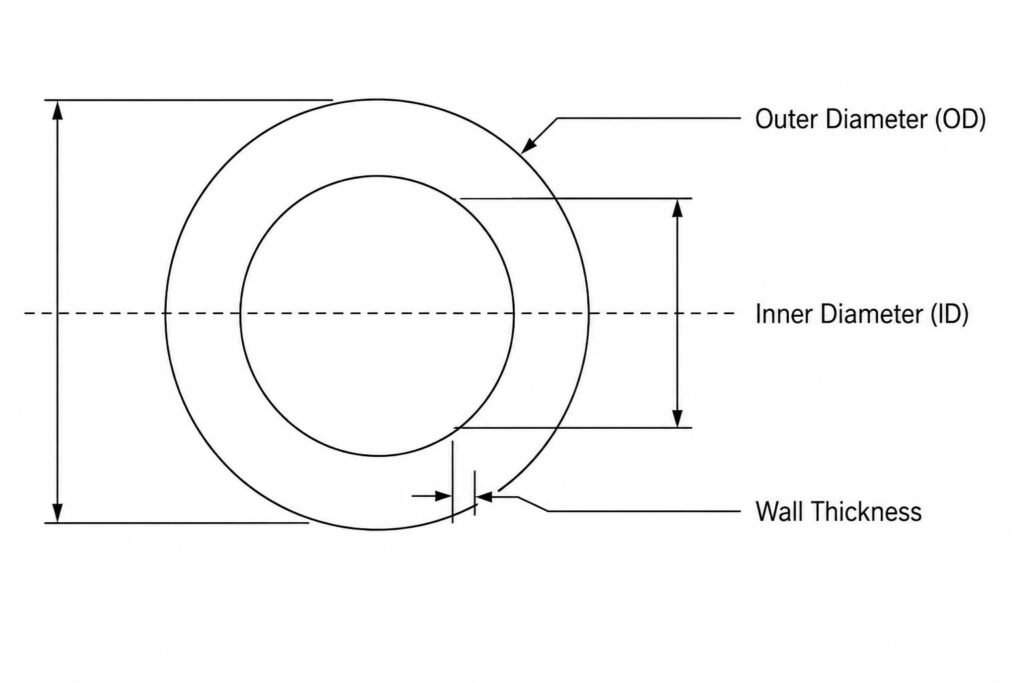
A complete quartz tube specification needs four numbers: outer diameter (OD), inner diameter (ID) or wall thickness, length, and tolerance on each. OD and wall thickness are usually the primary drivers of both cost and lead time — thinner walls and tighter tolerances cost more to hold consistently, especially at larger diameters.
Standard tube stock is produced in common OD and wall-thickness combinations. If your application falls outside standard sizing, custom draw runs are possible but typically require a minimum order quantity and longer lead time than stock sizes.
Choosing the Right Grade
Grade selection comes down to three questions, in this order:
- What's the maximum operating temperature?
This determines whether standard industrial-grade material is sufficient or whether a higher-purity grade is needed to avoid devitrification risk at the top of your range. - Does the application need UV transmission?
If yes, grade selection needs to account for OH content and wavelength — see JGS1 vs JGS2 vs JGS3 for the full breakdown. - Does the application require ultra-low metal contamination?
Semiconductor and high-purity chemical applications usually call for synthetic material — see our guide on natural vs synthetic quartz glass.
For general industrial furnace tubes and sight glasses, natural fused quartz at standard purity is usually sufficient and more cost-effective than a premium synthetic grade.
Custom Fabrication Options
Standard tube stock is a starting point, not a finished part. Common finishing operations include:
- Cutting to length, with fire-polished or ground ends
- Flaring or necking one end to a different diameter
- Tapering for transitions between sizes
- Drilling side ports or feedthroughs
- Grinding and polishing ends for sealing surfaces
- Bending into elbows or custom shapes, within limits set by wall thickness and diameter
For a full walkthrough of how quartz glass is processed from raw stock into a finished part, see our guide on how quartz glass is made.
Common Applications
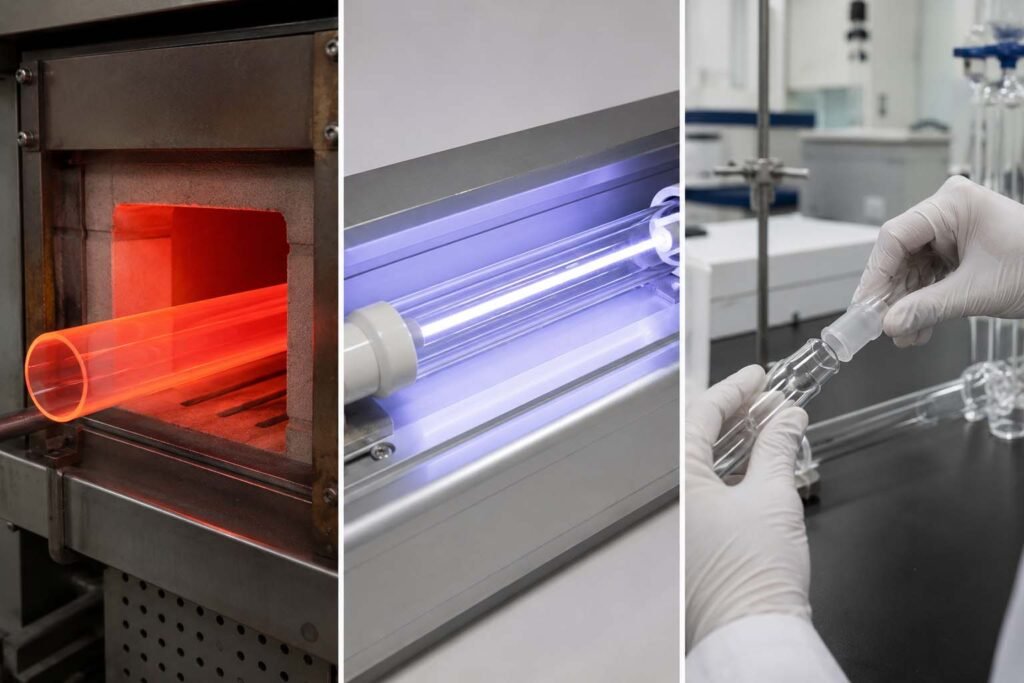
Furnace and process tubes — used in heat-treatment furnaces, tube furnaces, and CVD systems, chosen for their high-temperature stability and thermal shock resistance.
Sight glasses and viewports — used where operators need to visually monitor a process at elevated temperature or pressure.
Lighting — UV lamp jackets, halogen lamp envelopes, and infrared heater tubes rely on quartz for its combination of heat tolerance and optical transmission.
Laboratory tubing — general-purpose tubing for gas and liquid handling in chemically demanding or high-temperature test setups.
Semiconductor processing — high-purity tubes used in diffusion furnaces and wafer processing equipment, where contamination control is critical.
Frequently Asked Questions
What's the smallest quartz tube diameter available?
Capillary tubing can go well under 1 mm OD, though minimum practical size depends on wall thickness and the supplier's drawing capability.
Can quartz tubes be bent or shaped after production?
Yes, within limits. Bending is typically done with a torch while the material is hot enough to form, and is more practical on thinner-wall tubing than heavy-wall stock.
What tolerance can I expect on OD and wall thickness?
This varies by size and supplier, and tighter tolerances generally cost more, especially at larger diameters or thinner walls. Confirm achievable tolerance for your specific size before finalizing a drawing.
Do I need a custom draw run, or will standard stock work?
Check standard size charts first — most applications fit an existing standard OD/wall combination. Custom draws are reserved for sizes outside the standard range.
What grade of quartz tube do I need for a UV lamp application?
This depends on your exact wavelength. See our guide on JGS1 vs JGS2 vs JGS3 to match grade to wavelength range.
Can opaque and transparent quartz tubes be used interchangeably?
Not usually. Opaque tube is chosen specifically for its heat distribution and shielding properties, while transparent tube is chosen for visibility or optical transmission — the two serve different functional purposes even at the same size.
Getting the Right Tube for Your Application
Most tube specification problems come down to skipping one of the three grade questions above, or assuming standard stock will work without checking actual size availability. If you're not sure which size, grade, or finishing options fit your project, send us your dimensions, temperature range, and application details for a quick recommendation.


