
Flat quartz glass — plates, windows, and blanks — looks like the simplest form the material comes in, but it's also where specification mistakes get expensive. Flatness, parallelism, and surface finish requirements vary enormously depending on whether a part is a rough protective window or a precision optical component, and pricing follows that difference closely.
Related resources: quartz plates and sheets and custom quartz windows.
This guide covers how flat quartz glass is specified, what the key surface quality terms actually mean, and how to avoid over- or under-specifying a part.
Quick answer: Flat quartz glass is specified by dimensions, thickness, flatness (measured in fringes or wavelengths), parallelism, and surface quality (scratch-dig rating). Standard commercial-grade plates use looser tolerances and cost less; precision optical windows require tight flatness and polished surfaces and cost significantly more. Since fused silica is typically supplied in blocks rather than stock sheet, most thicknesses are cut and finished to order.
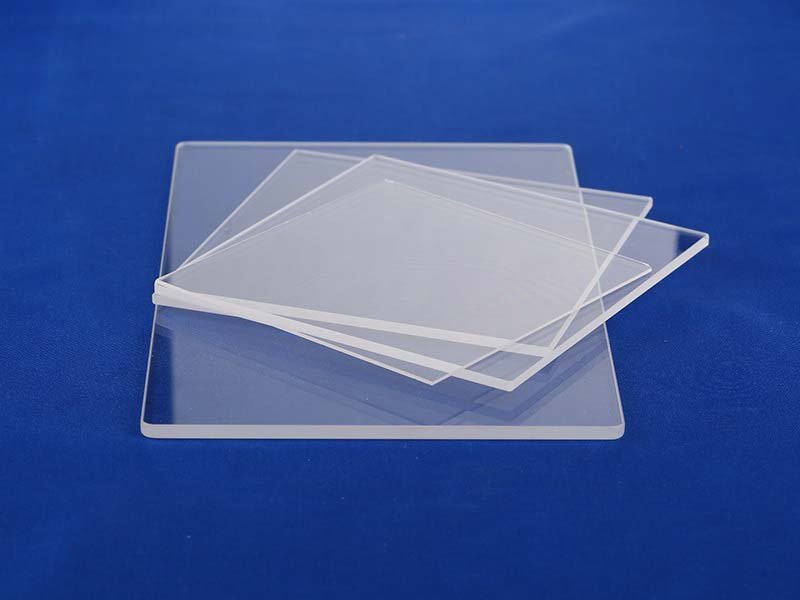
Flat Quartz Glass at a Glance
| Spec | Typical Range |
|---|---|
| Standard dimensions | ~1 mm × 1 mm up to 500+ mm square, larger on request |
| Thickness | ~0.1 mm to 50 mm |
| Dimension tolerance | ±0.01 mm to ±0.1 mm depending on grade |
| Flatness | 1–5 fringes per 25×25 mm for precision optical grade |
| Surface quality (scratch-dig) | Commercial: 60/40; Precision optical: down to 10/5 or better |
| Edge finish | Fine ground standard; polished on request |
Values above are general industry reference figures. Confirm exact specs with your supplier's data sheet.
For quartz glass properties and grading in general, see our guides on what quartz glass is and JGS1 vs JGS2 vs JGS3.
Plates, Windows, and Blanks — What's the Difference?
These three terms overlap, but generally describe different points in the finishing process:
- Blanks are cut-to-size pieces before final surface finishing — the starting point for a custom part.
- Plates typically refer to flat stock finished to a commercial or general-purpose surface quality, suitable for structural, protective, or general viewing use.
- Windows usually implies optical-grade finishing — tighter flatness, parallelism, and surface quality — because the part is expected to transmit light without distorting it.
The distinction matters because pricing and lead time scale with finishing requirements, not just size. A "blank" ordered as a rough-cut piece costs far less than the same dimensions finished to window-grade flatness and polish.
Understanding Flatness and Parallelism
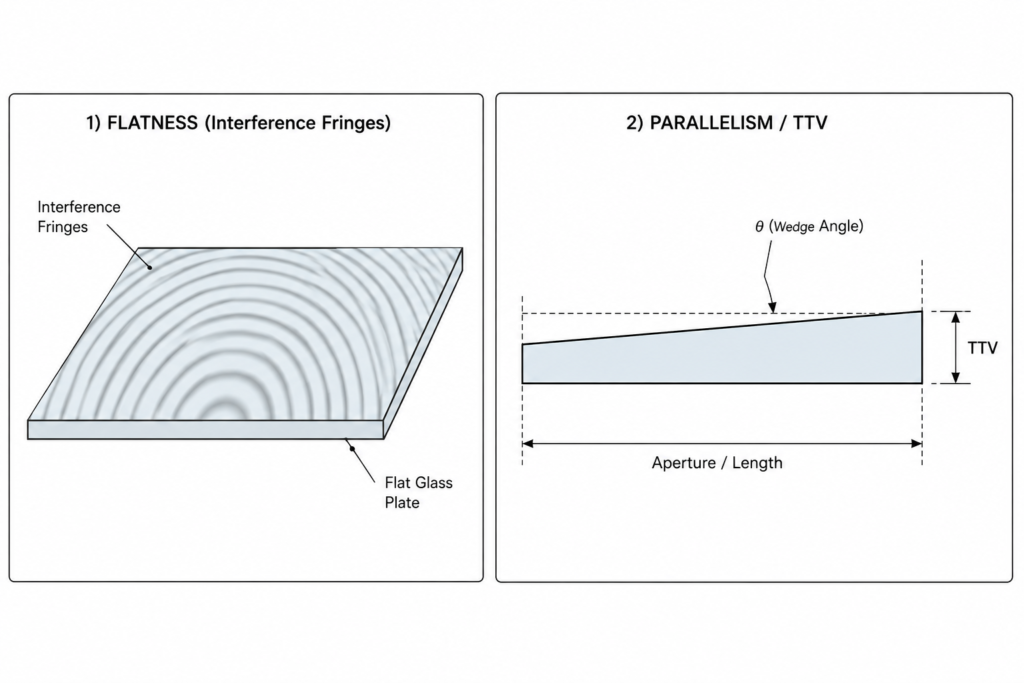
Flatness describes how much a surface deviates from a perfectly flat plane, typically measured in fringes using an optical interferometer — each fringe represents a specific fraction of a wavelength of light. Fewer fringes means a flatter surface. Commercial-grade plate might show several fringes across a given area; precision optical windows can be held to a fraction of a single fringe.
Parallelism (or total thickness variation, TTV) describes how consistent the thickness is across the part — whether the two faces are truly parallel or slightly wedge-shaped. This matters most in optical applications where a wedge would deflect a light path unintentionally, and less in general protective or structural windows.
If your application doesn't involve precision optics — a viewport, a protective cover, a general sight window — commercial-grade flatness is almost always sufficient, and specifying tighter flatness than needed adds cost without adding function.
Understanding Surface Quality (Scratch-Dig)
Surface quality is commonly rated using a scratch-dig number (for example, 60/40 or 10/5), where the first number relates to scratch severity and the second to the size of surface digs or pits. Lower numbers mean a cleaner, more defect-free surface.
Commercial and general industrial plate typically ships at a coarser scratch-dig rating, which is fine for applications where light scatter and cosmetic appearance don't affect function. Precision optical windows — especially for laser or imaging applications — need much tighter scratch-dig ratings, since surface defects can scatter light or create localized stress points.
How Thickness Is Specified
Because fused silica typically starts as a boule or block rather than stock sheet, most thicknesses are cut and ground to order rather than pulled from a fixed inventory of standard sheet thicknesses. Some suppliers maintain common stock thicknesses for faster turnaround, but a non-standard thickness usually just means a custom cut rather than a fundamentally different process.
Thinner plates (under roughly 1 mm) require more careful handling during grinding and polishing and may carry tighter minimum order quantities or longer lead times than mid-range thicknesses.
Shapes Beyond Flat Windows
Flat quartz stock isn't limited to simple flat plates. Common variations include:
- Wedge windows, with a slight intentional angle between faces, used to prevent unwanted reflections from creating interference patterns
- Convex and concave windows, which introduce mild optical power rather than staying perfectly flat
- Custom shapes, including rectangles, discs with flats, and complex outlines cut to a drawing
Common Applications
Protective and viewing windows — sight windows for furnaces, process equipment, and enclosures where visibility and durability matter more than optical precision.
Precision optics — laser windows, imaging system components, and beam-path windows where flatness and surface quality directly affect performance.
Semiconductor and wafer-related components — flat quartz blanks used as substrates, spacers, or process fixtures.
Microscopy — thin quartz slides and coverslips for applications where standard glass would absorb too much UV light.
Frequently Asked Questions
What's the difference between a quartz "blank" and a finished "window"? A blank is typically cut to size but not yet finished to precision flatness and surface quality; a window implies that finishing has been completed to optical-grade standards.
Do I need tight flatness for a general viewport application? Usually not. Commercial-grade flatness is normally sufficient unless the window is part of a precision optical path — specifying tighter flatness than needed adds cost without functional benefit.
How thin can quartz plates be made? Plates can be produced well under 1 mm thick, though very thin plates require more careful handling and may have longer lead times or higher per-unit cost.
What does a scratch-dig rating like 60/40 actually mean? It's a two-number surface quality specification — lower numbers indicate a cleaner surface with fewer or smaller scratches and digs, generally required for precision optical applications rather than general protective windows.
Can flat quartz glass be cut into custom shapes, not just squares and circles? Yes, custom outlines are possible, machined or cut to a drawing, though complex shapes with sharp internal corners carry the same brittleness considerations as any other machined quartz part.
Specifying Flat Quartz Glass Correctly
The fastest way to avoid overpaying is to match flatness and surface quality specs to what your application actually needs, rather than defaulting to precision-optical specs out of caution. If you're not sure what level of finishing your part requires, send us your dimensions, thickness, and intended use, and we can recommend the right spec.


