
Quartz wafer boats, carriers, holders and cleaning baskets can look similar in a catalog, but they solve different process problems. A furnace boat prioritizes repeatable slot position at temperature. A transfer carrier prioritizes stable handling and automation interfaces. A wet-process basket must also drain, rinse and avoid trapping chemistry.
Choosing the correct family starts with the process step and the wafer-contact philosophy. Geometry follows from wafer diameter, capacity, pitch, orientation, robot interface and the zones that may touch the wafer.
Quick answer: Use a quartz wafer boat for controlled wafer spacing in diffusion, oxidation, annealing or deposition; a carrier or holder for transport, staging or equipment interfacing; and a cleaning basket where liquid access, drainage and rinse behaviour are primary. Custom assemblies often combine these functions, so state the process rather than relying on a name.
Key Takeaways
- Define wafer diameter, thickness range, capacity, pitch and orientation before selecting a geometry.
- Map every permitted contact zone; slot width alone does not define safe support.
- Hot-process parts need dimensional stability, cleanliness and a thermal-cycle plan.
- Wet baskets need open flow paths, drainage and chemistry-compatible cleaning requirements.
- Robot or cassette interfaces should be specified from datums and tested with representative wafers.
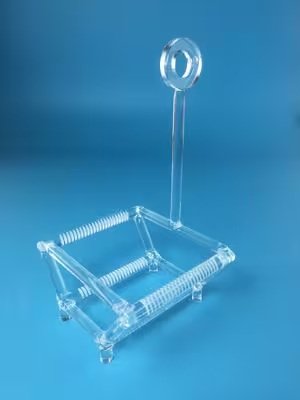
Boat, Carrier, Holder or Basket?
Names vary between fabs and suppliers, so the assembly function should appear in the drawing title or RFQ. A “boat” usually holds multiple wafers at controlled pitch through a thermal process. A carrier may move wafers between stations or locate them inside a tool. A holder may support one wafer or a small set at defined contact points. A basket is usually optimized for immersion, spray, rinse and lift-out.
The categories overlap. A vertical process carrier can still be called a boat, and a wet cassette can be called a carrier. Procurement becomes clearer when the specification states temperature, atmosphere or chemistry, loading direction and handling method next to the name.
| Component | Primary job | Geometry that usually matters most | Typical process risk |
|---|---|---|---|
| Wafer boat | Hold a batch at controlled pitch in a hot zone | Slot pitch, slot profile, rail spacing and straightness | Distortion, particle generation or uneven contact |
| Carrier | Move or stage wafers between interfaces | Datums, handles, feet and automation envelope | Misalignment or unstable transfer |
| Holder | Locate a wafer or small group | Contact points, seating plane and orientation | Edge damage or optical/process shadowing |
| Cleaning basket | Expose wafers to liquid and allow drainage | Open area, flow direction and lift-out angle | Trapped chemistry, poor rinse or wafer movement |
Start With the Process, Then Freeze the Geometry
A robust selection sequence starts with environment: temperature, atmosphere, chemical exposure and number of cycles. Next define wafer data and batch capacity. Then lock the process orientation and contact zones before adding handling features. Reversing that order often produces a beautiful carrier that interferes with the process or cannot be cleaned.
For semiconductor and photovoltaic applications, review the complete semiconductor quartz handling collection. Use the individual product pages when the process family is already clear.
Slot Geometry and Wafer Contact
Slot pitch controls capacity and process spacing, but the slot profile controls how the wafer is supported. Specify slot width as a range that covers wafer thickness, dimensional tolerance, thermal movement and loading clearance. Define groove depth and root radius so the edge seats consistently without wedging into a sharp corner.
Contact should be sufficient for stable handling but no larger than necessary. Mark frontside/backside restrictions, bevel or notch sensitivity and any exclusion zone near active surfaces. For custom quartz wafer boats, rail spacing and slot phase between rails are as important as the individual groove dimensions.
| Feature | Specify | Inspection question |
|---|---|---|
| Pitch | Nominal, tolerance and accumulated limit | Does the last slot remain within position? |
| Slot width | Minimum/maximum and measurement depth | Can every wafer load without excessive play? |
| Slot depth/profile | Depth, included angle and root radius | Where does the wafer actually contact? |
| Rail spacing | Datum-to-datum distance and parallelism | Are both edges supported at the same height? |
| End slots | Usable or process keep-out | Are loading tools clear of the frame? |
Hot-Zone Capability: Boats and Process Carriers
Thermal-process assemblies are built around long rods, rails, end plates and welded joints. Fabrication must maintain pitch and alignment through joining and annealing. Large temperature cycles make abrupt thickness changes and highly restrained welds undesirable, while a long unsupported span may sag even when the material itself remains chemically stable.
Common manufacturing operations include precision rod selection, slot grinding, drilling, jigged assembly, quartz welding, annealing, dimensional inspection and high-purity cleaning. The practical tolerances are linked: an aggressive slot-position tolerance can be meaningless if rail bow or assembled twist is left uncontrolled.
- Specify overall straightness and twist over the controlled length.
- Identify furnace support locations and the hot-zone envelope.
- Define whether dimensions apply before or after final annealing/cleaning.
- Use radiused transitions and balanced joints where the process allows.
- Agree which accumulated pitch or wafer-plane measurements are reported.
Wet-Process Capability: Cleaning Baskets
A quartz wafer cleaning basket should let chemistry reach the required surfaces and leave the assembly during withdrawal. Crossbars, handles and feet can create stagnant zones, retain droplets or interfere with spray patterns. Review the basket in the actual tank orientation, not only as an isolated CAD model.
Drain holes and open frames improve liquid exchange but also create more edges and welded features. Specify acceptable surface finish, post-fabrication cleaning and packaging. If ultrasonic cleaning is used, state frequency and power conditions so delicate spans and wafer movement can be considered.
Carriers, Holders and Automation Interfaces
For quartz wafer carriers and holders, the outside interface can be more critical than the internal slots. Define the pickup location, center of gravity, locating feet, permitted rotation and insertion path. A robot-safe envelope should include tolerance, not only nominal CAD geometry.
Choose primary, secondary and tertiary datums that match how the tool locates the part. Inspection from cosmetic outer surfaces can produce measurements that do not predict equipment fit. If a carrier replaces an existing part, a sample plus a tool-interface drawing is more useful than a sample alone.
What to Specify for a Custom Assembly
A focused specification should describe the process and critical interfaces before listing general tolerances. Separate must-meet dimensions from reference dimensions and identify the features that may be adjusted for manufacturability.
- Wafer diameter, thickness range, edge/notch details and capacity
- Horizontal or vertical orientation, pitch and loading direction
- Allowed contact zones and prohibited active-surface zones
- Temperature/atmosphere or chemical/rinse process conditions
- Furnace, tank, robot and storage interfaces with datums
- Cleanliness, packaging, inspection report and sample-approval needs
Frequently Asked Questions
Is a quartz wafer boat the same as a wafer carrier?
Sometimes the names are used interchangeably, but a boat usually emphasizes batch spacing through a process while a carrier emphasizes handling or equipment interface. Define the function on the drawing.
How should wafer slot pitch be toleranced?
Specify nominal pitch, local pitch tolerance and—where it affects the tool—an accumulated position limit from a stated datum. One tolerance alone may not control the last slot.
Why use quartz instead of a polymer cassette?
Quartz is selected for high-temperature, purity and chemical environments where many polymers are unsuitable. For room-temperature transfer, polymer or other materials may be more economical.
Can one carrier work for both furnace and wet cleaning?
It can be designed, but competing needs such as thermal stability, drainage, handling and joint geometry must be evaluated. Separate fixtures are often easier to optimize.
What is the most important prototype check?
Use representative wafers and the actual loading/tool interface to verify contact, pitch, stability and clearance before committing to a production batch.
Related Quartz Glass Resources
- Custom Quartz Wafer Boats
- Quartz Wafer Carriers and Holders
- Quartz Wafer Cleaning Baskets
- Quartz Components for Semiconductor and Solar Manufacturing
Technical References
Match the Quartz Assembly to the Process Step
Send the wafer data, process conditions, capacity, contact restrictions and equipment interface. We can review a new drawing or reverse-engineer a replacement from a sample plus critical measurements.


