
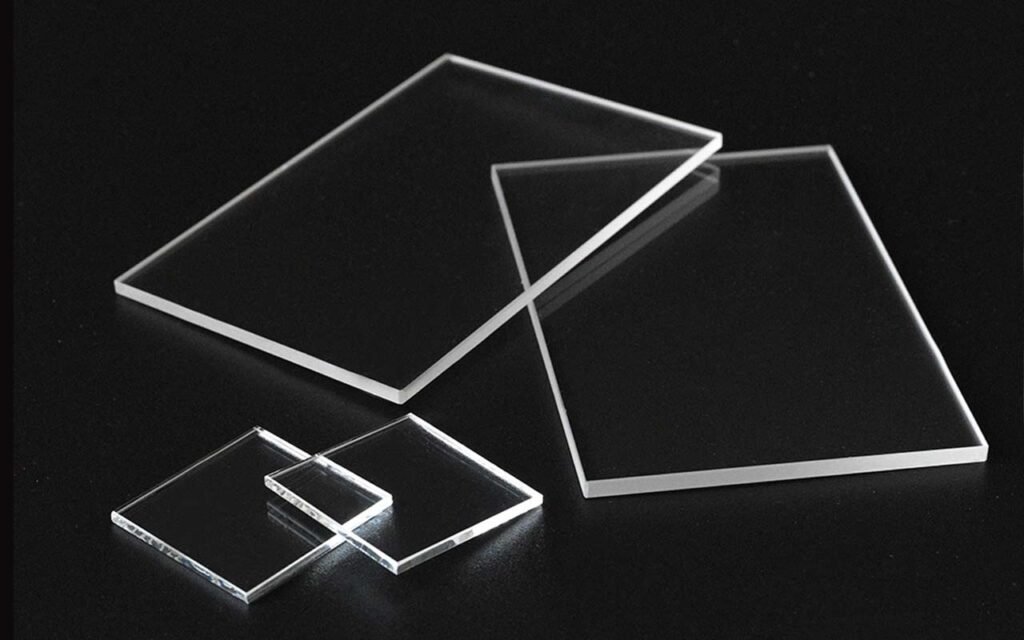
JGS1, JGS2 and JGS3 are useful purchasing categories for optical quartz glass, but the label alone does not define a finished optical component. The working wavelength and thickness must be stated because transmission changes with both material route and optical path length.
Choose the Grade by Working Wavelength
JGS1 — Far-UV Direction
Use JGS1 as the starting category when transmission below about 220 nm matters. It is commonly associated with synthetic fused silica and a higher hydroxyl content. Deep-UV work should specify transmission at the exact wavelength and finished thickness.
JGS2 — UV-Visible Direction
JGS2 is widely used for general UV-visible windows, instruments and laboratory optics. It is not a substitute for a transmission curve where a narrow UV cutoff or an OH absorption band is critical.
JGS3 — Near-IR Direction
JGS3 is selected for visible-to-near-IR use and typically follows a low-OH material route. For IR systems, define the actual operating bands and allowable absorption rather than relying only on the 260–3500 nm category.
Visible-Light Components
All three categories can cover much of the visible range. In visible-only systems, select by homogeneity, bubbles, striae, stress, cost and availability instead of assuming the highest UV grade is automatically best.
The JGS Name Does Not Define Optical Quality
The underlying classification also recognizes spectral, homogeneity, birefringence, striae, granular inhomogeneity, bubble and fluorescence levels. A commercial supplier may use the JGS label more loosely, so the RFQ should identify the measurable properties that matter to the finished part.
Minimum Purchase Specification
- JGS category and raw material supplier
- Operating wavelength or spectral band
- Minimum internal transmission at thickness
- Finished thickness and clear aperture
- Bubble and inclusion acceptance
- Striae and refractive-index homogeneity
- Stress birefringence limit
- Surface quality and flatness
- Parallelism, wedge or angular tolerance
- Edge treatment and coating requirement
Finished Components and Fabrication
JGS materials can be cut, ground, drilled, CNC-machined and polished into windows, discs, plates, wafers, cells, tubes and custom optical parts. Material selection should be completed before final polishing because the clear aperture, orientation and inspection plan may depend on the parent blank.
For replacement optics, send the old drawing together with the operating wavelength and actual failure mode. This helps distinguish a material problem from coating damage, thermal stress, contamination or an incorrect mounting condition.
Data Qualification
The wavelength bands shown above follow the JC 185-81 category definitions. Actual cutoff, transmission, hydroxyl content and optical quality remain grade-, thickness- and lot-dependent. The approved drawing, sample data and supplier certificate take precedence.
Send the working wavelength, component thickness, drawing and required optical performance.
Request Grade Selection Support
Grade-Qualified Material Purity
Electric-fused / flame-fused quartz: SiO₂ ≥99.99%; synthetic JGS1-grade fused silica: ≥99.999%. Grade and lot certificate govern supplied material.
Material Route, OH Content and Working Band
| Material route | Grade | Applicable band | OH content | Typical use |
|---|---|---|---|---|
| Synthetic hydrolysis-fused silica | JGS1 | 185–2500 nm | ≈1000 ppm | Deep-UV optics and lithography |
| Flame-fused natural quartz | JGS2 | 220–2500 nm | 120–260 ppm | UV-visible windows and instruments |
| Vacuum-fused quartz | Grade-specific | UV–near IR; confirm grade | <3 ppm | Semiconductor and lamp components |
| Vacuum-fused low-OH quartz | JGS3 | 260–3500 nm grade classification | ≤10 ppm | IR observation and low-OH components |
| Electric-fused continuously drawn quartz | Grade-specific | UV cut-off depends on grade | 5–150 ppm; heat-treatment dependent | Lamps, heaters and optical-fiber support parts |
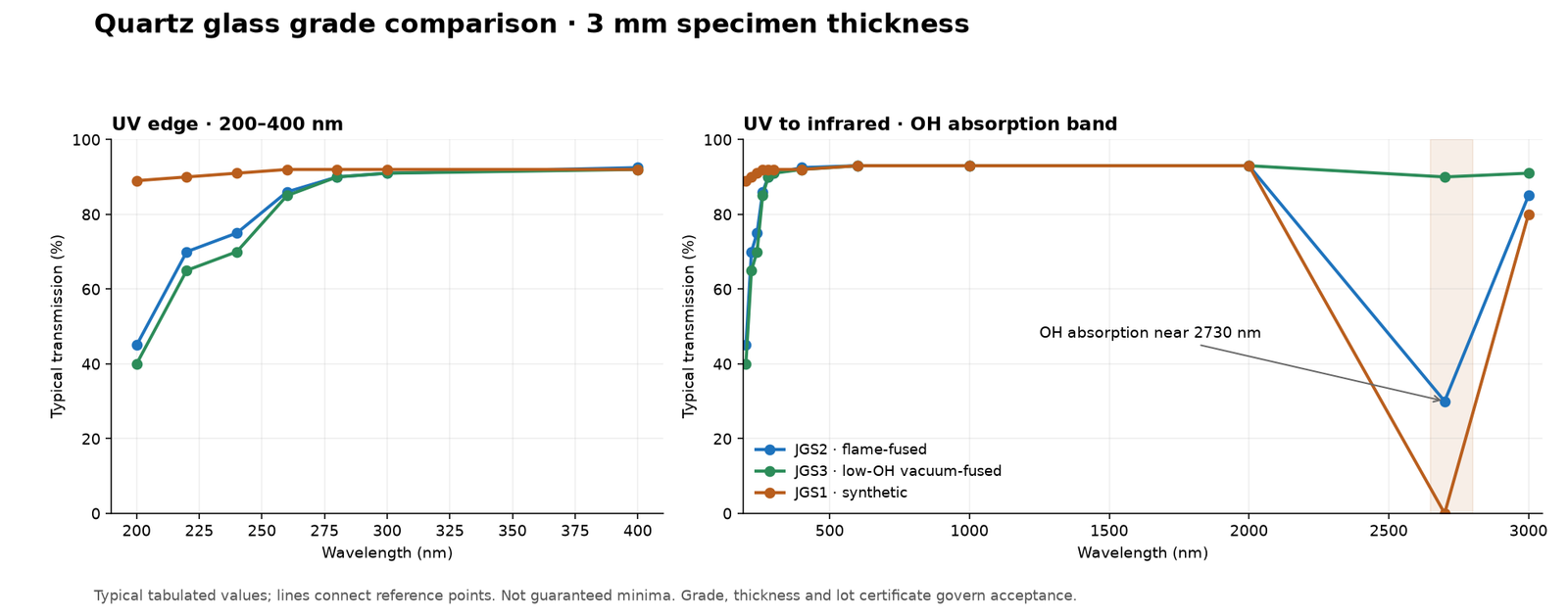
OH content is grade- and batch-dependent; the lot certificate governs acceptance. UV-end transmission is influenced by metallic impurities. The absorption peak near 2730 nm is governed by OH, which is why JGS1 deep-UV material and JGS3 low-OH IR material behave differently.
Typical Physical Properties
| Property | Transparent quartz glass | Opaque quartz glass |
|---|---|---|
| Density | 2.2 × 10³ kg/m³ | 1.92–1.95 × 10³ kg/m³ |
| Hardness | 570–585 KHN100 | — |
| Tensile strength | 4.8–5.0 × 10⁷ Pa | — |
| Compressive strength | >1.1 × 10⁹ Pa | >1.0 × 10⁹ Pa |
| Linear expansion coefficient | 5.5 × 10⁻⁷ /°C | 5.4 × 10⁻⁷ /°C |
| Thermal conductivity | 1.4 W/(m·°C) | — |
| Specific heat | 660–680 J/(kg·°C) | 640–650 J/(kg·°C) |
| Softening point | 1630–1700 °C | 1580–1600 °C |
| Annealing point | 1180–1220 °C | 1050–1100 °C |
| General continuous service guideline | ≤1100 °C | ≤1000 °C |
Typical properties are reference data, not allowable assembly stresses. Transparent material short-term excursions may reach 1200 °C; sustained use follows the lower continuous-service guideline. Annealing and softening temperatures are material properties, not service ratings.
Typical Transmission · 3 mm Thickness
| Grade | 200 nm | 220 nm | 240 nm | 260 nm | 280 nm | 300 nm | 400 nm | 600 nm | 1000 nm | 2000 nm | 2700 nm | 3000 nm |
|---|---|---|---|---|---|---|---|---|---|---|---|---|
| JGS2 · flame-fused | 45 | 70 | 75 | 86 | 90 | 91 | 92.5 | 93 | 93 | 93 | 30 | 85 |
| JGS3 · low-OH vacuum-fused | 40 | 65 | 70 | 85 | 90 | 91 | 92 | 93 | 93 | 93 | 90 | 91 |
| JGS1 · synthetic | 89 | 90 | 91 | 92 | 92 | 92 | 92 | 93 | 93 | 93 | 0 | 80 |
All entries are transmission %. These are typical 3 mm specimen data, not guaranteed minima or values for all thicknesses. The 2700 nm tabulated point is near the 2730 nm OH band: JGS1 is approximately 0%, while low-OH JGS3 is approximately 90%. Specify wavelength, path length, surface finish and minimum transmission for the delivered part.


