
Not every quartz glass part starts as a standard tube, rod, or plate. Rings, flanges, sleeves, gaskets, nozzles, and other precision components are machined to a drawing, built from raw stock into a specific shape and tolerance. Knowing what's realistic to machine — and what isn't — helps before you finalize a design.
Related resources: machined quartz plates and custom quartz flanges.
This guide covers the common types of custom-machined quartz components, how the process works, and where the practical limits are.
Quick answer: Custom quartz components are typically machined from standard tube, rod, or plate stock using cutting, CNC machining, grinding, drilling, and polishing. Common part types include rings, flanges, sleeves, gaskets, nozzles, balls, and sample holders. Because quartz is brittle, designs need to avoid sharp internal corners, minimum wall thicknesses, and features that create high stress concentration.
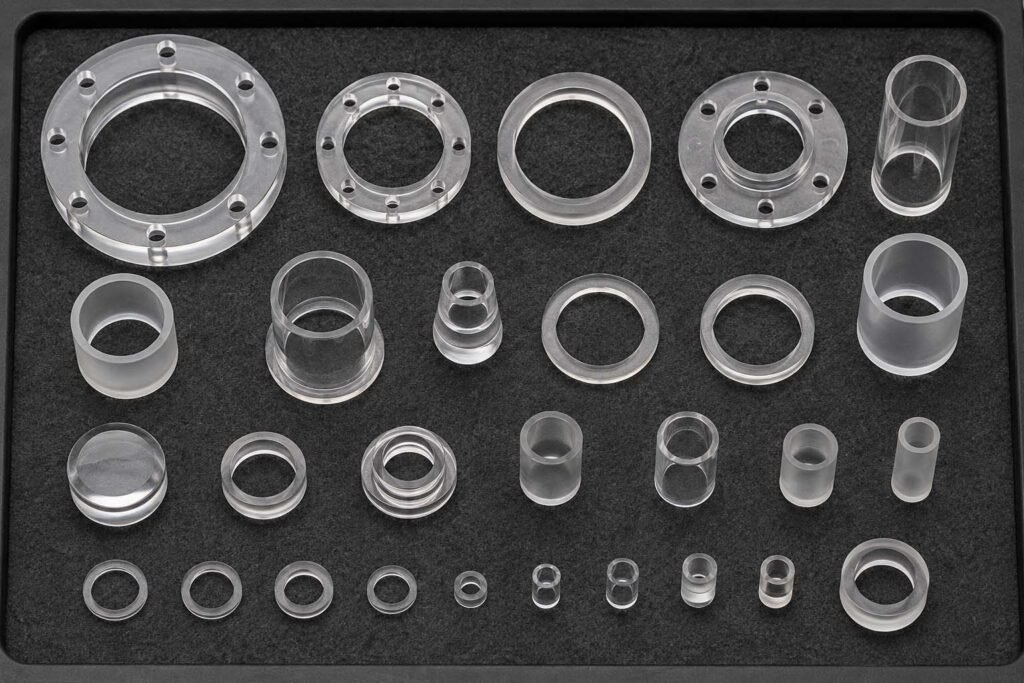
Common Custom Quartz Component Types
| Component | Typical Function |
|---|---|
| Rings | Spacers, seals, or structural separators in process equipment |
| Flanges | Mounting or sealing interfaces between chamber sections |
| Sleeves & sheaths | Protective covers for heating elements, thermocouples, or sensors |
| Gaskets | Sealing surfaces between quartz or mixed-material joints |
| Nozzles | Directed gas or fluid flow in process equipment |
| Balls & spheres | Valve components, bearings, or reference geometry |
| XRD sample holders | Sample staging for X-ray diffraction analysis |
| Brackets, supports & holders | Mounting and positioning for other components |
For how raw quartz stock is produced before machining, see our guide on how quartz glass is made.
What "Custom Machined" Actually Means
Almost every non-standard quartz part starts as tube, rod, or plate stock — see our guide on quartz rods vs. tubes for how those raw forms differ. From there, a combination of processing steps brings the part to its final shape:
- Cutting to rough dimensions
- CNC machining for precise geometry and features
- Grinding to reach final dimensional tolerance
- Drilling for holes, ports, or through-features
- Polishing for sealing surfaces or optical-quality finish
- Edge processing to chamfer or round edges, reducing chip and crack risk
The complexity and cost of a part depend heavily on how many of these steps it needs and how tight the tolerances are, not just its raw size.
Component Types in Detail
Rings are typically cut from tube stock and ground to precise height and flatness, used as spacers or separators in furnace and chamber assemblies.
Flanges need flat, often polished sealing faces and precise bolt-hole or port patterns, machined to mate with metal or other quartz components in a process chamber.
Sleeves and sheaths protect thermocouples, heating elements, or sensors from direct process exposure while allowing heat or signal transfer — wall thickness and closed-end geometry are the key design variables.
Gaskets made from quartz are less common than elastomer gaskets but are used where chemical or thermal resistance rules out other materials, typically requiring very flat, well-polished sealing surfaces.
Nozzles direct gas or fluid flow and often combine an external profile with a precisely sized internal bore, which usually means starting from tube stock and machining both surfaces.
Balls and spheres are ground and polished to tight roundness tolerance, used in valve components or as reference geometry in some measurement applications.
XRD sample holders need flat, low-background sample surfaces and precise dimensional consistency to avoid interfering with diffraction measurements.
Brackets, supports, and holders are typically the most freely shaped of this group, machined from rod or plate stock to mount or position other components within an assembly.
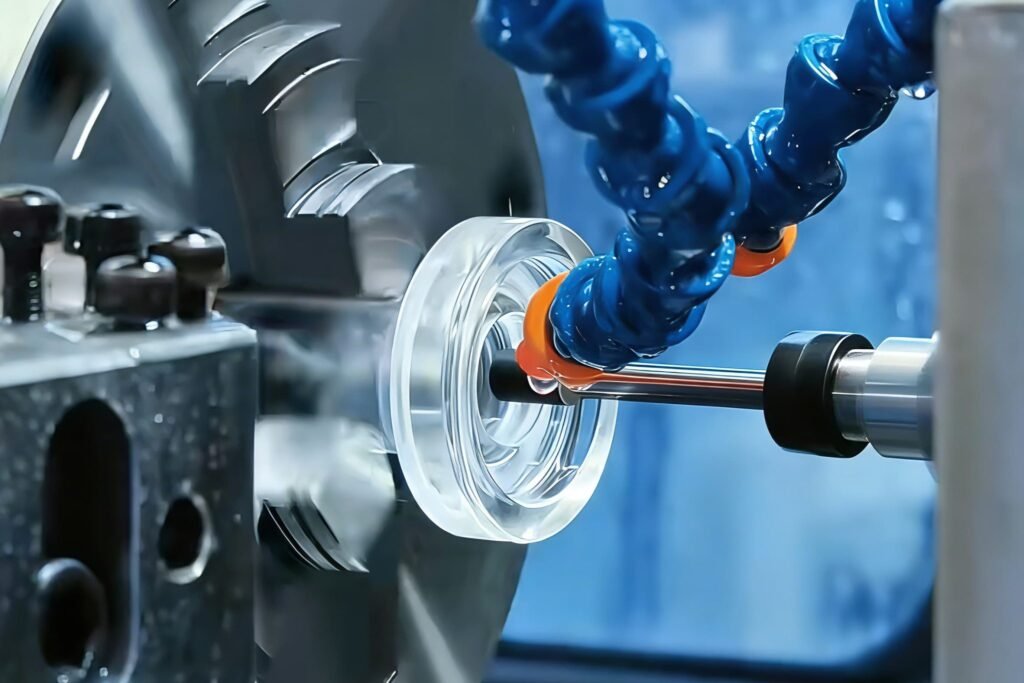
Design Considerations for Machined Quartz Parts
Quartz glass is hard and chemically stable, but mechanically brittle — that combination shapes what's practical to machine:
Avoid sharp internal corners. These concentrate stress and are common crack-initiation points. Internal corners should be radiused wherever the design allows.
Respect minimum wall thickness. Thin walls are achievable but become increasingly fragile and harder to hold tolerance on as size increases. What's realistic depends on the part's overall diameter and geometry.
Chamfer or round exposed edges. Sharp edges chip easily during handling and assembly. Edge treatment is cheap insurance against damage later.
Plan for thermal expansion in assemblies. Where quartz parts mate with metal or other materials, mounting design should allow for the significant difference in thermal expansion rather than clamping rigidly.
Our guide on what quartz glass is covers brittleness and thermal expansion in more general detail.
What's Hard or Impossible to Do
Extremely thin walls at large diameter. A thin wall might be fine on a small part but becomes structurally unreliable as diameter increases, since more surface area means more opportunity for a flaw to propagate.
Sharp 90° internal corners. These can sometimes be produced but carry meaningfully higher failure risk and are usually flagged for redesign during quoting.
Very tight tolerances at low cost on large parts. Tolerance, size, and cost trade off against each other — extremely tight tolerance on a large part is possible but adds significant processing time and cost.
Large single-piece parts without seams, beyond standard stock size limits. If a design exceeds the maximum practical size for tube, rod, or plate stock, it may need to be built from multiple pieces rather than machined as one.
Frequently Asked Questions
What information do I need to provide for a custom quartz part quote?
A dimensioned drawing, material grade requirement, tolerance callouts, and surface finish requirements are the minimum needed for an accurate quote.
Can quartz components be made to match metal part tolerances?
Often yes, though very tight tolerances cost more to hold in quartz than in most metals, given the material's hardness and brittleness.
Is there a minimum order quantity for custom quartz parts?
This varies by part complexity and supplier, but prototype and small-batch orders are generally possible, often at a higher per-part cost than volume production.
Can quartz parts be bonded or joined to each other?
Yes, through glass-to-glass fusion welding for permanent joints, or through mechanical fastening with appropriate gaskets and expansion allowance for assemblies that need to be separated.
How long does custom quartz machining typically take?
Lead time depends on part complexity, grade, and current order volume — simple parts from stock material are typically faster than parts requiring custom draw runs or extensive machining.
Getting Your Design Machined
Most design problems with custom quartz parts come from applying metal-part assumptions — sharp corners, thin walls, rigid mounting — to a brittle material that needs different treatment. If you have a drawing, send it over with your grade and tolerance requirements, and we can review it for manufacturability and provide a quote.


