
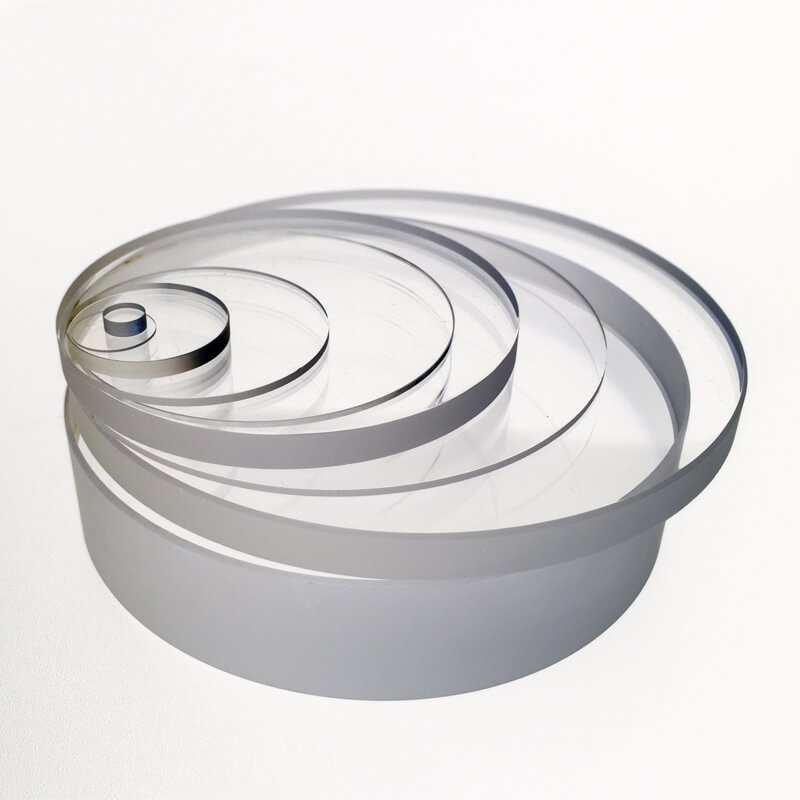
Quartz glass is a high-purity glass made almost entirely of silicon dioxide (SiO₂). It has no soda, lime, or boron added to it. That gives it much higher heat resistance, better chemical resistance, and wider optical transmission than ordinary glass.
Related resources: how quartz glass is manufactured and quartz glass tubes.
Engineers also call it fused silica or fused quartz. All three terms point to the same family of material. The exact name usually depends on the raw material and the manufacturing process, which we explain below.
This guide covers what quartz glass is made of, its core properties, the main types and grades, how it's manufactured, where it's used, and how it compares to other technical glass and ceramics.
Quick answer: Quartz glass is an amorphous, high-purity SiO₂ glass made by melting natural quartz or synthetic silica at temperatures above 1700°C. It withstands continuous use up to about 1100–1200°C, transmits light from deep UV to near-infrared, and resists almost all chemicals except hydrofluoric acid. It's used in semiconductor manufacturing, UV lighting, high-temperature furnaces, precision optics, and laboratory equipment.
Quartz Glass at a Glance
| Property | Typical Value |
|---|---|
| SiO₂ purity | 99.9% – 99.9999%, depending on grade |
| Continuous use temperature | Up to 1100–1200°C |
| Short-term use temperature | Up to 1300°C |
| Softening point | ~1650–1730°C |
| Coefficient of thermal expansion | ~0.50–0.55 × 10⁻⁶/°C |
| Optical transmission range | ~185 nm – 3500 nm |
| Refractive index (589 nm) | ~1.458 |
| Density | ~2.2 g/cm³ |
| Hardness (Mohs) | 5.5 – 6.5 |
| Electrical resistivity | >10¹⁸ Ω·cm at 20°C |
Values above are general industry reference figures. Actual specifications vary by grade and supplier.
What Is Quartz Glass Made Of?
Quartz glass is almost pure silicon dioxide. It contains no fluxing additives like sodium oxide or calcium oxide, which is what standard glass uses to lower its melting point.
There are two raw material sources:
- Natural quartz crystal. Purified and melted at high temperature. It carries small amounts of trace metals from the original mineral.
- Synthetic silica precursors. Made from chemical compounds like silicon tetrachloride. This route produces higher purity and fewer bubbles, but costs more.
At the molecular level, quartz glass is amorphous. Its SiO₄ units are arranged randomly, not in a repeating crystal lattice. This is different from natural crystalline quartz, which has an ordered structure. The amorphous structure is why quartz glass has the same properties in every direction — a trait called isotropy.
Key Properties of Quartz Glass
Thermal Properties
Quartz glass handles continuous use up to roughly 1100–1200°C, with short excursions to about 1300°C. Its coefficient of thermal expansion is around 0.50–0.55 × 10⁻⁶/°C — about 10 to 15 times lower than ordinary soda-lime glass.
This low expansion rate gives quartz glass strong thermal shock resistance. A piece heated to over 1000°C can be plunged into cold water without cracking. That property alone is why quartz glass is standard in furnace tubes, crucibles, and other parts that see fast temperature swings.
Optical Properties
Quartz glass transmits light across an unusually wide range — from deep ultraviolet around 185 nm through the visible spectrum and into the near-infrared, up to about 3500 nm. Ordinary glass blocks most UV light below 300 nm; quartz glass does not.
This is why quartz glass is the default choice for UV lamps, UV sterilization systems, and optical components that need to pass ultraviolet light without loss.
Chemical Resistance
Quartz glass resists almost every common acid, including concentrated nitric, sulfuric, and hydrochloric acid at elevated temperature. It's also stable in water, organic solvents, and most industrial chemicals.
The one major exception is hydrofluoric acid, which dissolves the silica structure. Strong alkaline solutions at high temperature will also etch the surface over time.
Electrical and Mechanical Properties
Quartz glass is an excellent electrical insulator, with resistivity above 10¹⁸ Ω·cm at room temperature. It stays insulating even at high temperatures where many other materials fail.
Mechanically, it has high compressive strength but limited tensile strength — a typical trait of glass and ceramic materials. It's hard (5.5–6.5 on the Mohs scale) but brittle, so it needs careful handling during installation and use.
Types of Quartz Glass
Natural Fused Quartz vs. Synthetic Fused Silica
| Natural Fused Quartz | Synthetic Fused Silica | |
|---|---|---|
| Raw material | Natural quartz crystal | Chemical silicon compounds |
| Purity | 99.9% – 99.99% SiO₂ | Up to 99.9999% SiO₂ |
| Trace metals | Present, low ppm levels | Nearly absent |
| UV transmission | Limited below ~250 nm | Strong from ~185 nm |
| Typical use | Furnace tubes, general industrial parts | Semiconductor optics, DUV lasers, precision windows |
| Relative cost | Lower | Higher |
Transparent, Opaque, and Translucent Quartz Glass
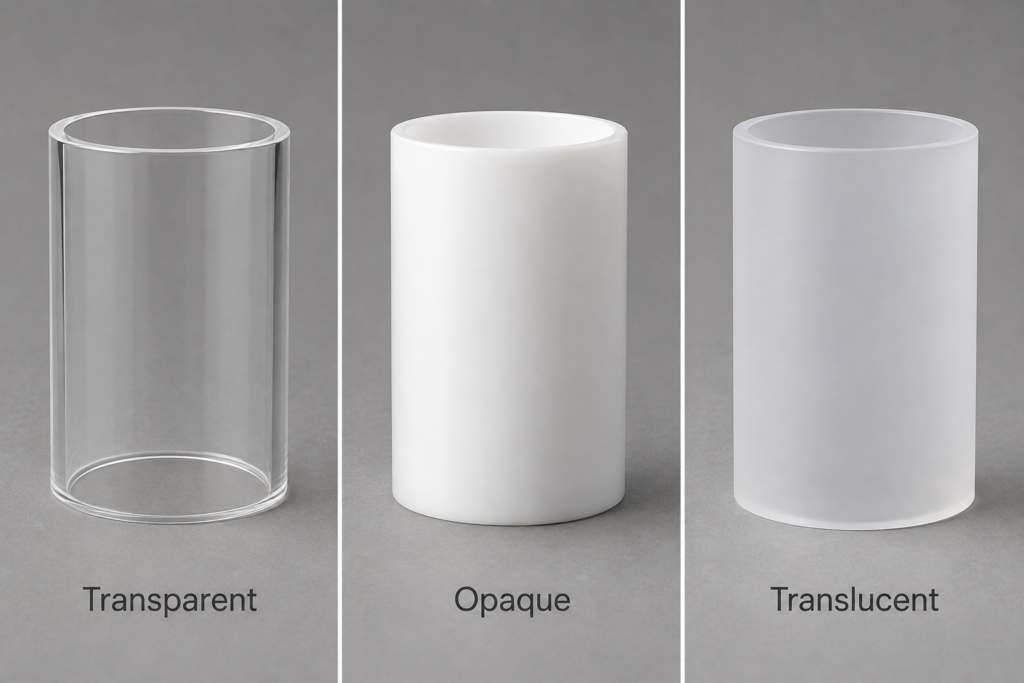
Quartz glass isn't always clear. Manufacturers also produce it in opaque and translucent forms for specific jobs.
- Transparent quartz glass is the standard clear form, used where optical clarity or UV transmission matters.
- Opaque quartz glass contains fine bubbles or crystalline inclusions, giving it a white, non-transparent look. It has more uniform heat distribution and is common in semiconductor diffusion tubes and boats.
- Translucent quartz glass sits between the two. It's made by partially sintering quartz powder, which diffuses light instead of blocking or fully passing it. It's often used for heating element sheaths and diffuser components.
Optical Grades: JGS1, JGS2, JGS3
In optical and industrial markets, quartz glass is often classified using the JGS grading system:
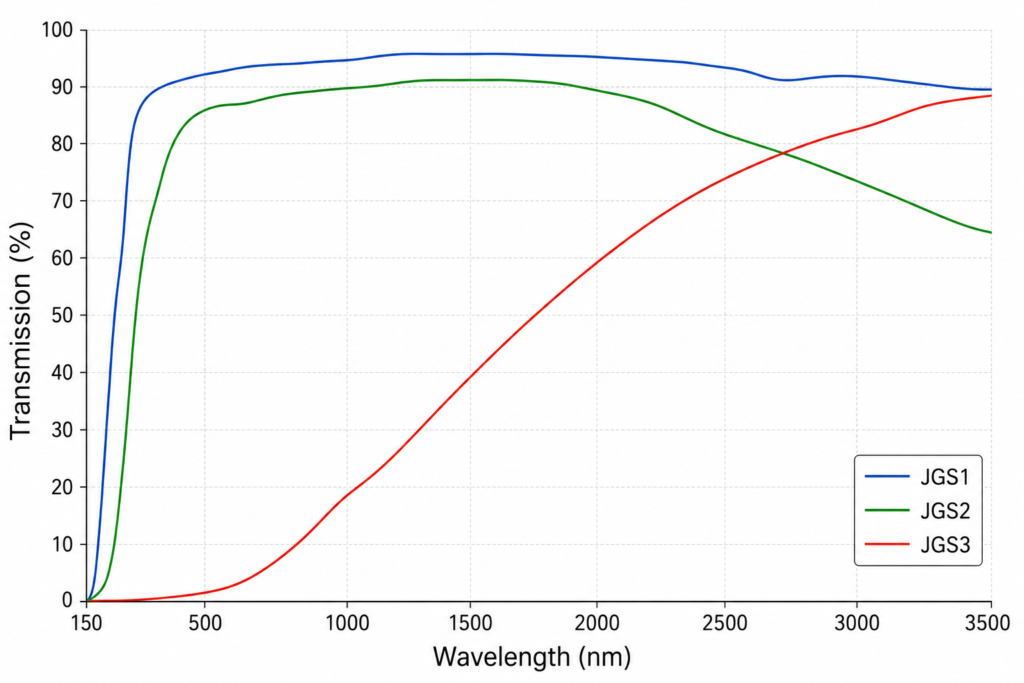
- JGS1 — Synthetic fused silica. Best deep-UV transmission, used for lithography and precision UV optics.
- JGS2 — Natural fused quartz. Good UV-to-visible transmission at a lower cost, common in sterilization sleeves and sight glass.
- JGS3 — Low-OH grade. Optimized for infrared transmission, used in IR sensing and high-power laser components.
The right grade depends on the wavelength range your application needs, not on which grade sounds the most "premium." JGS2 is often the correct choice even though JGS1 is the highest-purity option — using JGS1 where it isn't needed just adds cost.
How Is Quartz Glass Made?
Manufacturing starts with raw material selection — natural quartz sand or synthetic silica precursors, both purified to remove contaminants.
From there, one of several melting methods is used:
- Electric fusion melts quartz grains in an electric furnace. Common for bulk tubes, rods, and plates.
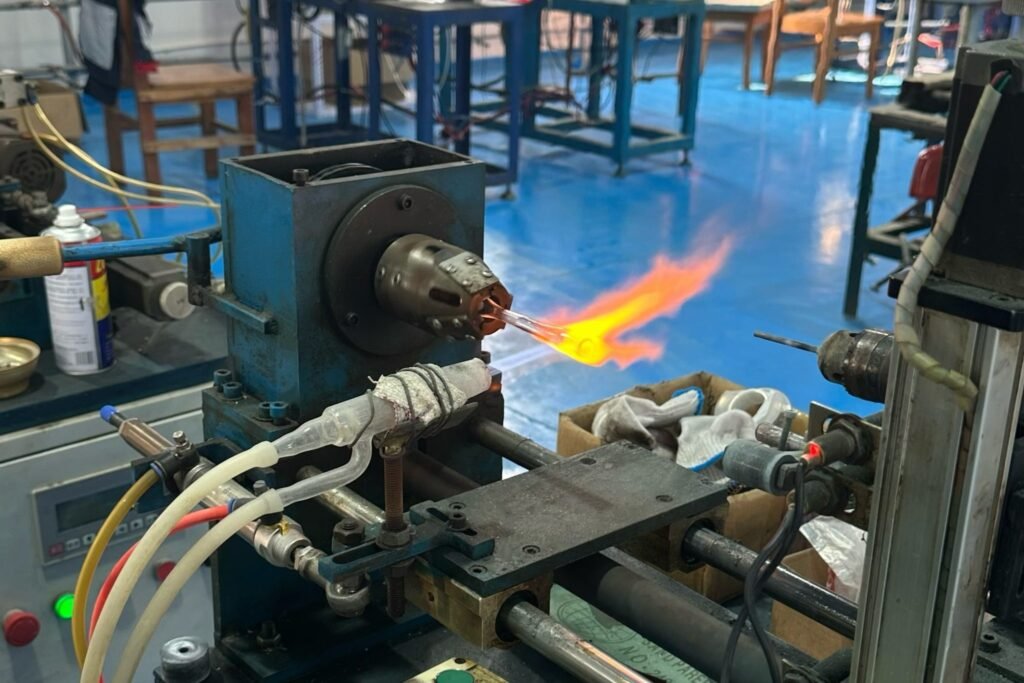
- Flame fusion uses an oxyhydrogen flame to melt and shape material, often for tubing and rod stock.
- Chemical vapor deposition (CVD) builds up ultra-pure synthetic silica from a gas-phase reaction. Used for the highest optical grades.
- Vacuum sintering produces opaque or bubble-free shapes for specific thermal or structural needs.
After melting and forming, components go through cold and thermal processing to reach final dimensions and tolerances. This typically includes cutting, CNC machining, grinding, polishing, drilling, edge processing, surface treatment, and coating. This is also where custom parts get made — most quartz glass components start as standard tube, rod, or plate stock and are machined into the final shape.
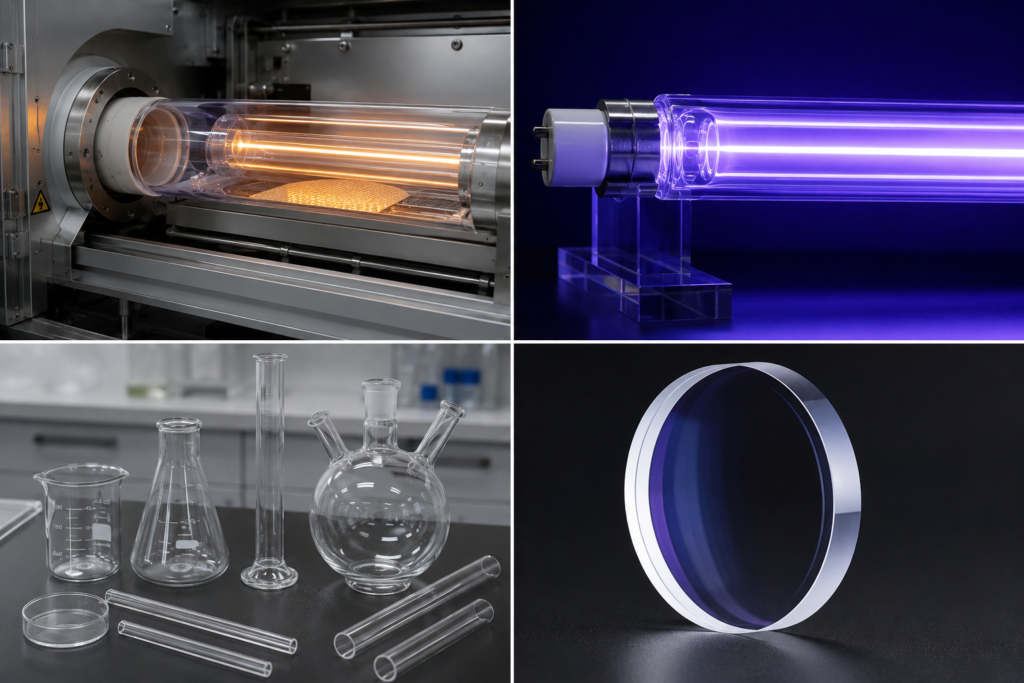
Applications of Quartz Glass
Semiconductor manufacturing. Diffusion furnace tubes, wafer boats, bell jars, and process chambers rely on quartz glass for its purity and thermal stability. It won't contaminate silicon wafers with metal ions the way some other materials can.
UV lighting and water disinfection. UV lamp jackets and sterilization sleeves need a material that transmits UV light efficiently. Ordinary glass can't do this — quartz glass can.
High-temperature furnaces. Sight windows, muffle liners, and process tubes used in heat-treatment and solar cell production lines need to survive continuous high heat and rapid temperature swings.
Precision optics and photonics. Lenses, windows, beam splitters, and laser components use quartz glass where optical clarity, low expansion, and UV or IR transmission all matter at once.
Laboratory equipment. Cuvettes, combustion boats, and test tubes use quartz glass for chemical resistance and thermal shock resistance during repeated testing.
Quartz Glass vs. Other Materials
| Property | Quartz Glass | Borosilicate Glass | Soda-Lime Glass | Sapphire (Al₂O₃) |
|---|---|---|---|---|
| SiO₂ content | ≥99.9% | ~81% | ~73% | N/A (Al₂O₃) |
| Max continuous temp | ~1100–1200°C | ~500°C | ~120–150°C | ~1800°C |
| Thermal expansion | ~0.50–0.55 × 10⁻⁶/°C | ~3.3 × 10⁻⁶/°C | ~9.0 × 10⁻⁶/°C | ~5.3 × 10⁻⁶/°C |
| UV transmission | Excellent (from ~185 nm) | Poor (below ~300 nm) | Very poor | Good (from ~150 nm) |
| Chemical resistance | Excellent, except HF | Good | Fair | Excellent |
| Relative cost | Medium–high | Low | Very low | Very high |
Quartz glass sits between borosilicate glass and sapphire. It costs more than borosilicate but far less than sapphire, and it clears the temperature and UV performance ceiling that borosilicate can't reach.
Limitations of Quartz Glass
Devitrification risk. At sustained temperatures above roughly 1150°C, quartz glass can partially crystallize into cristobalite. This weakens the material and reduces clarity. Surface contamination — alkali residue, fingerprints, dust — speeds this process up, so clean handling before high-temperature use matters.
Brittleness. Like most glass and ceramic materials, quartz glass has low impact and tensile strength. It handles compressive load well but is vulnerable to sudden mechanical shock or point loading. Mounting designs should include expansion gaps and soft gaskets rather than rigid clamping.
Frequently Asked Questions
What is quartz glass made of?
Quartz glass is made almost entirely of silicon dioxide (SiO₂), from either natural quartz crystal or synthetic silica precursors, with no soda, lime, or boron additives.
Is quartz glass the same as fused silica?
They're part of the same material family. In common use, "fused silica" usually refers to the synthetic version, while "fused quartz" refers to material melted from natural quartz crystal.
How is quartz glass different from regular glass?
Regular glass contains additives that lower its melting point but also lower its heat resistance, chemical resistance, and UV transmission. Quartz glass skips those additives, which is why it performs so differently.
Why is quartz glass used in semiconductor manufacturing?
It combines high purity, high-temperature stability, and low contamination risk — all necessary to avoid introducing metal ions into silicon wafer processing.
Can quartz glass withstand high temperatures?
Yes. It supports continuous use up to about 1100–1200°C and short-term exposure to around 1300°C, with strong resistance to thermal shock.
Is quartz glass chemically resistant?
Yes, to almost everything except hydrofluoric acid and strong hot alkaline solutions.
What are the main grades of quartz glass?
The most common classification is JGS1, JGS2, and JGS3, based on UV and IR transmission performance. Material is also split by origin (natural vs. synthetic) and appearance (transparent, opaque, translucent).
Why does quartz glass cost more than regular glass?
Higher raw material purity, higher melting temperatures (above 1700°C), and specialized tooling all add cost compared to standard glass production.
Choosing the Right Quartz Glass for Your Application
Material selection usually comes down to three questions: What temperature range does the part need to survive? What wavelength range matters, if any? And what's the chemical environment?
From there, grade selection gets simpler. High-temperature structural parts generally don't need optical-grade material. UV-sensitive applications need JGS1 or JGS2. IR applications point toward JGS3. Getting this match right avoids paying for purity the application doesn't use.
We work with engineers and buyers to match quartz glass grade and form — tube, rod, plate, or custom-machined component — to the actual operating conditions, and can cut, grind, polish, drill, and finish parts to your drawing. If you're specifying quartz glass for a new project, reach out with your requirements for a quick recommendation.


