
Quartz glass looks simple — clear, smooth, uniform. The process behind it isn't. Getting from raw silica to a finished quartz component takes furnace temperatures over 1700°C, tightly controlled atmospheres, and several rounds of precision finishing. That's also why quartz glass costs more than ordinary glass.
Related resources: custom precision quartz components and quartz blocks, blanks and ingots.
This guide walks through the full manufacturing process, from raw material selection to the final machined part.
Quick answer: Quartz glass is made by melting high-purity silica — either natural quartz crystal or synthetic silicon compounds — at temperatures above 1700°C, using methods like electric fusion, flame fusion, or chemical vapor deposition. The molten silica is formed into ingots, tubes, or rods, then cooled and finished through cutting, grinding, polishing, and other precision processing to reach final dimensions.
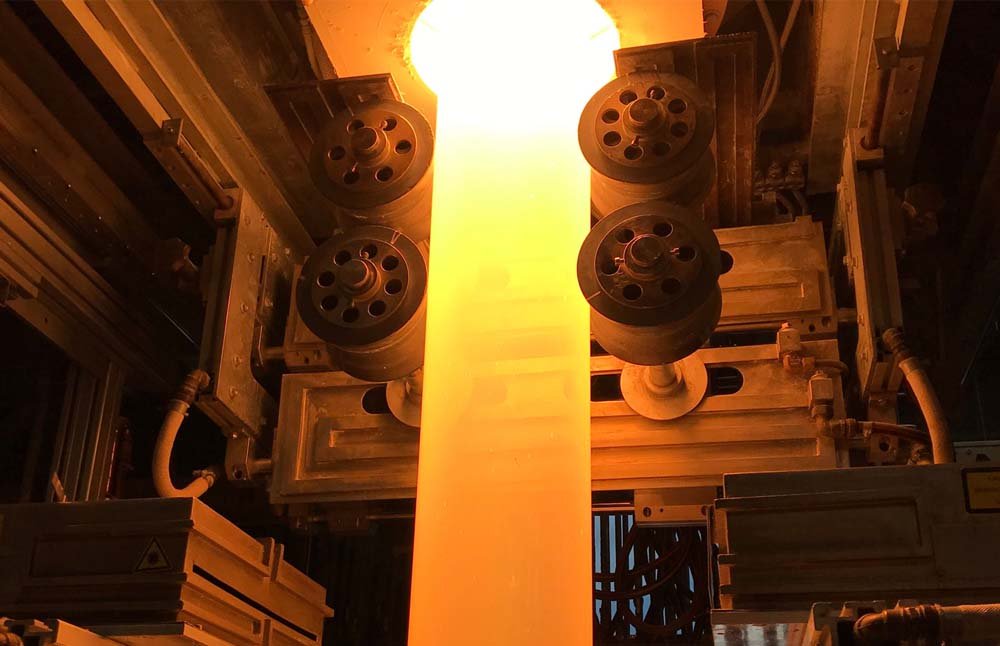
The Manufacturing Process at a Glance
| Stage | What Happens |
|---|---|
| 1. Raw material selection | Natural quartz sand or synthetic silicon compounds are sourced and purified |
| 2. Melting | Silica is melted at 1700°C+ using electric, flame, or vapor-phase methods |
| 3. Forming | Molten silica is shaped into ingots, tubes, rods, or plates |
| 4. Cooling and annealing | Material is cooled under controlled conditions to relieve internal stress |
| 5. Cold and thermal processing | Cutting, CNC machining, grinding, polishing, drilling, and edge work bring parts to final spec |
| 6. Quality inspection | Dimensional, optical, and stress checks confirm the part meets spec |
Step 1: Raw Material Selection and Purification
Everything starts with silicon dioxide, sourced one of two ways:
- Natural quartz sand or crystal, purified to remove metallic impurities before melting. This is the more economical route and is used for general industrial and structural components.
- Synthetic silicon compounds, such as silicon tetrachloride, used when the application needs extremely low metal content and minimal bubble formation — typically for optical and semiconductor-grade material.
Purity control at this stage matters more than in almost any other type of glass manufacturing. Even parts-per-million levels of metallic contamination can affect optical transmission and high-temperature performance later on.
Step 2: Melting
Quartz glass requires processing temperatures above 1700°C — far higher than the roughly 1000°C used for standard soda-lime glass. That difference is the main reason quartz glass manufacturing needs specialized furnaces, refractories, and far more energy input.
There are four common melting methods, chosen based on the required purity and final shape:
Electric fusion (arc melting). Quartz grains are melted in an electrically heated furnace or crucible. This is a common method for producing bulk ingots, tubes, and plates from natural quartz feedstock.
Flame fusion (Verneuil-type process). An oxyhydrogen flame melts silica directly, often used to produce continuous tube and rod stock. This method also allows fine control over wall thickness during drawing.
Chemical vapor deposition (CVD) / flame hydrolysis. A silicon-bearing gas is oxidized or hydrolyzed in a flame, producing an extremely fine silica "soot" that's deposited and fused onto a target to build up a boule. This route produces the highest-purity synthetic fused silica, used for optical and semiconductor-grade material, but it's slower and more expensive than electric or flame fusion.
Vacuum sintering. Used for specialized shapes, including opaque or low-bubble-density quartz, where partial sintering under vacuum controls porosity and internal structure.
Step 3: Forming
Once molten, silica is shaped into one of several standard forms:
- Ingots or boules, later sliced or machined into plates, discs, or blocks
- Tubes, drawn continuously from a furnace and sized by wall thickness and diameter
- Rods, drawn or extruded in solid round or profile shapes
- Plates, cast or rolled to thickness and later cut to size
Forming conditions — draw speed, furnace temperature stability, and target rotation — directly affect wall thickness consistency, bubble content, and internal stress in the finished stock.
Step 4: Cooling and Annealing
Rapid, uneven cooling introduces internal stress that can cause cracking or distortion later, especially during machining or thermal cycling in service. Controlled annealing — cooling the material slowly through its stress-relief temperature range — reduces this risk and stabilizes the material before it moves to finishing.
Step 5: Cold and Thermal Processing
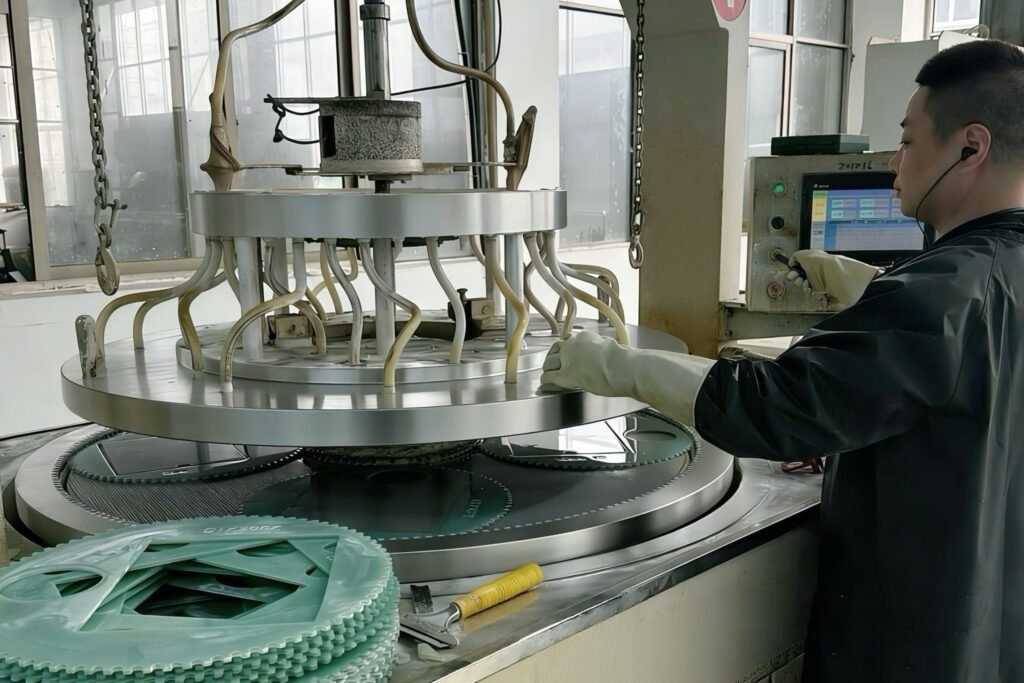
Raw quartz stock — tube, rod, or plate — is rarely the finished product. Most components go through several finishing steps to reach final dimensions, tolerances, and surface quality:
- Cutting — sizing stock to length or blank dimensions
- CNC machining — shaping complex geometries and features to tolerance
- Grinding — removing material to reach precise dimensions
- Polishing — achieving optical-quality surface finish where needed
- Drilling — adding holes, ports, or feedthroughs
- Edge processing — chamfering or rounding edges to reduce stress concentration and chipping risk
- Surface treatment — etching or texturing surfaces for specific applications
- Coating — applying anti-reflective or other functional coatings for optical components
This is also the stage where standard tube, rod, or plate stock becomes a custom part. Most quartz components are ordered as machined parts built to a drawing, not as raw stock.
Step 6: Quality Inspection
Before shipment, finished parts typically go through several checks:
- Dimensional inspection, often using a coordinate measuring machine (CMM) to confirm the part matches drawing tolerances
- Visual and optical inspection, checking for bubbles, inclusions, striae, and surface scratches
- Stress measurement, using polarized light to detect residual internal stress that could lead to failure in service
For optical-grade parts, additional checks may include transmission testing at the relevant wavelength and surface flatness or figure measurement.
Why This Process Makes Quartz Glass Expensive
Three things drive up cost compared to standard glass manufacturing:
Energy. Melting at 1700°C+ instead of ~1000°C means significantly more energy input per unit of material.
Tooling and equipment. High-purity furnaces, specialized refractories, and diamond-based cutting and grinding tools all cost more than standard glass-processing equipment, and diamond tooling is required because quartz glass is hard and abrasion-resistant.
Labor and precision. Most quartz parts are machined to a drawing rather than molded, which takes more processing time and skilled labor per part than mass-molding standard glass.
The payoff is a part that performs reliably at temperatures, purity levels, and optical wavelengths that standard glass simply can't reach.
From Raw Silica to Finished Part: A Typical Flow
For a machined component like a furnace tube or optical window, the path usually looks like this: raw silica is purified, melted using the method suited to the required purity, formed into tube or plate stock, annealed to relieve stress, then cut, machined, ground, and polished to the customer's drawing before final inspection and shipment.
The exact sequence and number of steps depend on the part's geometry, tolerance requirements, and whether it needs optical-grade surface finish or coatings.
Frequently Asked Questions
What temperature is needed to melt quartz glass?
Processing temperatures typically exceed 1700°C, well above the roughly 1000°C used for standard soda-lime glass.
What's the difference between electric fusion and flame fusion?
Electric fusion melts quartz grains in an electrically heated furnace, commonly used for bulk ingots and plates. Flame fusion uses an oxyhydrogen flame and is common for continuous tube and rod production.
Why is CVD used for some quartz glass but not all?
CVD (chemical vapor deposition) produces the highest-purity synthetic fused silica, but it's slower and more expensive than melting natural quartz. It's reserved for optical and semiconductor-grade material where that purity is actually needed.
Can quartz glass be custom machined after melting?
Yes. Most quartz components start as standard tube, rod, or plate stock and are cut, ground, drilled, and polished into custom parts to meet a specific drawing.
Why does quartz glass need annealing?
Annealing relieves internal stress introduced during melting and forming. Without it, parts are more prone to cracking during machining or thermal cycling in service.
How is quality checked on finished quartz parts?
Typical checks include dimensional inspection (often with a CMM), visual inspection for bubbles and inclusions, and polarized-light stress measurement, with additional optical testing for precision optical components.
Getting Custom Quartz Parts Made
Understanding the manufacturing process helps explain why lead times and cost vary so much between simple stock shapes and precision-machined components. If you're working from a drawing, we can advise on the right raw material form and finishing steps for your part — send us your specifications for a quote.


