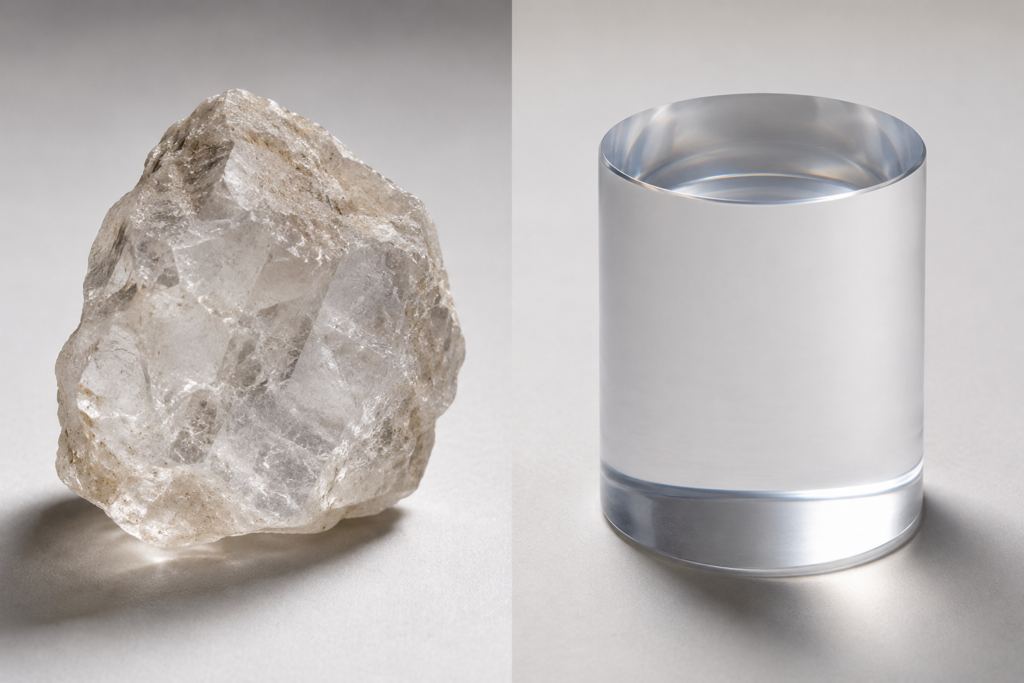
Natural vs Synthetic Quartz Glass: Key Differences and Which to Choose
2026-08-25 09:36:13
Every piece of quartz glass starts from one of two raw material sources: natural quartz crystal or synthetic silicon compounds. This one choice, made before melting even begins, sets the ceiling on a part's purity, its optical performance, and its cost.
This guide breaks down what actually separates natural from synthetic quartz glass, and how to decide which one your application needs.
Quick answer: Natural quartz glass is melted from mined quartz crystal and carries trace metal impurities, but it's more affordable and available in larger sizes. Synthetic quartz glass (fused silica) is grown from chemical precursors, reaching much higher purity and better deep-UV performance, at a higher cost. Structural and general industrial parts usually use natural material; high-purity optical and semiconductor applications usually require synthetic.
Natural vs. Synthetic Quartz Glass at a Glance
Property
Natural Fused Quartz
Synthetic Fused Silica
Raw material
Mined quartz crystal
Chemical silicon precursors (e.g. SiCl₄)
SiO₂ purity
~99.9% – 99.99%
Up to 99.9999%+
Trace metal impurities
Present, low ppm range
Near-absent
Deep-UV transmission
Limited below ~250 nm
Excellent from ~185 nm
Bubble/inclusion content
Low to moderate
Very low
Typical size availability
Large diameters and volumes
Smaller, slower-grown batches
Relative cost
Lower
Higher
Typical use
Furnace tubes, structural parts, general optics
DUV optics, semiconductor lithography, precision windows
Values above are general industry reference figures. Confirm exact specs with your supplier's data sheet.
What Makes Quartz Glass "Natural" vs. "Synthetic"?
Natural fused quartz starts as mined quartz crystal, which is purified and melted — typically by electric fusion or flame fusion — into glass. The mineral origin means some trace metallic elements, like aluminum, iron, and titanium, carry through into the finished glass, usually at low parts-per-million levels.
Synthetic fused silica starts from a chemical compound, most commonly silicon tetrachloride, and is built up through flame hydrolysis or chemical vapor deposition (CVD). Because it never touches a natural mineral source, it avoids nearly all of the metallic impurities that come with natural quartz.
Both end up as the same basic material — amorphous SiO₂ glass — but the raw material path changes what's possible in terms of purity, optical performance, and cost.
Purity and Trace Impurities
This is the most fundamental difference. Natural fused quartz typically reaches 99.9–99.99% SiO₂ purity, with trace metals present at low ppm levels. Synthetic fused silica can reach 99.9999% purity or higher, with metallic impurities close to undetectable.
For applications where metal contamination is a functional risk — semiconductor wafer processing is the clearest example — that purity gap isn't a minor detail. It's the entire reason synthetic material gets specified.
For structural or general thermal applications, where the part just needs to survive heat and resist chemicals rather than maintain ultra-high purity, natural material's purity level is usually more than sufficient.
Optical and UV Performance
Trace metal impurities absorb light, particularly at shorter wavelengths. That's why natural fused quartz has limited transmission below roughly 250 nm, while synthetic fused silica stays highly transparent down to around 185 nm.
If your application involves deep-UV transmission — photolithography, UV spectroscopy below 250 nm, certain laser systems — synthetic material isn't optional. For general UV-Vis use, such as UV sterilization sleeves, natural material's transmission range is typically wide enough.
OH Content Isn't Fixed by Origin
It's a common assumption that natural material is automatically low-OH and synthetic material is automatically high-OH. That's not quite right. OH (hydroxyl) content depends more on the specific production process than on raw material origin alone.
Flame hydrolysis, a common synthetic route, tends to produce high-OH material. But other synthetic and post-processing methods can produce low-OH synthetic silica. Natural material processed under standard conditions tends to run low-OH, but this varies by supplier and process too.
The practical point: don't assume OH content, and by extension IR or UV performance, purely from whether material is labeled natural or synthetic. Check the actual transmission spec for your wavelength.
Size, Form, and Bubble Content
Natural quartz can be melted in larger batches relatively economically, which makes it the practical choice for large-diameter tubes, bulk plates, and big structural components.
Synthetic fused silica is grown more slowly, particularly through CVD, which limits practical boule size and adds cost as part size increases. For large optical blanks or bulk industrial parts, cost and lead time can rise quickly with synthetic material.
On bubble and inclusion content, synthetic material generally comes out cleaner, since the vapor-phase growth process avoids the inclusions that can form during bulk melting of natural crystal. Natural material can still meet low-bubble requirements for most non-optical applications, but for zero-defect optical paths, synthetic is usually the safer specification.
Cost Comparison
Natural fused quartz costs less, for two compounding reasons: the raw material itself is cheaper, and the melting processes used (electric or flame fusion) are faster and less energy-intensive than CVD or flame hydrolysis.
Synthetic fused silica costs more across the board — raw material, processing time, and energy input are all higher. That cost is easy to justify when the application needs the purity or optical performance synthetic material provides. It's much harder to justify when a structural or general-purpose part doesn't actually need it.
Common Myth: "Synthetic" Doesn't Mean Lower Quality
In some industries, "natural" is marketed as the premium option and "synthetic" as the cheaper substitute. Quartz glass runs the opposite direction. Synthetic fused silica is generally the higher-purity, higher-performance, and higher-cost material. Natural fused quartz is the more economical, general-purpose option.
If you're specifying material based on instinct rather than the actual data sheet, this is the assumption most likely to lead you the wrong way.
Which Should You Choose?
Work through these questions:
Does the application involve semiconductor processing, deep-UV optics, or any process sensitive to metal contamination? Choose synthetic.
Does the part need transmission below 250 nm? Choose synthetic.
Is the part large, structural, or thermal rather than optical? Natural is usually sufficient and more cost-effective.
Is budget or lead time a major constraint, and does the application not require ultra-high purity? Natural is the practical choice.
Not sure where your application falls? Start from the purity and wavelength requirements, not the material label — the right answer usually becomes clear once those numbers are defined.
Frequently Asked Questions
Is synthetic quartz glass "fake" quartz?
No. Synthetic fused silica is the same SiO₂ glass as natural fused quartz — it's just grown from chemical precursors instead of melted from mined crystal, generally resulting in higher purity.
Which is better, natural or synthetic quartz glass?
Neither is universally better. Synthetic offers higher purity and better deep-UV performance; natural offers lower cost and easier availability in large sizes. The right choice depends on the application.
Is natural quartz glass less pure than synthetic?
Generally yes. Natural material typically reaches 99.9–99.99% SiO₂ purity, while synthetic material can exceed 99.9999%.
Does synthetic quartz glass always have better UV transmission?
It typically does, since it lacks the metallic impurities that absorb short-wavelength light in natural material. But always confirm transmission specs for your exact wavelength rather than assuming based on origin alone.
Is synthetic quartz glass more expensive than natural?
Yes, usually significantly more, due to slower production methods and higher energy and raw material costs.
Can natural quartz glass be used for optical applications?
Yes, for general UV-Vis and visible-range optics where deep-UV transmission below 250 nm isn't required. Deep-UV and semiconductor-grade optics typically require synthetic material.
Specifying the Right Material
Natural and synthetic quartz glass solve different problems. Natural material covers most structural, thermal, and general optical needs at a lower cost. Synthetic material earns its higher price when purity and deep-UV performance are non-negotiable.
If you're not sure which one your application actually needs, send us your purity, wavelength, and size requirements, and we can recommend the right raw material and grade for your part.
Calculate quartz window thickness for vacuum or pressure service by checking unsupported span, pressure differential, mounting, material and safety factors.
Calculate quartz thermal expansion and differential movement against steel or ceramics for furnace tubes, supports, seals and high-temperature assemblies.