
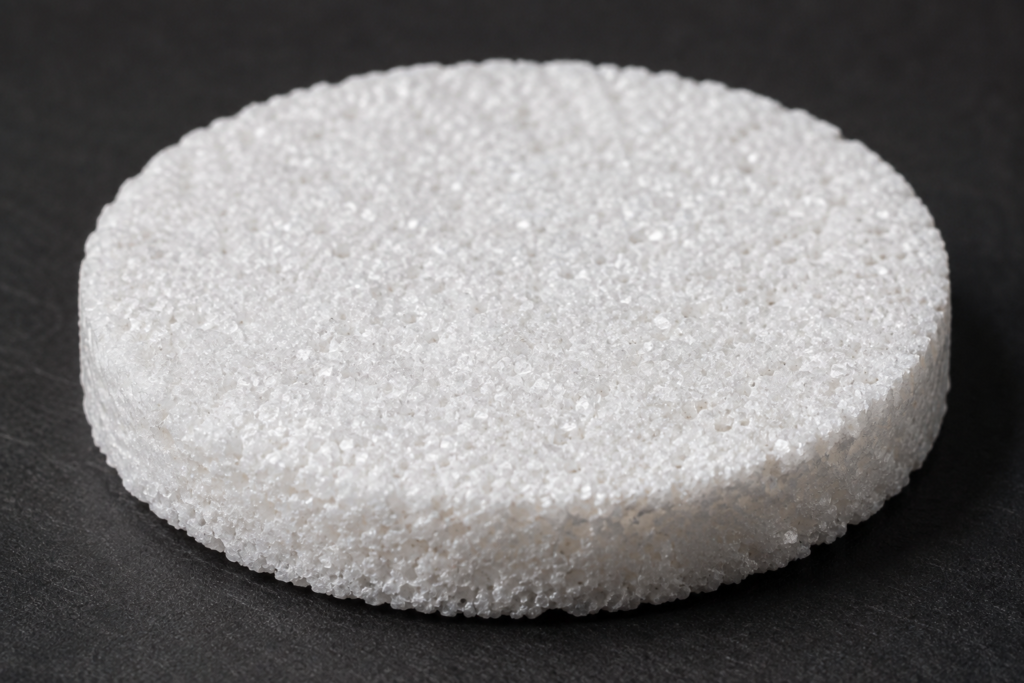
A quartz frit doesn't look like the rest of the quartz glass product family — instead of clear and solid, it's a porous, slightly translucent disc. But it's made from the same high-purity material, and it solves a specific problem: filtering, diffusing, or regulating flow in conditions too hot, corrosive, or purity-sensitive for standard filter media.
Related resources: quartz fritted discs and quartz fritted filters, funnels and bubblers.
This guide covers what quartz frits are, how porosity grading works, and where they're used.
Quick answer: A quartz frit (or sintered disc) is a porous filtration component made by fusing quartz particles together at high temperature, leaving a network of interconnected pores. Porosity is specified by grade, typically ranging from coarse (G00, ~100+ microns) to ultra-fine (G4/G5, under 10–16 microns). Frits are used for liquid and gas filtration, sparging, flow regulation, and heat diffusion in high-temperature or chemically aggressive environments where standard filter materials fail.
Quartz Frits at a Glance
| Spec | Typical Range |
|---|---|
| Porosity grades | G00 to G4/G5 |
| Pore size range | ~5 microns to 540+ microns |
| Standard diameters | ~10 mm to 500 mm |
| Standard thickness | ~1.5 mm to 5 mm (thicker on request) |
| Continuous use temperature | Up to ~1100°C |
| Material purity | Typically 99.99% SiO₂ |
Values above are general industry reference figures. Confirm exact specs with your supplier's data sheet.
For background on quartz glass manufacturing, see our guide on how quartz glass is made.
How Quartz Frits Are Made
Frits are produced by sintering — fusing quartz particles of a controlled size together at high temperature, just short of full melting, so the particles bond at their contact points while leaving open pore space between them. The particle size used directly determines the resulting pore size, which is why porosity grade selection starts with picking the right raw particle size rather than adjusting a finished part afterward.
This is a fundamentally different process from the melting and forming used for tubes, rods, and plates, which is why frits are typically treated as their own product category rather than a variation on standard stock.
Understanding Porosity Grades
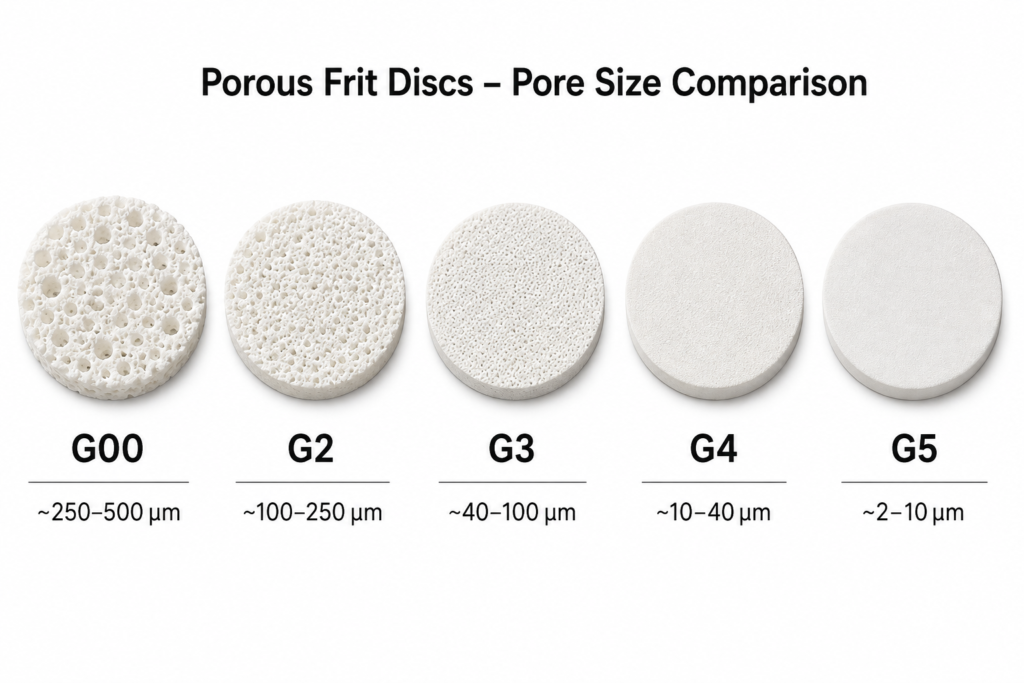
Porosity grades run from coarse to ultra-fine, and picking the wrong one is the most common specification mistake:
| Grade | Approximate Pore Size | Typical Use |
|---|---|---|
| G00–G1 | Coarse (~100–540 microns) | Gas sparging, coarse particle separation, bed support |
| G2 | ~40–100 microns | Pre-filtration, coarse sediment prep |
| G3 | ~16–40 microns | General analytical filtration, medium/fine sediment |
| G4 | ~10–16 microns | Fine analytical filtration, very fine sediment |
| G5 | ~5–10 microns | Ultra-fine filtration, specialized analytical use |
Grade definitions vary slightly by supplier and standard. Always confirm the pore size range for the exact grade you're specifying.
The general principle: match porosity to the smallest particle size you actually need to retain, not to whatever "fine" sounds safest. Over-specifying porosity fineness increases pressure drop across the frit and can slow flow more than necessary for the application.
Choosing Diameter and Thickness
Diameter is usually dictated by the housing or vessel the frit needs to fit into — this is typically a fixed constraint rather than a design choice. Thickness affects both mechanical strength and flow resistance: a thicker frit is more robust but creates more pressure drop for a given porosity grade, so thickness and porosity need to be considered together rather than independently.
Custom diameters and thicknesses are generally available beyond standard stock sizes, particularly for high-volume or specialized applications.
Reprocessable vs. Standard Frits
Some suppliers distinguish between standard integrally-formed frits and "reprocessable" frits that are sintered in a way that allows further shaping — carving, slotting, or machining — after the initial sintering step. If your application needs a non-standard shape rather than a simple flat disc, confirm with your supplier whether the frit can be reprocessed this way before finalizing a design.
Common Applications
Liquid and gas filtration — removing particulates from process fluids or gases, particularly in high-temperature or chemically aggressive conditions where polymer or paper filter media would degrade.
Gas sparging and diffusion — introducing gas into a liquid as fine, evenly distributed bubbles, common in chemical processing and some analytical setups.
Chromatography and lab filtration — supporting or filtering samples in analytical glassware, where chemical inertness prevents contamination of results.
Bed support in packed columns — providing a porous support surface for catalyst beds or packing material while allowing flow through.
Heat diffusion — some frit applications use the porous structure specifically for its heat distribution properties rather than filtration itself.
Frequently Asked Questions
What porosity grade should I use for general lab filtration?
G3 or G4 covers most general analytical filtration needs. Finer grades (G5) are reserved for ultra-fine particle retention where standard grades let too much through.
Can quartz frits handle hydrofluoric acid?
No — like other quartz glass products, frits are vulnerable to HF, which will etch and eventually dissolve the silica structure.
How does frit thickness affect performance?
Thicker frits are mechanically stronger but create more resistance to flow at a given porosity grade, so thickness and porosity should be selected together based on your flow rate and pressure requirements.
Are quartz frits reusable, or are they single-use?
Quartz frits are generally reusable and can often be cleaned by back-flushing, chemical cleaning, or high-temperature baking, depending on what's been filtered.
Can quartz frits be custom-shaped instead of a flat disc?
Some suppliers offer reprocessable frits that can be further machined into non-disc shapes — confirm this capability before finalizing a custom design.
What's the maximum temperature a quartz frit can handle?
Typically up to around 1100°C for continuous use, consistent with standard high-purity quartz glass, though this varies somewhat with porosity grade and thickness.
Specifying the Right Frit
Frit specification comes down to three linked decisions: porosity grade (matched to the particle size you need to retain), diameter (matched to your housing), and thickness (balanced against flow resistance). If you're not sure which combination fits your process, send us your filtration requirements — flow rate, particle size, housing dimensions — and we can recommend the right frit.


