
Quartz glass shows up in industrial heating in a role that's easy to overlook: not as the heat source itself, but as the material that makes an electric filament or lamp usable as a fast, efficient radiant heater. This guide covers how quartz infrared heating elements work, what specifying a heater tube or lamp holder involves, and where a related but different component — sputtering targets — fits into the broader "specialty quartz" category.
Related resources: quartz infrared heaters and quartz lamp holders and heater components.
Quick answer: Quartz infrared heaters use a clear or coated quartz glass tube to house a resistive filament (typically tungsten) or a halogen lamp element, taking advantage of quartz's high infrared transmittance, low thermal expansion, and fast thermal response. Related components include ceramic or quartz lamp holders and end fittings, and — in a separate application entirely — quartz sputtering targets used as source material in thin-film deposition.
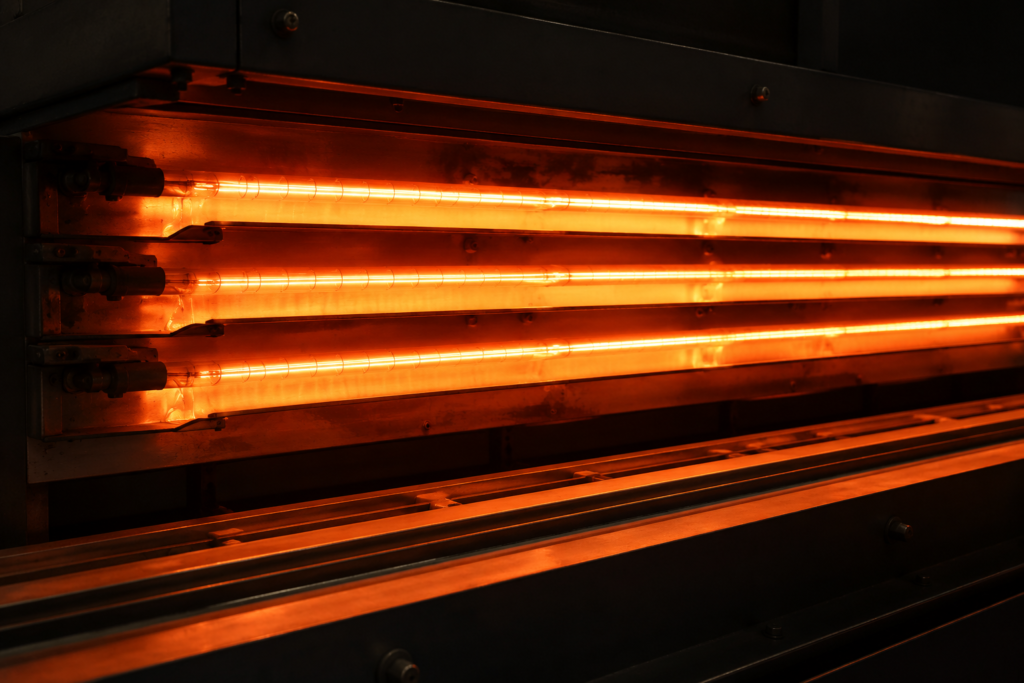
Quartz Heating Components at a Glance
| Component | Function |
|---|---|
| Quartz IR heater tube | Houses the resistive filament or halogen element, transmits infrared radiation |
| Reflector coating (gold or white) | Directs radiant heat toward the target instead of radiating in all directions |
| Ceramic or quartz lamp holders | Mount and electrically connect the heater tube within equipment |
| End terminals/seals | Provide electrical connection while sealing the tube's fill gas |
| Sputtering targets | Separate application — quartz source material for thin-film deposition, not a heating component |
Why Quartz Is Used for Infrared Heating
Quartz glass transmits infrared radiation efficiently — often cited above 90% transmittance — which lets the heat generated by an internal filament radiate outward with minimal loss through the tube wall itself. Combined with a low thermal expansion coefficient and fast thermal response, this makes quartz-housed elements able to reach operating temperature and cool back down far faster than heavier ceramic or metal-sheathed heating elements.
That fast response is a practical advantage in production settings: quartz IR heaters can reach full output in a few seconds, which matters for processes with frequent start-stop cycles or tight thermal control requirements.
How a Quartz IR Heater Element Is Built
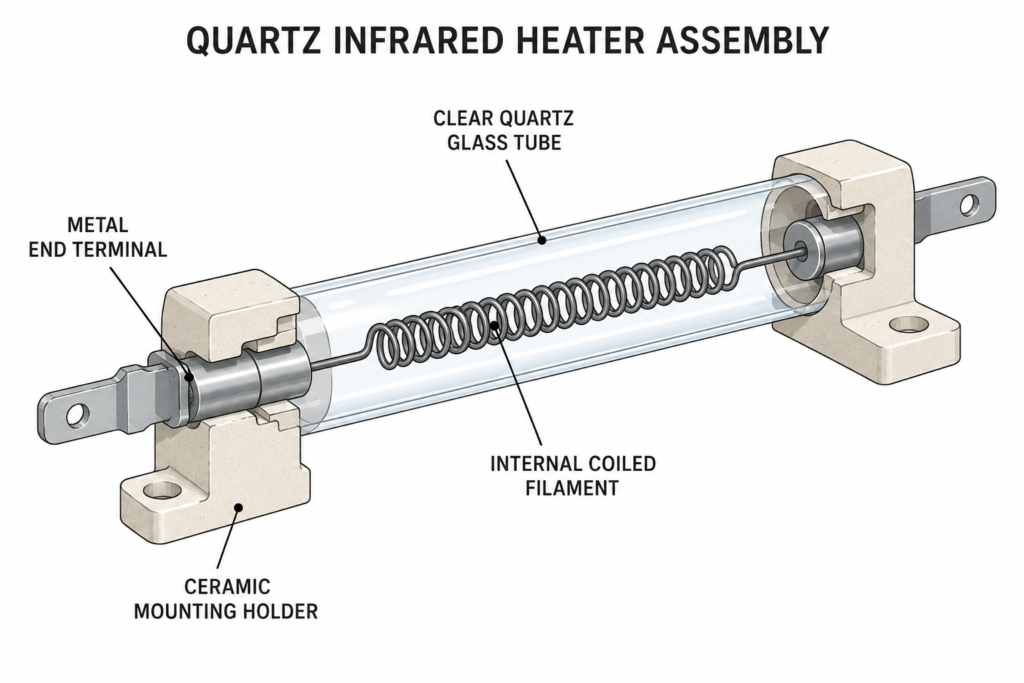
A basic quartz IR heater consists of a resistive filament — commonly tungsten, sometimes carbon fiber for longer-wavelength output — mounted inside a quartz glass tube, with metal terminals sealed at each end for electrical connection. Depending on design, the tube may be evacuated, filled with an inert or halogen gas, or left open, each affecting the element's lifespan and output characteristics.
For general tube sizing and grading background applicable to the housing itself, see our quartz glass tube buyer's guide.
Reflector Coatings
Many industrial IR heaters use a coating on part of the tube's exterior to control radiation direction:
- Gold reflector coatings direct infrared energy toward the target side while reducing rearward radiation — common in one-sided heating setups like drying tunnels and curing ovens.
- White reflective coatings perform a similar directional function using a different coating material and are sometimes preferred for their stability at very high temperatures over long service life.
Coating choice affects both heating efficiency and equipment design, since a reflector-coated heater changes how much surrounding structure needs its own reflective shielding.
Lamp Holders and Mounting
Heater tubes need a way to mount securely while maintaining electrical connection and, in many designs, some tolerance for thermal expansion. Ceramic holders are common because they combine electrical insulation with high-temperature stability; ends are often designed for quick removal and replacement without disassembling the surrounding equipment housing — a practical feature since heater elements are a wear item with a finite service life.
Holder design needs to match the specific heater tube's terminal type and diameter, so replacement components should be specified against the exact heater model rather than assumed to be universal.
Common Applications
Industrial drying and curing. Paint curing, coating drying, and similar processes benefit from the fast response and directional control quartz IR heaters offer over convection ovens.
Electronics and PCB processing. Medium-wave elements provide controlled, even heating for reflow soldering and similar processes where heat-sensitive components need precise thermal management.
Material processing and forming. Plastics, textiles, and other materials that need controlled surface heating without full convection heating use quartz IR elements for speed and targeting.
General industrial and comfort heating. Quartz IR heaters are also used in lower-precision settings like workspace or outdoor heating, where the same fast-response, directional heating properties are simply convenient rather than process-critical.
Sputtering Targets: A Different Application Entirely
It's worth separating out sputtering targets, since they use quartz glass in a completely different role than heating components. In physical vapor deposition (sputtering) processes, a quartz target serves as source material — bombarded with ions in a vacuum chamber to deposit a thin silica film onto a substrate, often for semiconductor or optical coating applications.
This has nothing to do with the material's infrared transmittance or thermal response; here what matters is purity and consistency of the source material itself, since any impurity in the target can end up in the deposited film. Specification for this application is closer to the high-purity considerations covered in our guide on quartz components for semiconductor and solar manufacturing than to anything about heating element design.
Frequently Asked Questions
Why is quartz used instead of ceramic for infrared heater tubes?
Quartz transmits infrared radiation more efficiently than most ceramics and has a much faster thermal response, making it better suited to processes needing quick heat-up and cool-down cycles.
What's the difference between gold and white reflector coatings?
Both redirect radiant heat toward the target rather than radiating it in all directions; the choice generally comes down to supplier preference, cost, and long-term stability requirements at the operating temperature involved.
How long do quartz IR heater elements typically last?
Service life varies with operating conditions, but well-designed elements in appropriate chemical environments are commonly rated for several thousand hours or more of use.
Can I replace just the quartz tube, or does the whole heater assembly need replacing?
This depends on the design — some systems allow tube or filament replacement independently, while sealed assemblies typically require full unit replacement. Check your specific heater's design before assuming a component-level repair is possible.
Is a sputtering target the same product as a heater tube?
No — despite both being quartz glass components, they serve entirely different functions and are specified against different requirements (purity and deposition performance versus infrared transmittance and thermal response).
Specifying Heating Components Correctly
Getting a quartz heater specification right mostly comes down to matching tube size, wattage, and coating to your existing equipment or process requirements, since these components are rarely interchangeable across different heater models. If you're specifying replacement or custom heating elements, send us your equipment details and process requirements for a recommendation.


