Quartz Crucibles for Silicon Ingot Growth: The Critical Component in Semiconductor & Solar Production
2026-08-28 07:54:06
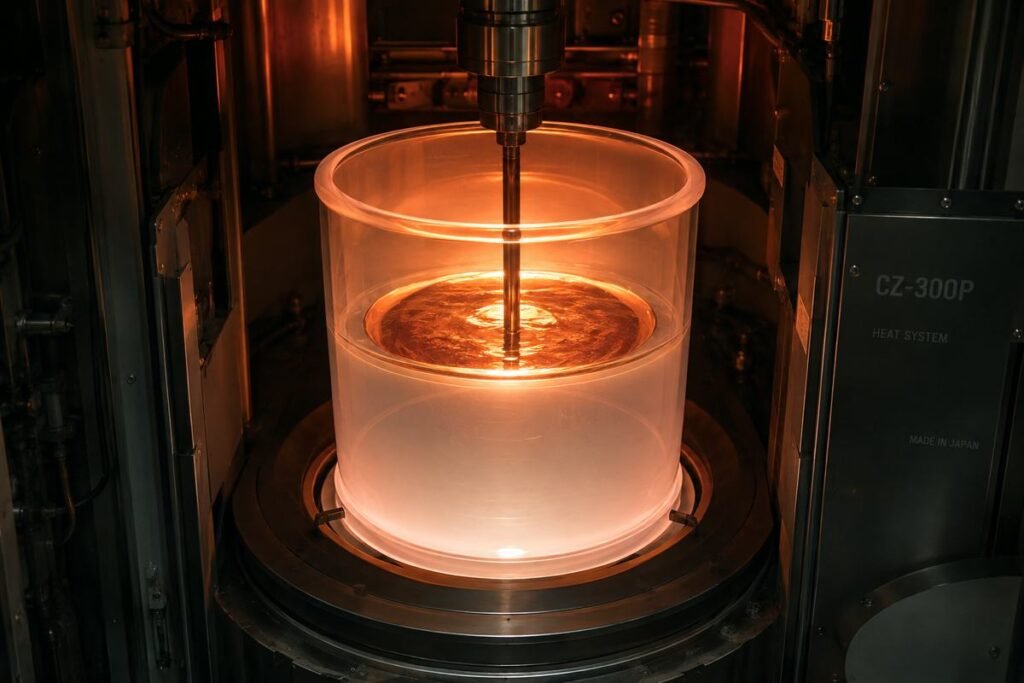
Almost every silicon chip and most solar cells trace back to a single piece of equipment: a fused quartz crucible holding molten silicon during crystal growth. It's a single-use, high-purity component that has to survive extreme temperature for many hours without contaminating the silicon inside it — and it's one of the highest-value applications quartz glass has.
This guide covers how quartz crucibles work in silicon ingot production, what drives their purity and quality requirements, and why they're consumed rather than reused.
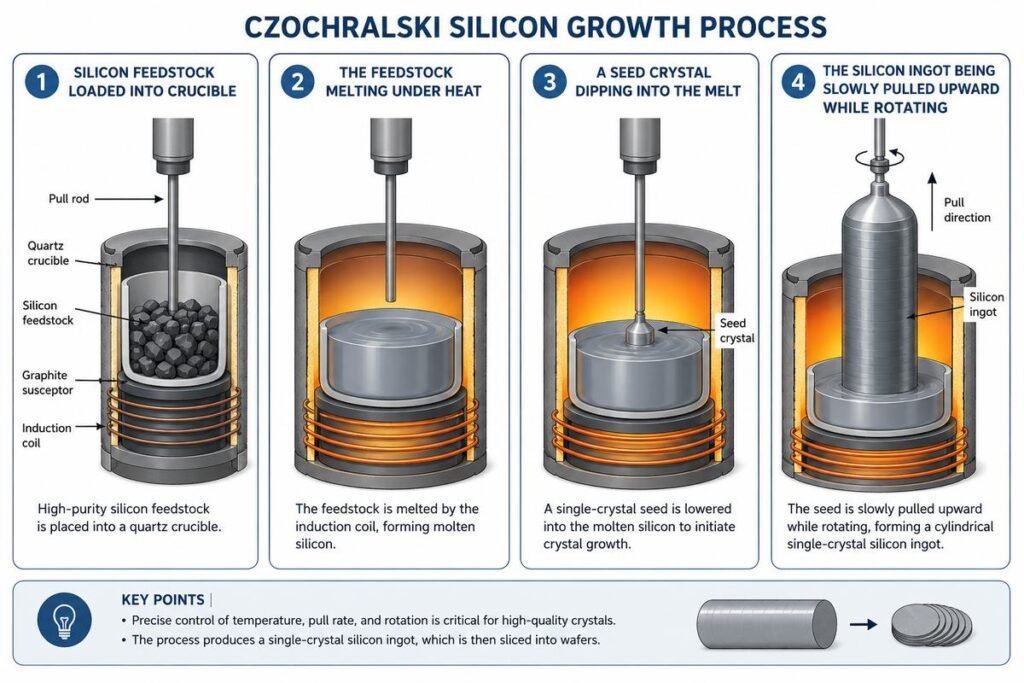
Quick answer: Quartz crucibles are used to hold and melt high-purity silicon during the Czochralski (CZ) process, where a seed crystal is slowly pulled from the melt to grow a single-crystal silicon ingot for semiconductor wafers or solar cells. Crucibles require very high SiO₂ purity, low and controlled bubble content, and dimensional stability at temperatures around 1420°C — and they're single-use, replaced after each growth run.
Quartz Crucibles at a Glance
Property
Typical Requirement
SiO₂ purity
Ultra-high purity (often 4N–5N and above)
Operating temperature
~1420°C (above silicon's melting point)
Bubble content
Tightly controlled — bubble growth during use affects yield
Structure
Often layered: high-purity transparent inner layer, natural or synthetic outer layer
Service life
Single-use per growth run (or limited multi-pull cycles)
Primary industries
Semiconductor wafer production, solar (PV) ingot growth
Values above are general industry reference figures. Confirm exact specs with your supplier's data sheet.
How the Czochralski Process Uses a Quartz Crucible
In the Czochralski (CZ) method, polycrystalline silicon feedstock is loaded into a quartz crucible and heated until it melts, at a temperature around 1420°C. A small seed crystal is then dipped into the melt and slowly withdrawn while rotating, pulling a single continuous crystal — the ingot — out of the melt as it solidifies.
The crucible has to hold this molten silicon for the entire growth run, which can last many hours, without deforming, cracking, or introducing contamination into the melt. This is a far more demanding role than most other quartz glass applications, which is why crucible-grade material sits at the top end of purity requirements across the whole product category.
Why Purity and Bubble Control Matter So Much
Any impurity that migrates from the crucible wall into the silicon melt can end up in the finished crystal, potentially affecting the electrical properties that make the silicon useful for semiconductor devices in the first place. This is why crucible-grade quartz is held to some of the tightest purity standards in the entire quartz glass industry.
Bubbles are a related but distinct concern. As the crucible sits at high temperature for hours, trapped gas bubbles in the glass can grow and migrate. If a bubble reaches the inner surface and bursts, it can introduce a defect directly into the silicon melt at a critical moment in the growth process. Crucible manufacturers control bubble size, distribution, and growth behavior specifically to manage this risk over the full duration of a growth run.
Why Crucibles Are Single-Use
Unlike many other quartz components that can be cleaned and reused, most crucibles are consumed in a single growth cycle, or occasionally used for a small number of pulls before replacement. Extended high-temperature exposure causes devitrification and structural changes in the crucible wall — the same limitation covered in our guide on what quartz glass is — which makes the material progressively less reliable for maintaining a clean, defect-free melt over repeated use.
For high-value single-crystal semiconductor production, this trade-off is straightforward: the cost of a new crucible is small compared to the value of the ingot it produces, so reliability wins over reuse.
Natural vs. Synthetic Material in Crucible Construction
Many crucibles use a layered construction: a high-purity synthetic or carefully processed natural quartz layer facing the silicon melt, backed by a more economical natural quartz outer layer for structural support. This balances the extreme purity requirement at the melt interface against the cost of using premium material throughout an entire large crucible.
For the underlying material trade-offs between natural and synthetic quartz glass, see our guide on natural vs synthetic quartz glass.
Solar vs. Semiconductor Requirements
Both semiconductor and solar-grade silicon growth rely on the same basic crucible technology, but the purity bar differs. Semiconductor-grade ingots, destined for logic and memory chips, generally demand tighter purity and defect control than solar-grade monocrystalline ingots, where cost efficiency at scale matters more given the lower value-per-wafer of solar cells compared to semiconductor devices. Crucible specification should match the actual end-use purity requirement rather than defaulting to the highest available grade.
Frequently Asked Questions
Why can't quartz crucibles be reused indefinitely?
Extended exposure to silicon melt temperature causes devitrification and structural degradation in the crucible wall, increasing contamination and defect risk with each use — which is why most crucibles are single-use or limited to a small number of growth cycles.
What temperature does a silicon growth crucible need to withstand?
Around 1420°C, above silicon's melting point, sustained for the full duration of the growth run, which can run many hours.
Why do bubbles matter so much in crucible-grade quartz?
Bubbles can grow and migrate during extended high-temperature exposure, and a bubble reaching the melt interface can introduce a defect directly into the growing crystal — a risk that doesn't apply the same way to non-melt-contact quartz applications.
Is the same crucible grade used for solar and semiconductor silicon?
Not always — semiconductor-grade ingots typically demand tighter purity and defect control than solar-grade ingots, where cost efficiency at scale is a bigger factor.
What's the difference between the inner and outer layers of a layered crucible?
The inner layer, in contact with the silicon melt, uses higher-purity material to minimize contamination risk. The outer layer provides structural support and is often made from more economical natural quartz.
Specifying Crucible-Grade Quartz
Crucible specification comes down to matching purity, bubble control, and layer construction to your actual growth process and end-use purity requirement. If you're sourcing crucibles or related high-purity quartz components for silicon growth, send us your process parameters and purity requirements for a recommendation.
Calculate quartz window thickness for vacuum or pressure service by checking unsupported span, pressure differential, mounting, material and safety factors.
Calculate quartz thermal expansion and differential movement against steel or ceramics for furnace tubes, supports, seals and high-temperature assemblies.