
Specifying a quartz tube for a real application usually isn't just "pick a diameter." A tube mounted into a hot process — a furnace liner, a diffusion tube, a process viewport — needs its geometry, thermal movement, and structural margin checked together, not one at a time after the fact. This walkthrough uses our free engineering calculators to work through a realistic example from rough numbers to a spec worth quoting.
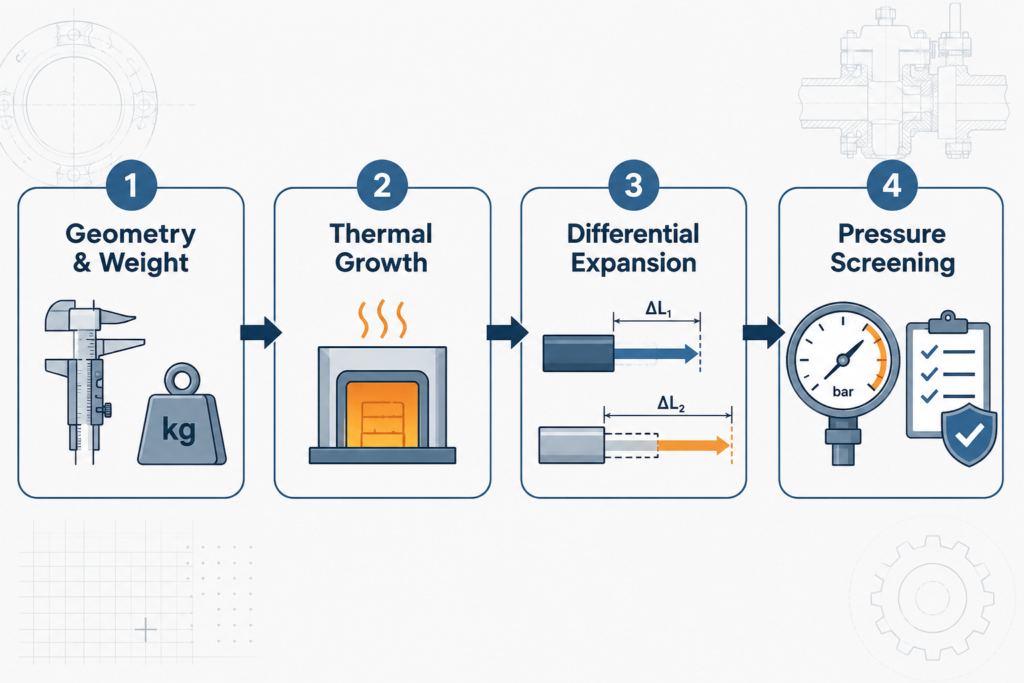
Quick answer: For a quartz tube mounted in a high-temperature, mildly pressurized process, work through four checks in order: geometry and weight, thermal growth at operating temperature, differential expansion against whatever it mounts to, and a pressure screening check on wall thickness. Each step uses a different calculator, and each result feeds into the next decision.
The Scenario
Say you're specifying a quartz process tube that will run from room temperature up to around 1000°C, mounted into a stainless steel flange at one end, with a small positive internal pressure during operation. You've got a rough target size in mind — 50 mm OD, 3 mm wall, 1 meter long — and need to confirm that's actually workable before requesting a quote.
Step 1: Confirm Geometry and Weight
Start with the Quartz Tube Dimension calculator. Enter OD (50 mm) and wall thickness (3 mm), and it returns the ID (44 mm) along with bore area, quartz cross-section, and internal volume. Add your length (1,000 mm) and it estimates weight — in this case, about 0.975 kg.
This step matters beyond just confirming the size looks right. Weight affects shipping cost and handling, and knowing your quartz cross-section early makes the next two steps — thermal and pressure screening — faster to work through, since both depend on this same geometry.
Step 2: Check Thermal Growth at Operating Temperature
Next, run the Thermal Expansion calculator using quartz's standard coefficient (about 0.55 ppm/K), your tube's length (1,000 mm), and your temperature range — 20°C up to 1000°C in this case. The result: about 0.54 mm of linear growth over that range.
This confirms one of quartz's core advantages for this kind of application — a full 980°C swing produces well under a millimeter of movement over a meter of length. If you were running this same check on a different material with a much higher CTE, this step alone might rule it out.
Step 3: Check Differential Expansion at the Mounting Point
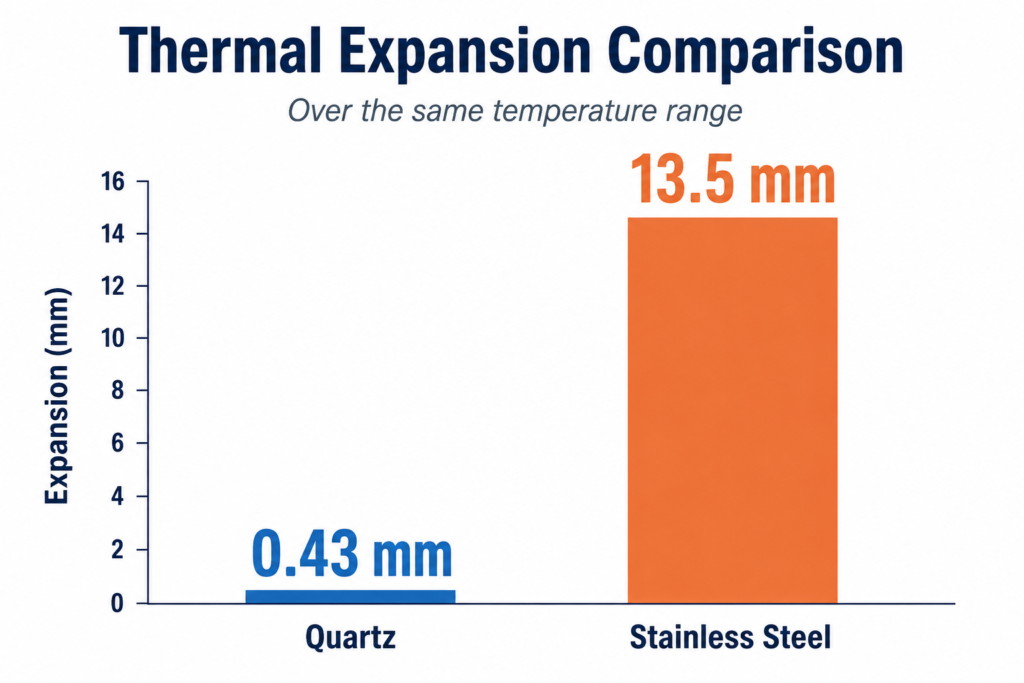
Here's where the flange mounting matters. Run the Differential Expansion calculator, entering your quartz tube (1,000 mm, 0.55 ppm/K) alongside the material it's mounting to — 304 stainless steel (1,000 mm, 17.3 ppm/K) — over the same temperature range, 20°C to 800°C in this example (a slightly lower range than the tube's peak, reflecting that the flange itself may run cooler than the hottest zone).
The result: quartz grows about 0.43 mm, the stainless steel grows about 13.5 mm, for a differential of roughly 13 mm. That gap is the number your mounting and seal design actually needs to absorb — a rigid, unaccommodating joint at this temperature range would put serious stress on the quartz well before reaching peak temperature.
This is the step that most often gets skipped when someone specifies quartz tube geometry in isolation and hands it to a mechanical designer separately. Running it early avoids finding out about a 13 mm mismatch after parts are already on order.
Step 4: Run a Pressure Screening Check
Finally, with your geometry confirmed, run the Tube Pressure Screening calculator using your OD (50 mm), ID (44 mm), expected internal pressure (2 bar in this example), a screening allowable stress (5 MPa is a conservative starting point), and a safety factor (3 is a reasonable default for an initial pass).
The calculator returns an inner-wall hoop stress of about 1.57 MPa against an effective allowable stress of 1.67 MPa (5 MPa ÷ safety factor 3) — meaning this geometry has a small but real margin at 2 bar, with a calculated maximum screening pressure around 2.12 bar before that margin runs out.
This is a screening result, not a certified rating. It doesn't account for surface condition, ports, end loads, sealing force, thermal gradients at the exact operating condition, cyclic loading, or assembly stress — all of which matter for quartz specifically because it's brittle and sensitive to stress concentration. If your margin comes back this tight, it's a signal to either increase wall thickness or get a qualified engineering review before finalizing the design, not a green light on its own.
Putting It Together
Across these four steps, the original 50 mm OD × 3 mm wall × 1,000 mm tube holds up reasonably well: manageable weight, minimal thermal growth, a differential expansion gap that needs to be designed into the mounting (not eliminated, since that's not possible with dissimilar materials), and a pressure margin that's positive but not generous. That last point alone might be reason to bump wall thickness slightly, which is exactly the kind of adjustment this kind of pre-quote check is meant to surface.
Frequently Asked Questions
Do I need to run all four calculators for every quartz tube order?
Not necessarily — simple, low-pressure, room-temperature applications may only need the geometry and weight check. The thermal and pressure steps matter most when temperature swings or mounting to a dissimilar material are involved.
What safety factor should I use for pressure screening?
This depends on your application's risk tolerance and any relevant industry standard you're working to. A factor of 3 is a common conservative starting point for an initial screen, not a universal answer.
Why does the differential expansion example use a lower temperature range than the tube's peak?
Mounting points and flanges often run cooler than the hottest zone of a process tube, so it's worth calculating differential expansion at the temperature the joint itself actually experiences, not necessarily the tube's peak operating temperature.
What happens if the pressure screening margin comes back negative or very tight?
Treat it as a signal to revisit wall thickness, operating pressure, or material selection before ordering — and for any application where failure has real consequences, get a qualified engineering review rather than relying on the screening result alone.
Can these calculators replace a formal engineering analysis for critical applications?
No. They're designed to catch obviously undersized or mismatched designs early and speed up the first pass toward a quote. Final designs for critical or high-consequence applications need qualified engineering review and, where appropriate, proof testing.
Getting to a Final Spec
Once these four checks look reasonable, you have a geometry, weight, and initial structural margin worth sending in as a real request rather than a rough guess. If a result raises a question — a tight pressure margin, a large differential expansion gap, or anything in between — send us the numbers along with your application details, and we can help work through the next level of detail.


