
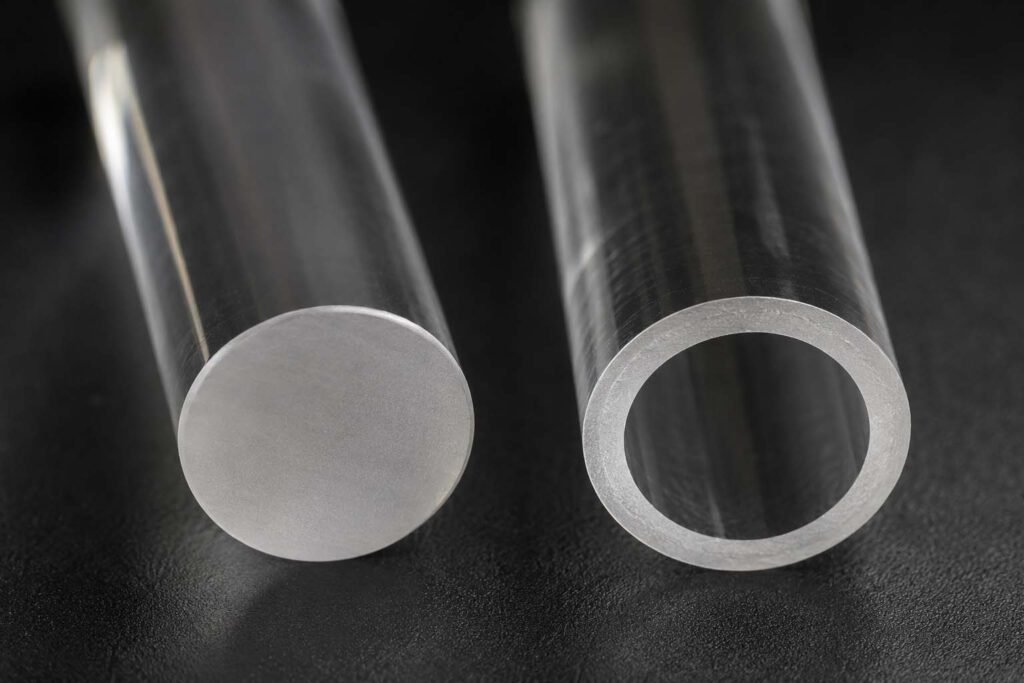
Quartz glass stock comes in two basic forms: solid rod and hollow tube. It sounds like an obvious choice — solid or hollow — but the decision affects strength, weight, cost, and what finishing operations are even possible. Getting it wrong at the specification stage often means reworking a drawing later.
Related resources: fused quartz rods and quartz glass tubes.
This guide compares rods and tubes directly and walks through how to decide which one your part actually needs.
Quick answer: Quartz rods are solid, offering higher structural strength per cross-section and no internal bore — used for support structures, stirring rods, and mounting posts. Quartz tubes are hollow, used wherever a fluid, gas, or line-of-sight path is needed — furnace liners, sight glasses, and lamp envelopes. If your part needs an internal passage, it's a tube. If it needs to support load or transmit force, it's usually a rod.
Quartz Rods vs. Tubes at a Glance
| Quartz Rod | Quartz Tube | |
|---|---|---|
| Cross-section | Solid | Hollow |
| Typical diameter range | ~1 mm to 100+ mm | ~0.5 mm to 400+ mm OD |
| Structural strength | Higher per cross-section | Lower, but lighter for the same OD |
| Internal passage | None | Yes (fluid, gas, or optical path) |
| Typical forms | Round, square, rectangular profiles | Round, occasionally shaped profiles |
| Common uses | Support posts, stirring rods, feedthrough pins, structural members | Furnace tubes, sight glasses, lamp envelopes, fluid/gas lines |
Values above are general industry reference figures. Confirm exact specs with your supplier's data sheet.
For background on how both forms are produced, see our guide on how quartz glass is made.
What Actually Separates a Rod from a Tube
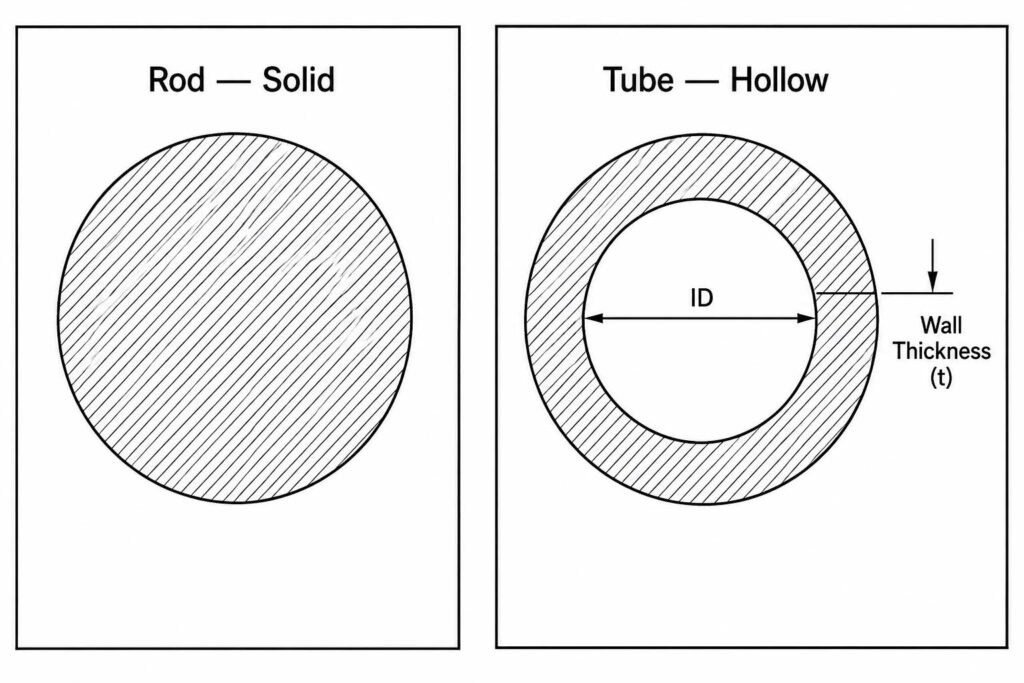
Both start from the same melting process, but forming diverges from there. Rods are drawn or extruded as a continuous solid cross-section. Tubes are drawn around a mandrel or with a hollow forming die, leaving a controlled internal bore.
That structural difference is the whole story: a rod has no internal dimension to control beyond its outer profile, while a tube has to hold both OD and ID (or wall thickness) within tolerance simultaneously — which is part of why tube production and quality control is generally more involved than rod production at a comparable size.
When to Choose a Rod
Structural support. Mounting posts, standoffs, and support members that need to resist bending or compressive load benefit from a rod's solid cross-section.
Stirring and handling tools. Lab stirring rods, probes, and handling tools are solid by design — there's no need for a bore, and solid material is more resistant to accidental breakage under sideways force.
Feedthroughs and pins. Where a rigid, solid pin needs to pass through a wall or fixture, rod stock is the natural choice.
Custom profiles. Beyond round rod, square and rectangular profile stock is available for parts that need flat mounting faces or specific cross-sectional geometry.
When to Choose a Tube
Fluid or gas passage. Any application where something needs to flow through the part — process gas lines, liquid handling, chromatography — requires a tube.
Line-of-sight or optical path. Sight glasses and viewports need an open bore to see through, which only a tube provides.
Furnace liners and process chambers. These need an internal volume to contain wafers, samples, or process gas, which is inherently a tube application.
Lamp envelopes. UV and infrared lamp housings are tubes by definition, containing the lamp element inside the bore.
Weight-sensitive large-diameter parts. At larger diameters, a tube is significantly lighter than an equivalent-OD solid rod, which matters for handling and mounting large components.
Can You Convert Between Them?
Rod stock can be bored or drilled to create a tube-like part with a custom internal diameter — useful when you need a bore size that doesn't match standard tube stock, or a thicker wall than standard tubing offers. This is a machining operation, not a forming one, so it adds cost compared to starting from tube stock, but it gives more control over final ID.
Tube stock cannot be converted into solid rod. If a design might need a solid cross-section in some configurations and a bore in others, it's worth specifying rod stock with the option to bore it later, rather than the reverse.
Sizing and Tolerances
Rod diameter tolerance is generally easier to hold than tube tolerance at a comparable size, since there's only one dimension (OD) to control instead of two (OD and ID). This can make rod stock — and machined-from-rod parts — a more economical option when tight tolerance matters more than weight or the need for a bore.
For full detail on how tube sizing and grading works, see our quartz glass tube buyer's guide.
Frequently Asked Questions
Is quartz rod stronger than quartz tube?
For the same outer diameter, yes — a solid cross-section resists bending and compressive load better than a hollow one. But a tube is lighter, which matters for some applications more than raw strength does.
Can I get a custom bore size by drilling a rod instead of ordering tube?
Yes. This is a common approach when a needed ID doesn't match standard tube stock, though it adds machining cost.
What profile shapes are available besides round rod and tube?
Square and rectangular rod profiles are commonly available. Custom profile shapes may be possible depending on the supplier's drawing capability.
Which is more expensive, rod or tube, at the same diameter?
It depends on wall thickness and tolerance requirements, but tube production generally involves tighter dual-dimension control, which can add cost compared to solid rod of the same OD.
Do rods and tubes come in the same grades and purities?
Yes — grade selection (natural vs. synthetic, JGS1/2/3, transparent vs. opaque) applies to both forms in the same way. See our guides on natural vs synthetic quartz glass and JGS1 vs JGS2 vs JGS3.
Specifying the Right Form
If your part needs to pass fluid, gas, or light through it, you need a tube. If it needs to resist load, support a structure, or handle without a bore, you need a rod. Most specification issues come from not asking that first question clearly before moving on to size and grade.
If you're not sure which form fits your design, send us your application details and we can recommend rod or tube stock — plus the right grade and finishing — for your part.


