
Optical and fiber applications push quartz glass specification further than almost any other use case. It's not enough for the material to be pure and heat-resistant — it has to be optically homogeneous, dimensionally precise, and free of the internal defects that would scatter or distort light passing through it.
Related resources: quartz windows and fiber-optic quartz capillaries.
This guide covers what actually matters when specifying quartz glass for optics and fiber-related components, beyond the general grade and property questions covered elsewhere.
Quick answer: Optical and fiber-grade quartz glass requires synthetic fused silica or high-purity natural material, selected by wavelength (JGS1 for deep UV, JGS2 for general UV-Vis, JGS3 for IR), with tight control on refractive index homogeneity, bubble/inclusion content, and striae. Components include lenses, windows, beam splitters, prisms, and fiber preforms, often finished with anti-reflective or other functional coatings.
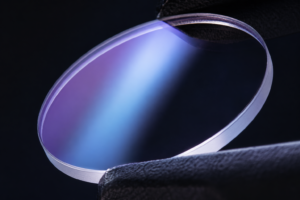
Optical Quartz Glass at a Glance
| Requirement | What It Controls |
|---|---|
| Grade (JGS1/JGS2/JGS3) | Wavelength range and OH content — see our grade guide |
| Refractive index homogeneity | Wavefront distortion across the optic |
| Bubble/inclusion content | Light scatter and localized defects |
| Striae | Internal refractive index variation from imperfect mixing during melt |
| Surface flatness/figure | Wavefront accuracy for precision optics |
| Coatings | Reflectance control at specific wavelengths |
For grade selection fundamentals, see our guide on JGS1 vs JGS2 vs JGS3. For flatness and surface quality specs on flat components, see our flat quartz glass guide.
Why Optical Applications Need More Than "High Purity"
General industrial and structural quartz applications mostly care about purity for contamination and thermal performance reasons. Optical applications add a second requirement entirely: the material has to be internally uniform enough that light passing through it isn't distorted.
Two defects matter here that don't come up much outside optics:
Striae are subtle streaks of varying refractive index within the glass, caused by incomplete mixing during the melt process. They're often invisible to the naked eye but can measurably distort a wavefront passing through the material — a serious problem for laser optics and imaging systems, largely irrelevant for a furnace tube.
Refractive index homogeneity describes how consistent the refractive index is across the whole piece. High-end optical applications may require homogeneity controlled to a fraction of a part per million, which is only achievable with carefully controlled synthetic material.
Choosing Material for Optical Components
Synthetic fused silica is the default choice for most demanding optical applications, since it minimizes both bubble content and trace metal impurities that can affect transmission and homogeneity. See our guide on natural vs synthetic quartz glass for the full comparison — natural material can still work for less demanding optical applications, particularly in the visible range where deep-UV performance and extreme homogeneity aren't required.
Grade selection follows the same wavelength logic covered in our JGS1 vs JGS2 vs JGS3 guide: JGS1 for deep-UV optics, JGS2 for general UV-visible use, JGS3 where infrared performance matters most.
Common Optical Component Types
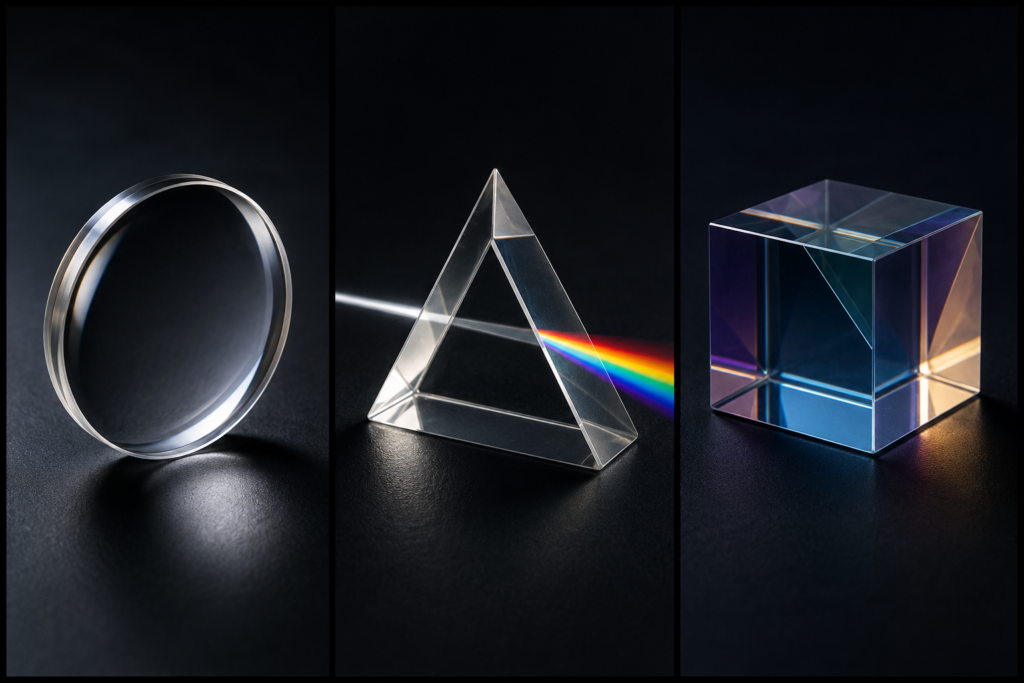
Windows — flat optical components that protect a system or pass light through with minimal distortion; see our flat quartz glass guide for flatness and surface quality specification.
Lenses — curved optical elements requiring precise radius of curvature and figure control in addition to material homogeneity.
Beam splitters — flat or cube components, often coated, designed to divide an incoming beam by a controlled ratio.
Prisms — used for beam steering, dispersion, or polarization control, requiring precise angular tolerances between faces.
Mirrors and mirror substrates — quartz glass provides a dimensionally stable substrate for reflective coatings, particularly valued for its low thermal expansion in precision or high-power applications.
Fiber-Optic Preform Material
Fiber-optic manufacturing starts with a preform — a solid rod or hollow tube of ultra-pure synthetic fused silica that's later drawn down into fiber at high temperature. Preform-grade material demands extremely tight control over OH content, metallic impurities, and internal defects, since any flaw in the preform carries through — and is optically magnified — in the drawn fiber.
This is one of the most demanding applications of synthetic fused silica production, typically requiring material produced via chemical vapor deposition for the purity and homogeneity control the process needs.
Coatings
Many optical quartz components are finished with a functional coating rather than used bare:
- Anti-reflective (AR) coatings reduce reflection losses at specific wavelengths, improving transmission efficiency.
- High-reflective (HR) coatings turn a quartz substrate into a mirror at a target wavelength.
- Conductive coatings are used in some specialized applications requiring a transparent conductive surface.
Coating selection depends entirely on the target wavelength and function — a coating optimized for one wavelength range can actually hurt performance at another, so coating specs need to match the actual operating wavelength, not just "AR coating" as a generic request.
Frequently Asked Questions
What's the difference between optical-grade and standard industrial-grade quartz glass?
Optical grade adds requirements around refractive index homogeneity, striae, and bubble content that standard industrial material doesn't need to meet, since those defects don't matter for structural or thermal-only applications.
Do all optical quartz components need synthetic material?
Not always — natural material can suffice for less demanding visible-range optics, but most precision, deep-UV, or laser applications require synthetic fused silica for its purity and homogeneity.
What is striae, and why does it matter?
Striae are internal refractive index variations from incomplete mixing during melting. They're often invisible but can distort a wavefront passing through the glass, which matters for precision optics but not for general structural or thermal use.
How is a fiber-optic preform different from standard rod stock?
Preforms require far tighter control over purity, OH content, and internal defects than general-purpose rod stock, since any imperfection is magnified when the preform is drawn down into thin fiber.
Do I need a coating on my optical quartz component?
It depends on your application's tolerance for reflection loss. Uncoated quartz already has reasonably low reflectance, but coatings become worthwhile when transmission efficiency at a specific wavelength is critical.
Specifying Optical-Grade Quartz Correctly
Optical specification is really about matching material and finishing requirements to how sensitive your application is to distortion and light loss — not defaulting to the tightest possible spec across the board. If you're not sure what level of optical quality your component needs, send us your wavelength, geometry, and performance requirements for a recommendation.


