
Semiconductor and solar cell manufacturing both depend on process steps that run at extreme temperature in ultra-clean conditions — exactly the environment quartz glass is built for. But not every quartz component in a fab or a solar line is specified the same way, and getting purity or geometry wrong can show up as yield loss rather than an obvious failure.
Related resources: quartz wafer boats and quartz furnace and diffusion tubes.
This guide covers the main quartz components used in these industries, how they're specified, and what to check before ordering.
Quick answer: Quartz components in semiconductor and solar manufacturing include wafer boats/carriers, diffusion furnace tubes, bell jars, and process chamber liners. These parts typically require high-purity synthetic or premium natural fused quartz (JGS1 or JGS2) to avoid introducing metal contamination during high-temperature processing. Specification depends on wafer size, slot configuration, process temperature, and chamber geometry.
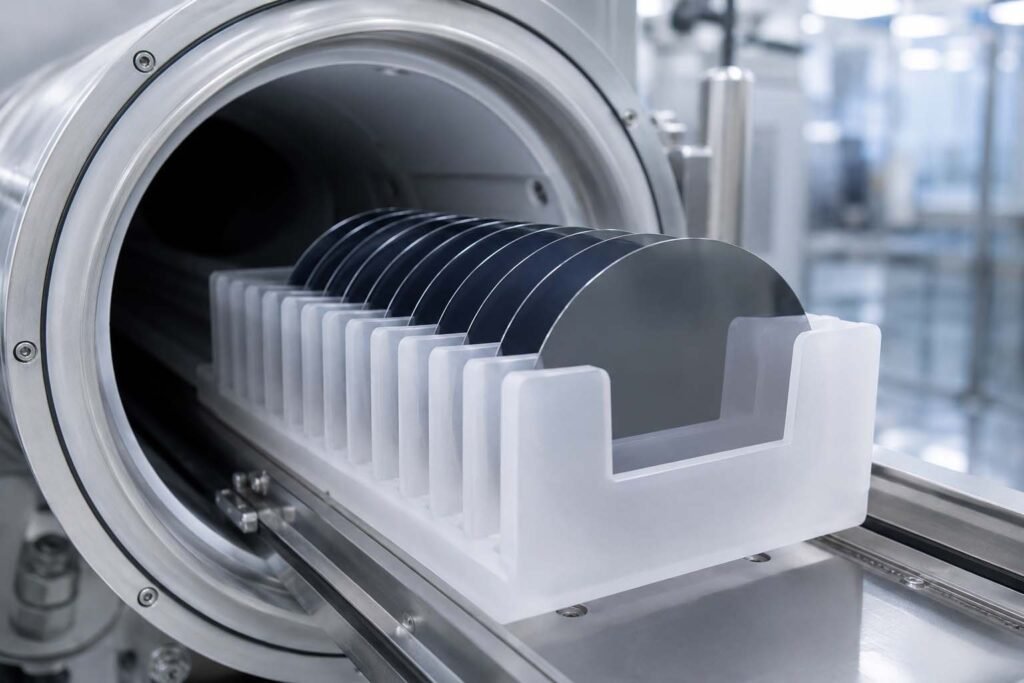
Key Semiconductor & Solar Quartz Components
| Component | Function | Typical Grade |
|---|---|---|
| Wafer boats/carriers | Hold and transport wafers through furnace processing | JGS1/JGS2, transparent or translucent |
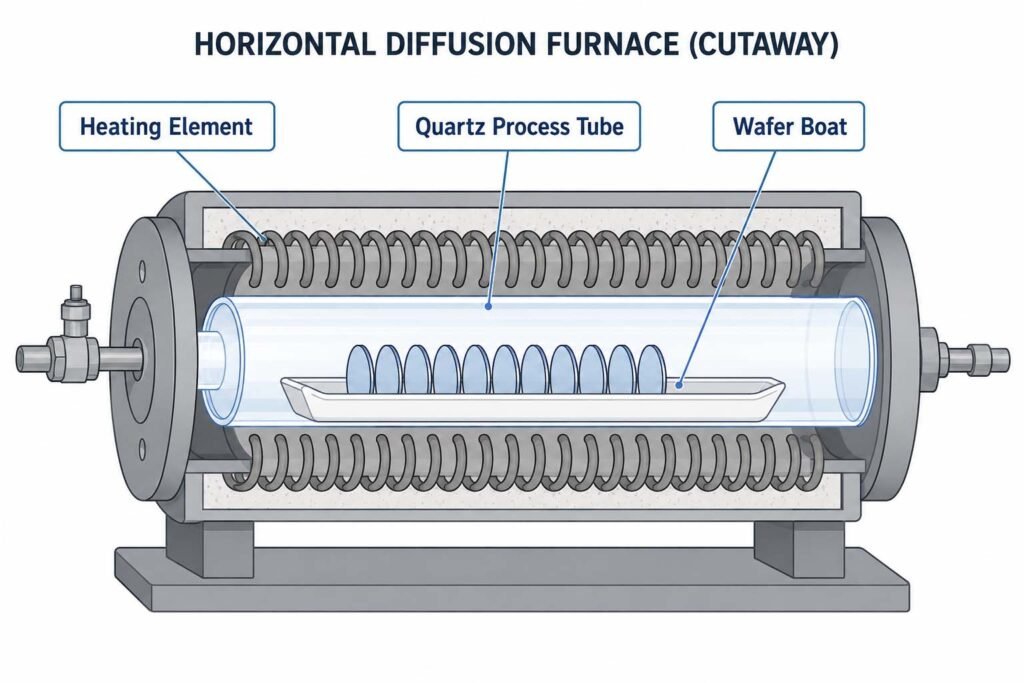
| Diffusion furnace tubes | Contain the process atmosphere during high-temp diffusion, oxidation, annealing | JGS1/JGS2, high purity |
| Bell jars | Enclose CVD or other process chambers | High-purity transparent or opaque |
| Process chamber liners | Protect chamber walls, prevent particle generation | Opaque or translucent, high purity |
| Sputtering targets | Source material for thin-film deposition processes | Ultra-high-purity synthetic |
Grade requirements vary by process step and supplier. Confirm exact specs against your process tool's requirements.
For background on quartz glass grading, see our guide on JGS1 vs JGS2 vs JGS3.
Why Quartz Is the Standard Material Here
Semiconductor and solar processes run at high temperature — often 1000°C or more — in steps like diffusion, oxidation, and annealing. At the same time, even trace metal contamination on a wafer surface can cause device failure. Quartz glass is one of the few materials that satisfies both requirements at once: it holds up structurally and dimensionally at these temperatures, and high-purity grades introduce essentially no metallic contamination.
For the full picture of quartz glass properties, see our guide on what quartz glass is.
Wafer Boats and Carriers
Wafer boats hold silicon wafers in precise, evenly spaced slots during furnace processing. Slot pitch, slot count, and wafer diameter (150 mm, 200 mm, 300 mm, and others) all need to match your specific furnace and process tool — this isn't a one-size-fits-all component.
Boats are available in transparent, translucent, and opaque quartz. Translucent and opaque material diffuses radiant heat more evenly across the boat, which reduces temperature differentials between wafers during fast thermal cycles — a meaningful factor in process uniformity.
Diffusion Furnace Tubes
These tubes contain the process atmosphere during diffusion, oxidation, and similar high-temperature steps, and they see some of the most demanding thermal cycling in the whole process line. Wall thickness, diameter, and length need to match the furnace geometry precisely, and purity requirements are typically at the high end of the JGS1/JGS2 range to avoid contaminating the wafers inside.
For general tube sizing and grading background, see our quartz glass tube buyer's guide.
Bell Jars and Process Chamber Components
Bell jars enclose CVD and similar deposition processes, and chamber liners protect the surrounding equipment from process byproducts while minimizing particle generation. These components are often larger and more custom-shaped than standard tube or rod stock, and typically require careful surface finish specification since particle generation from the quartz surface itself can affect yield.
Purity and Grade Requirements
Most semiconductor-grade quartz components call for JGS1 or high-purity JGS2 material — see our JGS1 vs JGS2 vs JGS3 guide for how these grades differ. In many cases, synthetic fused silica is specified specifically to minimize trace metal content; our natural vs synthetic quartz glass guide covers that distinction in detail.
The right choice depends on your specific process step and its sensitivity to contamination — not every component in a fab needs the highest available purity grade, and over-specifying adds unnecessary cost across high part volumes.
When to Replace Quartz Components
Quartz components in high-temperature service have a service life, not an indefinite lifespan. Watch for:
- Devitrification — a cloudy or frosted appearance where the glass has begun to crystallize, which weakens the material and increases particle generation
- Surface staining or discoloration from repeated process exposure
- Dimensional drift from repeated thermal cycling
- Visible cracking or chipping, especially at edges and mounting points
Our guide on what quartz glass is covers devitrification risk in more detail under material limitations.
Frequently Asked Questions
What grade of quartz is used for semiconductor wafer boats?
Typically JGS1 or high-purity JGS2, depending on the process step's sensitivity to trace metal contamination.
Why are some wafer boats opaque instead of transparent?
Opaque and translucent quartz diffuse heat more evenly, reducing temperature differences across wafers during fast thermal cycles — a practical advantage in some furnace processes even though transparency isn't needed.
How often do quartz furnace tubes need to be replaced?
This depends on operating temperature, cycle frequency, and contamination exposure. Devitrification and dimensional drift are the main signs it's time to inspect or replace a tube.
Can quartz components be custom-sized to match my furnace?
Yes. Wafer boats, tubes, and chamber components are commonly made or modified to match specific furnace models and wafer sizes.
Is natural or synthetic quartz used for semiconductor components?
Both are used, depending on the purity requirement of the specific process step. High-contamination-sensitivity steps typically call for synthetic material; see our natural vs synthetic quartz glass guide for the full comparison.
Specifying Quartz for Your Process Tool
Getting semiconductor and solar quartz components right comes down to matching grade and purity to the actual contamination sensitivity of your process step, and matching geometry precisely to your furnace or tool. If you're specifying wafer boats, diffusion tubes, or chamber components, send us your furnace model, wafer size, and process requirements for a detailed recommendation.


