
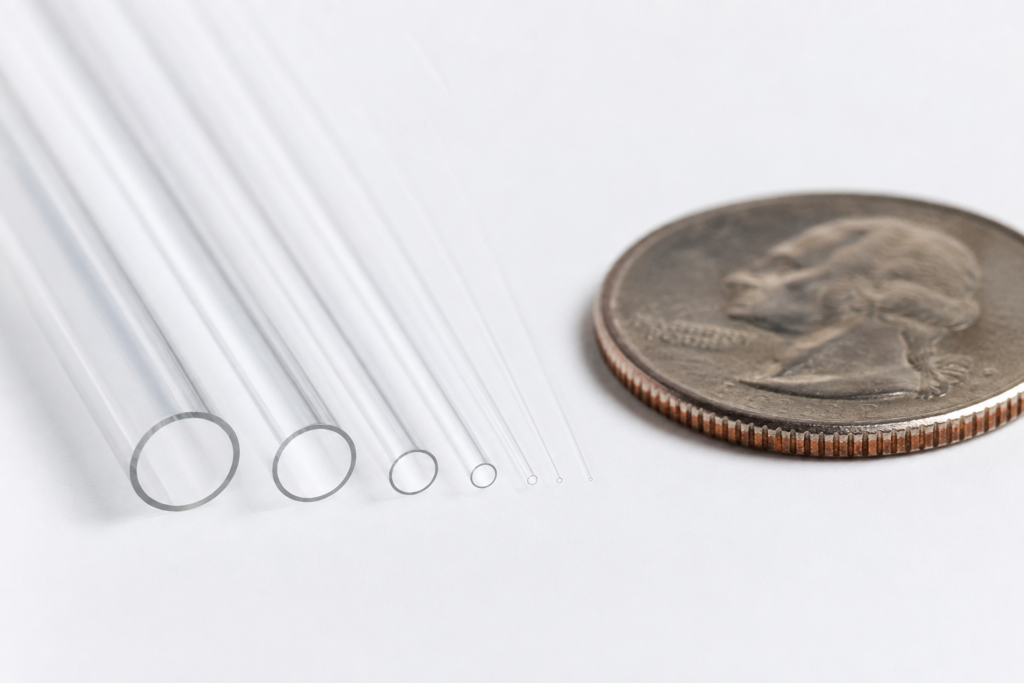
Capillary tubing is quartz glass at its smallest and most demanding — outer diameters that can be under a millimeter, wall thicknesses measured in microns, and tolerances tight enough that a fraction of a micron of variation can affect an instrument's results. This is a different specification exercise than standard tube stock.
Related resources: precision round quartz capillaries and multi-hole quartz capillaries.
This guide covers how quartz capillaries are sized, what tolerance actually matters most, and where they're used.
Quick answer: Quartz capillary tubes are precision-drawn tubing with outer diameters typically from about 0.1 mm to 10 mm, though sizes up to 50 mm are available. They're used where dimensional consistency directly affects performance — X-ray crystallography, gas and liquid chromatography, microfluidics, and fiber-optic preforms. Inner diameter (ID) tolerance, not outer diameter, is usually the most critical spec.
Quartz Capillaries at a Glance
| Spec | Typical Range |
|---|---|
| Outer diameter | ~0.1 mm to 10 mm (up to 50 mm for larger capillary/rod stock) |
| Wall thickness | As thin as ~0.01 mm on specialty items |
| OD tolerance | Often ±0.01 mm standard, tighter on request |
| ID tolerance | Can be held to sub-micron levels for critical applications |
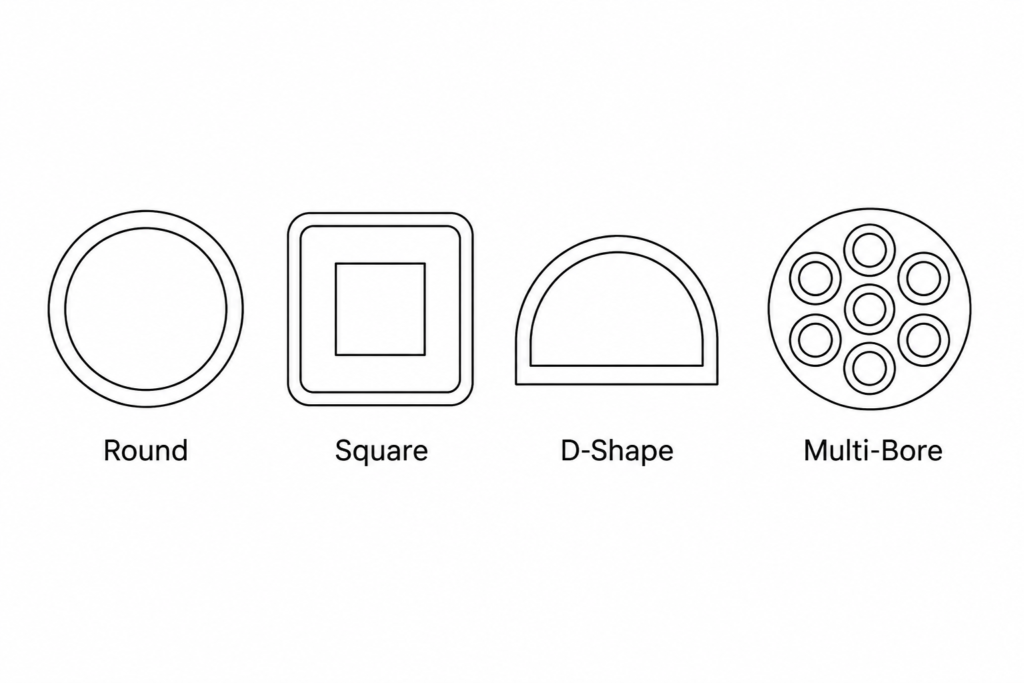
| Cross-sections | Round, square, rectangular, D-shape, multi-bore |
| Grades | JGS1/JGS2 (by wavelength), industrial grade for non-optical use |
Values above are general industry reference figures. Confirm exact specs with your supplier's data sheet.
For general tube sizing and grading background, see our quartz glass tube buyer's guide.
What Makes Capillary Tubing Different from Standard Tube
Standard tube production controls OD and wall thickness within a tolerance that's comfortable at millimeter scale. Capillary production has to hold that same kind of control at a much smaller scale, often continuously during a high-temperature draw process, using real-time diameter monitoring to adjust draw speed as the tube forms.
The smaller the target size, the more a small process variation shows up as a large percentage error. That's why capillary tubing is treated as its own product category rather than just "small tube" — it needs tighter process control at every step.
Why Inner Diameter Tolerance Matters Most
For most standard tube applications, wall thickness consistency matters for structural and thermal reasons. For capillary applications, inner diameter tolerance is usually the spec that actually determines whether the part works.
In chromatography and capillary electrophoresis, separation performance is directly affected by ID consistency — even a small variation in bore size changes flow characteristics and can distort results. In X-ray crystallography, capillary ID needs to match the sample and mounting requirements precisely. This is why capillary suppliers often quote ID tolerance separately, and more tightly, than OD tolerance.
Cross-Section Shapes
Round is the standard cross-section, but capillary tubing is also available in:
- Square and rectangular profiles, used in some optical and microfluidic applications where a flat viewing surface matters
- D-shape capillaries, combining a flat reference surface with a round bore
- Multi-bore configurations — double, triple, or more parallel channels in a single piece, used in specialized fluid or gas delivery applications
Shape selection depends entirely on the application's mounting, flow, or optical requirements — round covers the large majority of general use cases.
Grades and Optical Considerations
Capillaries used in optical or UV-sensitive applications — fluorescence detection, UV absorbance measurement, laser coupling directly through the capillary wall — need the same grade consideration as any other optical quartz component. See our guide on JGS1 vs JGS2 vs JGS3 for how UV and IR transmission vary by grade.
For purely mechanical or fluidic applications with no optical requirement, standard industrial-grade capillary material is usually sufficient and more cost-effective than an optical grade.
Coated vs. Uncoated Capillaries
Bare quartz capillary is brittle and can be difficult to handle without breaking, especially at very small diameters. For applications like HPLC that need to route thin capillary through instrument pathways, a polymer coating — typically polyimide — is often applied. This adds flexibility and abrasion resistance without significantly affecting the glass's core properties. Uncoated capillary is standard for applications where the coating isn't needed or would interfere with the application, such as certain optical measurements.
Common Applications
X-ray crystallography. Sample-holding capillaries need precise, consistent bore diameter to properly mount and expose crystal samples during data collection.
Chromatography and capillary electrophoresis. ID consistency directly affects separation efficiency, making this one of the most tolerance-sensitive capillary applications.
Microfluidics. Small, precise bores control fluid flow in lab-on-chip and sensor applications.
Fiber-optic preforms. Capillary and rod stock serve as intermediate material in some fiber manufacturing processes, where dimensional consistency affects the final drawn fiber.
High-temperature sensor and thermocouple protection. Thin-wall capillary sleeves protect sensors while minimizing thermal mass and response lag.
Frequently Asked Questions
What's the smallest quartz capillary diameter available?
Specialty items can go well under 0.1 mm OD, though minimum practical size depends on wall thickness and the specific supplier's drawing capability.
Why does ID tolerance cost more than OD tolerance?
Holding a precise bore size while simultaneously controlling outer diameter during a high-temperature draw is more demanding than controlling OD alone, which is why tight ID tolerance is often the main cost driver on a capillary quote.
Do I need a coated or uncoated capillary?
Coated (typically polyimide) capillary is common for handling durability in instruments like HPLC systems. Uncoated capillary is standard for optical applications or where the coating would interfere with the intended use.
Can capillary tubes be custom-shaped, like tapered or closed at one end?
Yes, many suppliers offer custom end treatments — closed ends, tapers, funnel shapes — particularly for applications like X-ray sample capillaries that need a specific loading geometry.
What grade of quartz capillary do I need for UV fluorescence work?
This depends on your exact wavelength. See our JGS1 vs JGS2 vs JGS3 guide to match grade to your transmission requirement.
Specifying Capillary Tubing Correctly
The biggest mistake in capillary specification is treating it like scaled-down standard tube. ID tolerance, cross-section shape, and coating all need explicit thought before ordering. If you're not sure which spec matters most for your application, send us your size, tolerance, and application details and we can recommend the right capillary configuration.


