
It's a reasonable assumption that quartz glass, with its purity and chemical resistance, would be the default material for pharmaceutical vials and syringes. In practice, it isn't — and understanding why clarifies where quartz glass actually earns its place in pharma and medical manufacturing.
This guide covers the real applications of quartz glass across pharmaceutical and medical settings, and explains the one major area where borosilicate wins instead.
Quick answer: Quartz glass is used throughout pharmaceutical and medical manufacturing in analytical instrumentation, laboratory equipment, UV sterilization systems, and high-purity process equipment. It is not typically used for primary packaging — vials, syringes, ampoules — because its very high processing temperature makes it impractical to form into thin-walled containers at production scale. Borosilicate glass dominates that specific application instead.
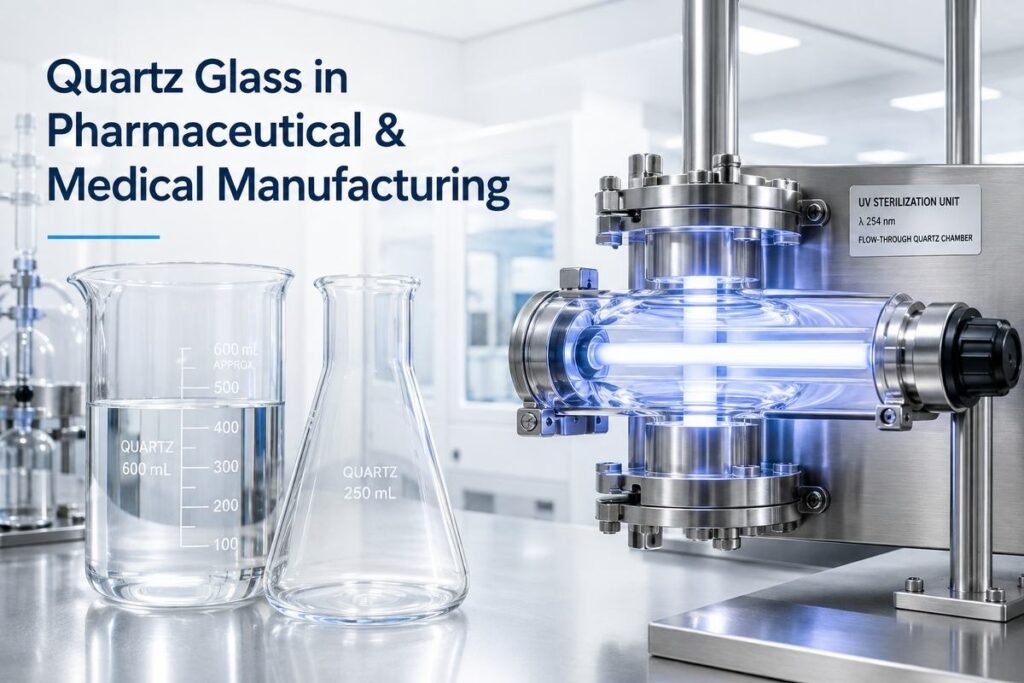
Where Quartz Glass Is Actually Used in Pharma and Medical
| Application | Why Quartz Glass Fits |
|---|---|
| Analytical & QC instrumentation | UV-Vis transmission for spectroscopy, chemical inertness for sample handling |
| Laboratory glassware | High-temperature stability, chemical resistance, low contamination risk |
| UV sterilization systems | UV transmission for disinfection of water, air, or surfaces in cleanroom and production settings |
| Process sight glasses & viewports | Visual monitoring of high-temperature or high-purity process steps |
| Diagnostic instrument components | Optical clarity and dimensional stability in sensor and detector assemblies |
Why Quartz Glass Isn't Used for Vials, Syringes, and Ampoules
Primary pharmaceutical packaging needs to be formed into precise, thin-walled shapes at high volume — a process that relies on flame-working glass tubing into vials, ampoules, and syringe barrels. Quartz glass has a working point temperature above roughly 1700°C, far higher than the temperatures used for standard pharmaceutical packaging glass. That makes it impractical to flame-convert into packaging shapes at the scale and cost pharmaceutical manufacturing requires.
Borosilicate glass (commonly Type I glass in pharmaceutical classification) fills this role instead, offering strong chemical resistance and low extractables at a working temperature that's actually practical for high-volume container forming. For background on how quartz and borosilicate compare more generally, see our guide on quartz glass vs borosilicate glass.
This is worth knowing before specifying quartz for a packaging-adjacent application — it's very likely the wrong material for the job, regardless of its purity advantages elsewhere.
Analytical and QC Instrumentation
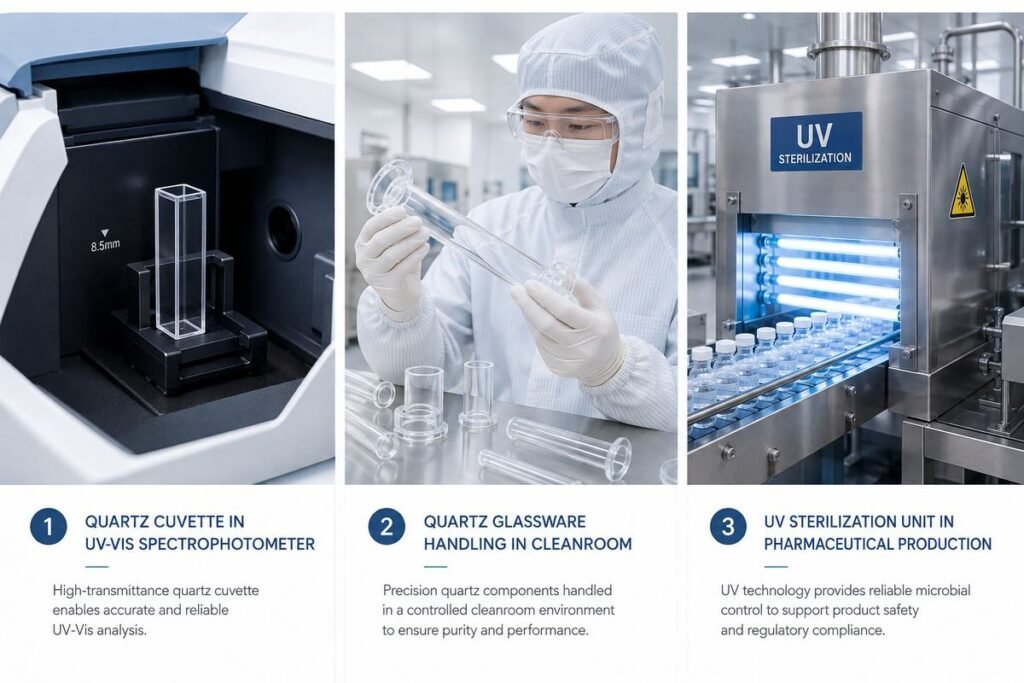
Pharmaceutical quality control relies heavily on spectroscopy, and quartz cuvettes are the standard choice wherever UV-Vis measurement is involved, since standard optical glass blocks much of the relevant UV range. Quartz crystal microbalance (QCM) sensors, used in some formulation and packaging research, also rely on precisely manufactured quartz crystal elements for their mass-sensing function.
For general lab glassware background, see our fused quartz labware guide, which also covers when quartz makes sense over borosilicate for general lab use.
Laboratory and Process Equipment
Beyond analytical instruments, quartz glass shows up throughout pharmaceutical R&D and manufacturing support functions: high-temperature sample preparation, chemically demanding reactions, and general lab work where trace contamination could affect results. It's the same set of advantages covered in our fused quartz labware guide — high-temperature tolerance, chemical resistance, and low contamination risk — applied specifically in a pharma quality-sensitive context.
UV Sterilization in Pharmaceutical Manufacturing
UV disinfection systems, used for purified water systems and some air and surface sterilization applications in pharmaceutical facilities, rely on quartz glass sleeves and lamp jackets for the same reason they're used in general UV sterilization — quartz transmits UV light efficiently, while standard glass blocks most of it. See our what is quartz glass guide for the underlying UV transmission properties driving this application.
Process Sight Glasses and High-Purity Equipment
Where pharmaceutical processing involves high temperature or requires visual monitoring without introducing contamination, quartz sight glasses and viewports serve the same function they do in other high-purity industrial settings — allowing operators to observe a process without compromising the sealed or sterile environment.
Frequently Asked Questions
Are pharmaceutical vials made of quartz glass?
Generally no — most pharmaceutical vials, ampoules, and syringes are made from borosilicate (Type I) glass, since quartz glass's high processing temperature makes it impractical for high-volume container forming.
Why is quartz glass used for pharma lab equipment but not packaging?
Lab equipment is typically shaped in lower volumes with more processing flexibility, where quartz's purity and thermal advantages are worth the added fabrication cost. Packaging needs to be flame-formed at high volume and low cost, which favors borosilicate's lower working temperature.
What role does quartz glass play in pharmaceutical quality control?
Primarily through analytical instrumentation — UV-Vis spectroscopy cuvettes, QCM sensors, and general lab glassware used in testing and formulation work.
Is quartz glass used in UV sterilization for pharmaceutical facilities?
Yes, in UV disinfection systems for purified water and some air/surface sterilization applications, where quartz sleeves transmit UV light efficiently.
Should I specify quartz or borosilicate for pharmaceutical process equipment?
It depends on the specific function. For general processing under 500°C with standard chemical exposure, borosilicate is often sufficient and more practical. For higher temperature, deep-UV, or extreme-purity requirements, quartz is the better fit. See our quartz glass vs borosilicate glass guide for a full comparison.
Specifying the Right Material for Pharma Applications
The key distinction is function, not industry: quartz glass fits pharma and medical applications that need its specific advantages — UV transmission, extreme temperature tolerance, or ultra-low contamination — not general container or packaging needs. If you're specifying quartz components for a pharmaceutical or medical application, send us your process requirements and we can confirm whether quartz is the right material and recommend the right form.


