
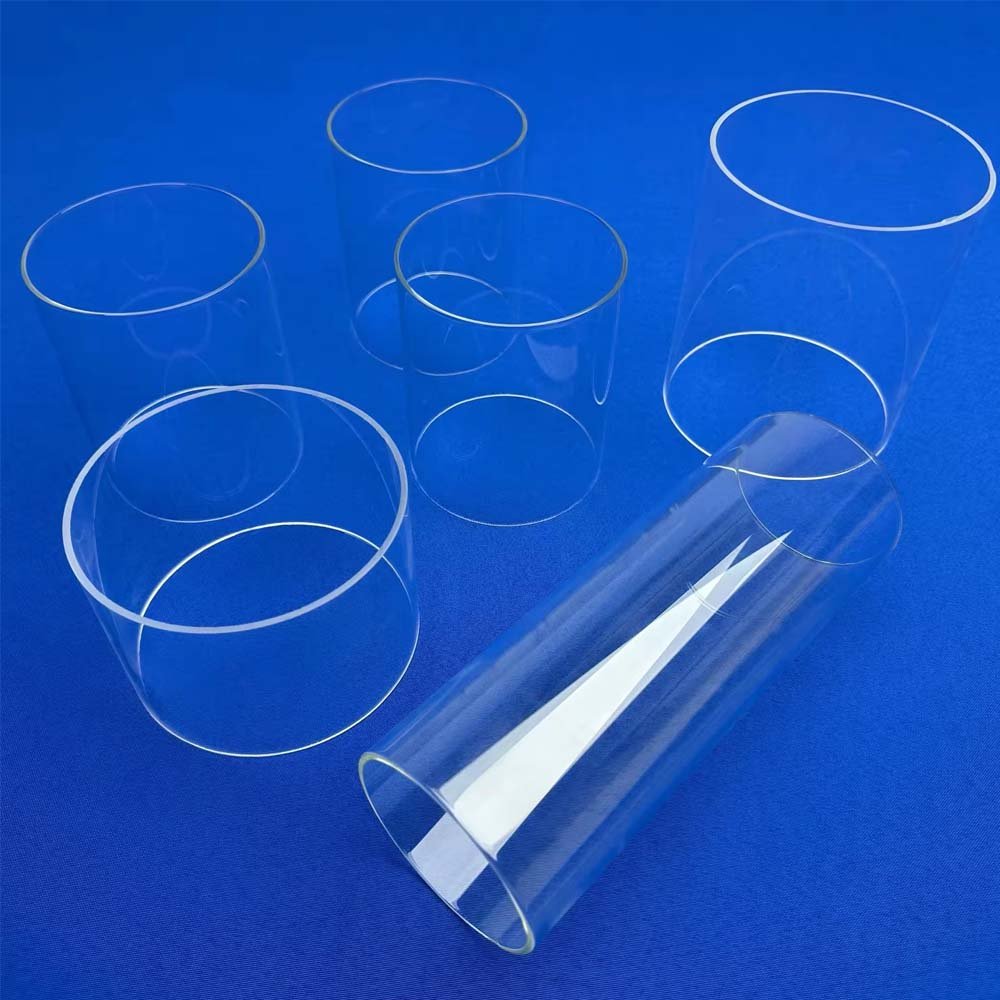
 Custom Large-Diameter & Thick-Wall Quartz Tubes
Custom Double-Bore & Multi-Bore Quartz Tubes
| Parameter | Factory Standard | Manufacturing Limit |
|---|---|---|
| Outer OD | 3–50 mm | Up to 100 mm on request |
| Hole count | 2–7 | Up to 19, pattern-dependent |
| Bore diameter | 0.3–10 mm per hole | Down to 0.2 mm, tolerance-dependent |
| Hole pitch | 1.2–3× bore diameter | Tighter pitch narrows web thickness |
| Web thickness (between holes) | ≥0.3 mm | Down to 0.15 mm on request |
| Length | Up to 3,000 mm | Longer via tube-to-tube welding |
| Hole position tolerance | ±0.03–0.05 mm | Tighter, confirmed per order |
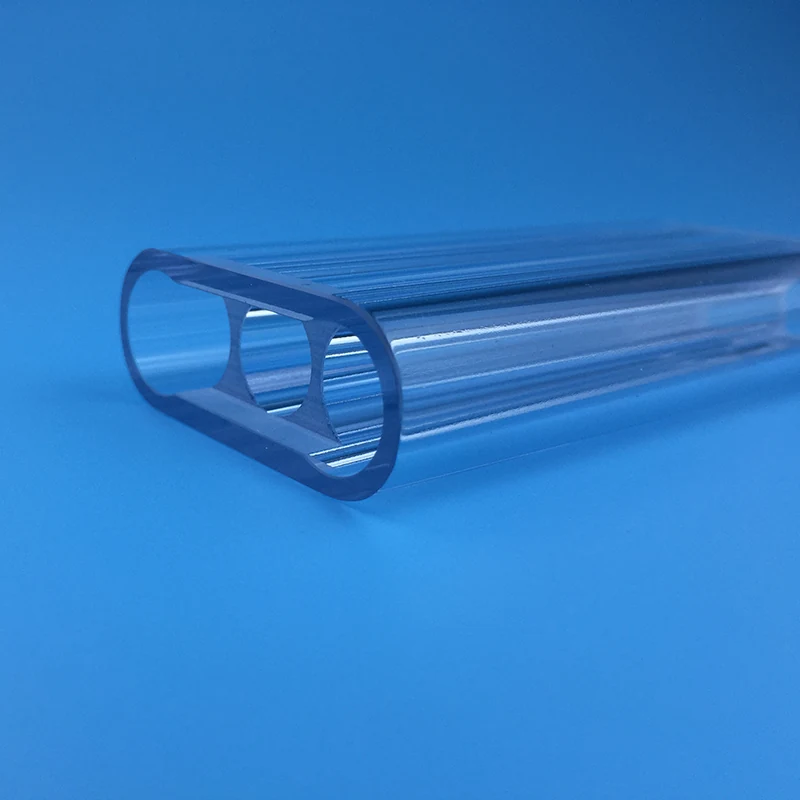
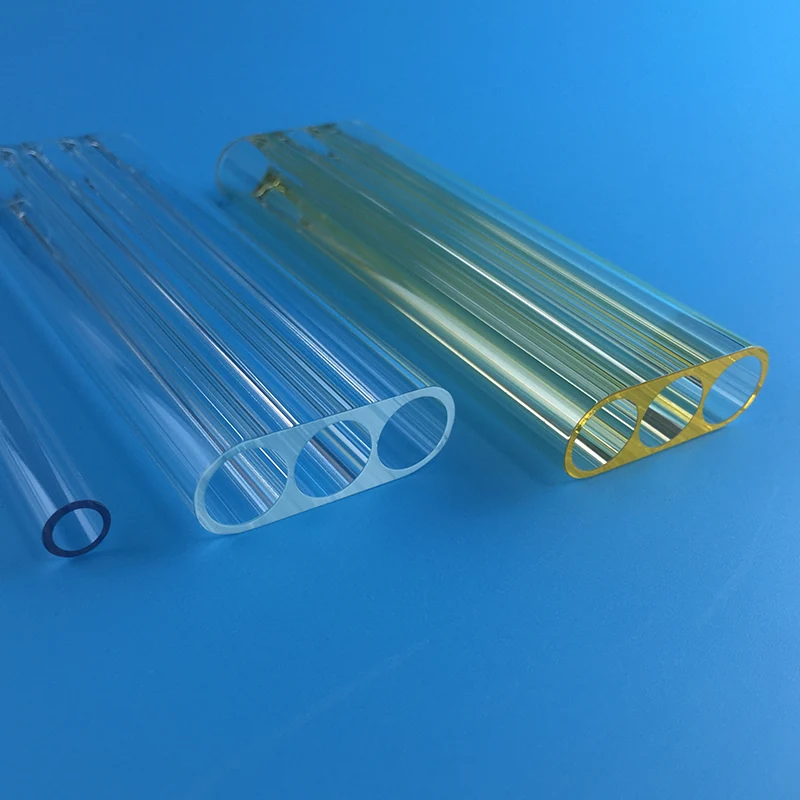
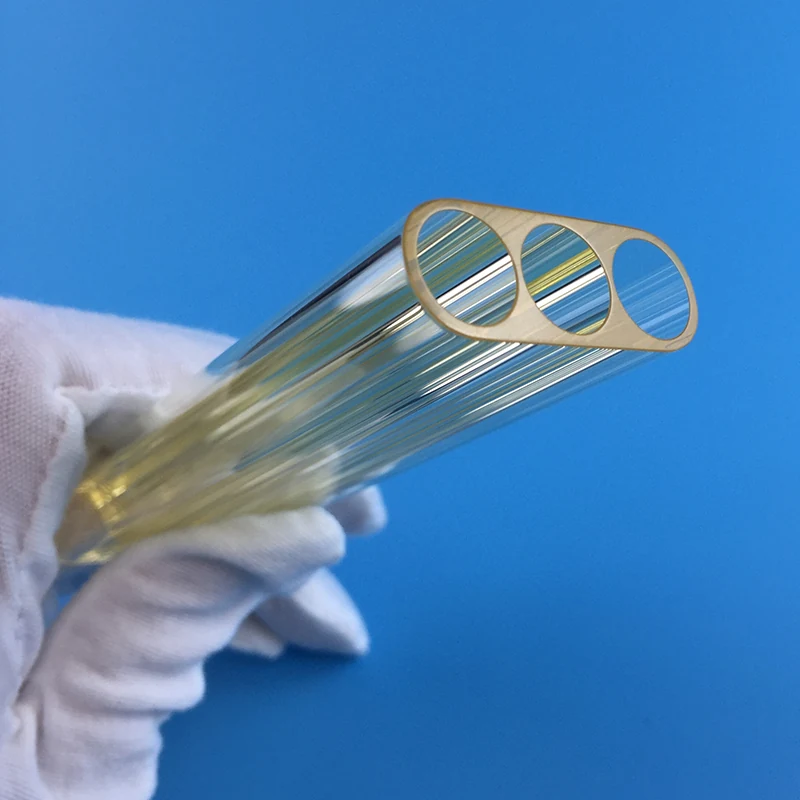
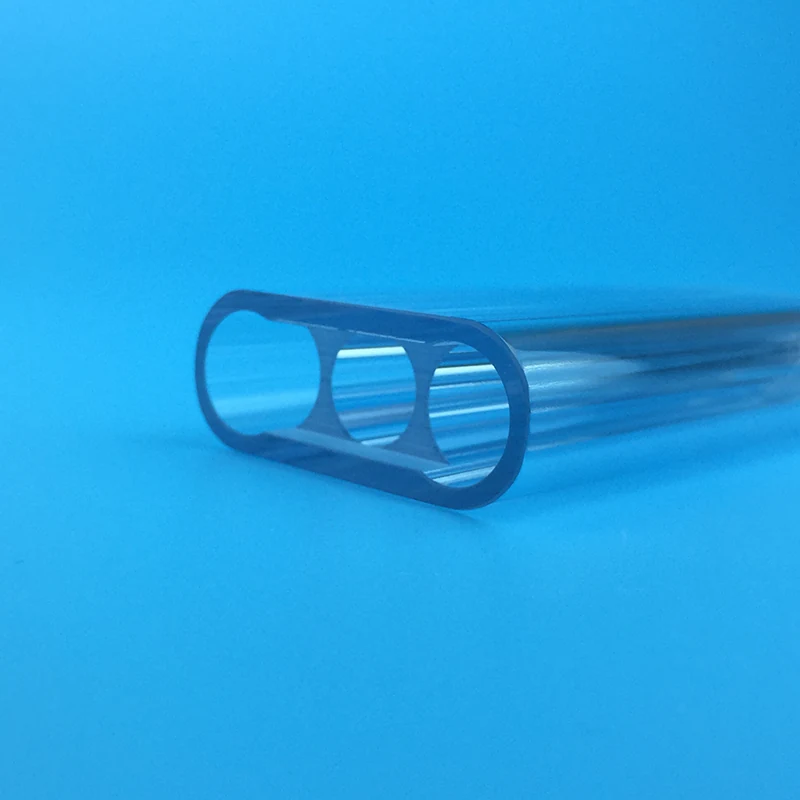
Quartz Glass draws quartz tubing with two or more parallel bores in a single piece — used where separate channels need to run side by side without a secondary assembly step.
Bore diameter, pitch, web thickness, and outer wall aren't independent choices — increasing bore diameter or tightening pitch directly eats into web thickness and the remaining outer wall. Send all four together on your RFQ rather than specifying one and asking us to fill in the rest.
Double-Bore, Multi-Bore and Eccentric-Bore Configurations
- Double-bore — two parallel channels, equal or unequal diameter, for applications needing two isolated paths (e.g., supply and return) in one part
- Multi-bore — three or more holes in a fixed pattern, typically symmetric around the tube axis
- Eccentric-bore — one or more holes offset from center, used when a channel needs to sit close to the outer wall
Precision drawing and redrawing is how the hole pattern is set and held through the draw — this is a Quartz Glass quartz tubes and tubing capability, not a separate process line.
Hole Diameter, Pitch and Web Thickness
Web thickness — the quartz wall left between adjacent holes — is usually the limiting factor, not hole diameter itself. A tight pitch with large bores can leave a web too thin to survive drawing or later handling without cracking. If your design needs a thinner web than the standard figures above, tell us the application (pressure, temperature, or just space constraint) so we can confirm whether it's achievable with secondary micro-machining instead of drawing alone.
Double-Bore & Multi-Bore Quartz Tubes Factory Standard & Manufacturing Limit
The table above separates what's repeatable without added cost or lead time (Factory Standard) from what's achievable but needs confirmation and usually more inspection (Manufacturing Limit). Maximum hole count and minimum bore diameter are not simultaneously available at the tightest pitch — the more holes you need, the more that constrains how small or how close together they can be.
Cross-Section Design and Bore Position Control
Bore position is checked against the outer OD, not just against the other holes — a pattern can be internally consistent but still off-center in the tube. For eccentric or asymmetric patterns, specify position from a fixed reference point (like the OD centerline) rather than only hole-to-hole spacing, so the whole cross-section can be verified in one measurement.
End finishing is cut-to-length and fire-polish, same as standard tubing; no special end treatment is applied to multi-bore parts unless requested.
2–7Longitudinal Bores
1–3 mmCommon Bore ID
6–10 mmCommon Double-Bore OD
±0.05–0.10 mmReference Bore Tolerance
≥99.99%Natural SiO₂ · synthetic ≥99.999%
≤1100 °CContinuous Service Guideline
Specifications
Double-Bore & Multi-Bore Tube Specifications
| Parameter | Reference Capability / Requirement |
|---|---|
| Outer Profile / OD | Round or drawing-specific profile; common double-bore OD 6–10 mm |
| Hole Count | 2–7 longitudinal channels |
| Bore Diameter | Common ID 1–3 mm; other bores reviewed by cross-section |
| Bore Tolerance | Reference ±0.05–0.10 mm according to bore size and length |
| Hole Pitch | Center-to-center spacing dimensioned on the cross-section |
| Web Thickness | Controlled between adjacent bores |
| Hole Position | Referenced to the outer-profile datum |
| Length | Cut length specified with bore continuity and straightness requirements |
| Material | JGS2-class high-purity fused quartz |
Standard Series
Multi-Bore Cross-Section Series
| Layout | Reference Bore | Outer Size | Typical Function |
|---|---|---|---|
| 2 bores · parallel | 2 × ID 1–3 mm | OD 6–10 mm | Dual gas or liquid routing |
| 2 bores · asymmetric | Different IDs | By drawing | Sensor plus reference channel |
| 3 bores · inline | Equal or mixed IDs | By drawing | Electrodes and thermocouple routing |
| 3 bores · triangular | Equal IDs | By drawing | Compact multi-channel probes |
| 4 bores · square | Equal IDs | By drawing | Optical fiber and electrode arrays |
| 7 bores · ring + center | Equal or mixed IDs | By drawing | Gas distribution and analytical instruments |
Dimensional Tolerances
Bore Diameter, Pitch & Position Tolerances
| Feature | Size / Condition | Reference Tolerance |
|---|---|---|
| Bore Diameter | Common precision bores | Reference ±0.05–0.10 mm |
| Hole Pitch | Center-to-center | Defined by cross-section and drawing |
| Web Thickness | Between adjacent channels | Controlled to preserve channel isolation |
| Hole Position | To outer datum | Drawing-specific |
| Cut Length | Finished tube | ±0.5 mm standard; ±0.1 mm precision where geometry permits |
| End Face | All channels exposed | Ground square or fire-polished |
Configurations
Bore Layouts & Outer Profiles
Parallel Double BoreTwo isolated longitudinal channels in one round tube
Asymmetric Double BoreDifferent bore diameters or offset locations
Inline Triple BoreThree channels arranged across one datum line
Triangular Triple BoreCompact three-channel cross-section
Four-Bore ArraySquare or rectangular channel pattern
Seven-Bore PatternCenter channel surrounded by six channels
Eccentric BoreSingle or multiple channels offset to a functional surface
Shaped Outer ProfileRound, square or custom outside envelope
Material Selection
Quartz Grades for Multi-Channel Tubing
Electric-Fused QuartzGrade-specific UV cut-offOH 5–150 ppm; heat treatment can adjust OH. General-purpose continuously drawn stock. Confirm UV boundary by grade datasheet.
Flame-Fused Quartz · JGS2220–2500 nmOH 120–260 ppm; UV-visible optical components.
Synthetic Fused Silica · JGS1185–2500 nmSiO₂ ≥99.999%; OH ≈1000 ppm. Selected for deep-UV transmission; strong OH absorption near 2730 nm.
Vacuum-Fused / Low-OH · JGS3Grade-specific UV–IR / 260–3500 nmVacuum-fused OH <3 ppm; JGS3-class OH ≤10 ppm. Use the lot certificate and transmission curve at the working thickness.
OH content varies by grade and batch; the lot certificate is authoritative. Compare material routes and typical transmission data.
Fabrication
Drawing, Redrawing, Cutting & End Finishing
- Cross-Section DesignBore ID, pitch, web and outer datum defined together
- Precision DrawingLongitudinal channels formed continuously through the tube
- Profile RedrawingOuter size and bore geometry reduced under controlled heat
- Cut-to-LengthEnds cut without closing or contaminating the channels
- End GrindingSquare faces expose all bores for assembly and inspection
- Bore InspectionChannel count, ID, pitch and continuity verified on finished parts
Applications
Multi-Bore Tube Applications
Gas DistributionSeparate channels for process, purge and reference gases
Thermocouple ProtectionMultiple insulated paths for sensor wires and junctions
Analytical InstrumentsParallel flow, reference and electrode channels
Laser & PhotonicsFiber, electrode and cooling paths in one quartz profile
Electrochemical ProbesIsolated channels for electrodes and electrolytes
Microfluidic RoutingMultiple longitudinal flow paths with a shared outer body
FAQ
Frequently Asked Questions
How many bores can be made in one quartz tube?
Reference layouts cover 2–7 channels. Bore count, diameter, pitch and web thickness must be reviewed as one cross-section.
What bore tolerance can be specified?
A reference range of ±0.05–0.10 mm is used according to bore size, length and redraw geometry.
Can the bores have different diameters?
Yes. Symmetric, asymmetric and eccentric layouts can combine different bore IDs when the remaining quartz web is sufficient.
Can you make prototype quantities?
Yes. One-piece prototypes are welcome; a dimensioned cross-section is required before production review.
Need a custom double-bore or multi-bore tube?Send the bore count, ID, pitch, web thickness, outer profile and required length.
Open the Tube ConfiguratorEngineering Data
Grade-Qualified Material Purity
Electric-fused / flame-fused quartz: SiO₂ ≥99.99%; synthetic JGS1-grade fused silica: ≥99.999%. Grade and lot certificate govern supplied material.
Engineering Data
Service Temperature
Transparent quartz: continuous use ≤1100 °C; short-term excursions ≤1200 °C. Opaque / milky quartz: continuous use ≤1000 °C. Load, atmosphere, support span and thermal cycling determine the application limit.
Engineering Data
Formed Stock versus Cold-Cut Dimensions
Formed stock and finished cut parts use different length tolerances. Continuously drawn transparent stock: ±1.0 mm at OD ≤50 mm / ±2.0 mm at OD >50 mm. Rotationally fused opaque stock: ±5.0 mm. Cold-cut finished parts: standard ±0.5 mm; precision ±0.1 mm only where agreed for the finished geometry.
Customize This Product
Enter your dimensions of Custom Double-Bore & Multi-Bore Quartz Tubes — the technical drawing updates instantly, then request a quotation.
Technical Drawing
Drawing redraws live · blue hatched area = cut section · all dimensions in mm
Parameters
Every field is editable — drawing, weight estimate and part code update instantly.
Common Options
pcs
Configuration Summary
Attached to your inquiry automatically when you press “Use This Configuration”.
—
Related Products
Custom Large-Diameter & Thick-Wall Quartz Tubes Custom Opaque, Milky, Colored & Translucent Quartz Tubes
 Custom Quartz Furnace & Diffusion Tubes
 Custom Quartz Gauge, Sight & Vacuum Tubes
 Custom Spiral, Helical & U-Shaped Quartz Tubes
 Custom Square, Rectangular & Shaped Quartz Tubes
 Custom UV & Ozone-Free Quartz Tubes
 Quartz Glass Tubes


